
Call Sheet Basics: How to Make, Read, and Send One

A call sheet is the single daily operational document that tells every cast and crew member where to be, when to arrive, and what scenes are scheduled. Without one, a shoot is guesswork. With a precise one, the entire production moves like a choreographed sequence.
Three things to know before anything else:
-
Who prepares it: The 1st Assistant Director (1st AD) builds and distributes the call sheet, typically with support from the production coordinator.
-
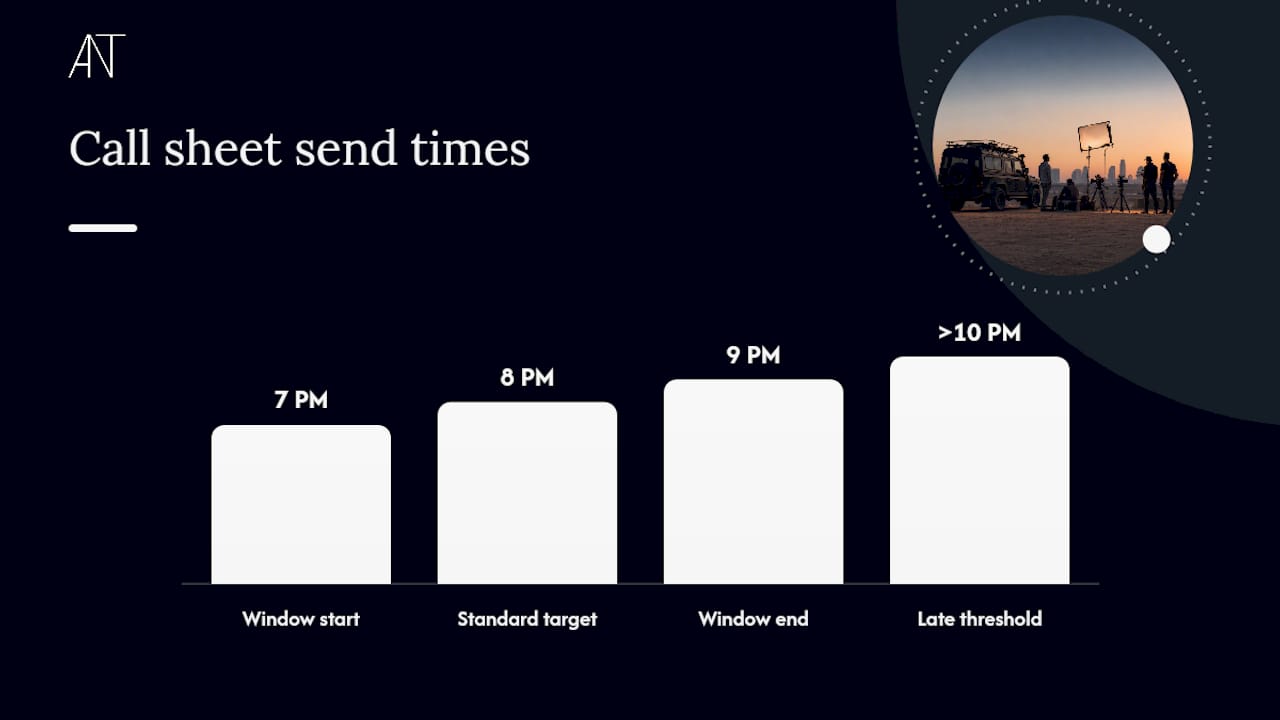
When to send it: Industry standard is 7–9 PM the evening before the shoot day, with 8 PM as the widely accepted target.
-
Three fields that are never optional: Location address with parking instructions, nearest 24-hour hospital (name, address, phone, estimated drive time), and general crew call time.
Before you hit send, verify those three fields yourself. Every other revision can wait. Those cannot.
Key Takeaways
A complete, accurately timed call sheet sent by 8 PM the night before is the single most effective tool for protecting a shoot day from logistical failure.
| Point | Details |
|---|---|
| Send by 8 PM | Distribute the final call sheet between 7–9 PM the night before; 8 PM is the industry standard. |
| 12 mandatory sections | Every call sheet needs a header, contacts, location, scene schedule, cast and crew tables, hospital, weather, meals, equipment notes, footer, and next-day preview. |
| Hospital field is non-negotiable | List the nearest 24-hour facility with name, address, phone, and estimated drive time from set. |
| Mark revisions clearly | Label any updated sheet “REVISED,” update the timestamp, and call affected departments for urgent changes. |
| Lock before you send | Export as a locked PDF and label “CONFIDENTIAL / DO NOT POST” on every distribution. |
| Use a template | Start from a proven 12-section template and adapt it to your production’s scale before building from scratch. |
Table of Contents
-
What are call sheet basics and why does every production need one?
-
The anatomy of a call sheet: 12 sections every sheet must include
-
A field note on what a call sheet actually feels like to use
-
Where to get trusted templates, examples, and deeper reading
What are call sheet basics and why does every production need one?
A call sheet is more than a schedule. It is the daily blueprint for your shoot that aligns cast and crew, reduces confusion, and protects both schedule and budget when something goes sideways.
Three core functions define it. First, logistics: the call sheet tells people where to go, how to get there, where to park, and what time to arrive. Second, personnel: it lists every cast member’s individual call time and every crew department’s report time, so no one is waiting on someone who thought they had an extra hour. Third, safety and contingency: it carries the nearest hospital, emergency contacts, weather conditions, and any special safety notes for the day’s work.
Picture a shoot day without one. The lead actor arrives at the wrong entrance because no parking instruction was sent. The gaffer’s team shows up 45 minutes late because they assumed the same call time as yesterday. A grip is injured and no one on set can immediately name the nearest emergency room. These are not hypothetical failures. They happen on productions that treat the call sheet as an afterthought.
On set, the call sheet is read at breakfast and during setup. Department heads scan it for their crew’s call times, the locations team checks parking and company-move instructions, and the safety officer goes straight to the hospital field. The document works only when it is complete, accurate, and in everyone’s hands the night before.
The anatomy of a call sheet: 12 sections every sheet must include
Professional templates organize a call sheet into 12 core sections to maintain consistency and readability across a production. Here is each one, with the detail level that actually matters on set.
-
Production header. Title, production company, shoot date, day out of total days (e.g., Day 4 of 22), director, producer, and 1st AD name. This block anchors every other piece of information.
-
Key contacts. Direct phone numbers for the 1st AD, production coordinator, UPM, and department heads. Not email. Phone numbers.
-
Location and parking. Full address, gate or entrance instructions, parking lot or street details, and any company-move address if the crew relocates mid-day. Vague parking directions cost 20 minutes every morning.
-
Scene schedule. Scene number, interior/exterior, day/night, brief description, page count in eighths, and cast members involved. Page counts are measured in eighths of a page to give the AD a precise time estimate per scene.
-
Cast call times. A table listing each cast member by character name and actor name, their set call time, makeup/hair call, and any special notes (e.g., prosthetics, stunt double).
-
Crew list and call times. Department-by-department breakdown: camera, grip, electric, sound, art, wardrobe, hair/makeup, and so on. Each entry shows the individual’s name, role, and call time.
-
Background/extras. Number of background performers, their call time, wardrobe instructions, and holding area.
-
Special equipment and notes. Any crane, drone, specialty camera, stunt rig, or effects equipment that requires advance setup or permits. Flag it here so no department is caught off guard.
-
Meal times. First meal, second meal, and any craft service notes. Union productions have contractual meal-break windows; missing them triggers penalties.
-
Weather and sun times. Current forecast, sunrise, sunset, and magic-hour windows for exterior shoots. This section is the first thing a DP checks on an outdoor day.
-
Nearest 24-hour hospital. Name, full address, phone number, and estimated drive time from set. Always verify it is a 24-hour facility before the sheet goes out. Safety officers treat this field as non-negotiable.
-
Footer, approvals, and next-day preview. The 1st AD’s signature or approval stamp, a brief preview of tomorrow’s location and scenes so crew can plan childcare and transport, and the confidentiality label.
Pro Tip: Write the hospital entry as: “[Hospital Name], [Full Address], [Phone], approx. [X] min from set.” That format takes ten seconds to read and zero seconds to misinterpret in an emergency.
How a call sheet is built and approved
The call sheet does not appear from nothing. It is the final output of a layered upstream workflow, and understanding that chain prevents the most common errors.
The process runs in this sequence:
-
Script breakdown. The 1st AD and production team break the script into scenes, tagging cast, locations, props, and special requirements.
-
Stripboard and shot list. Scenes are arranged on a stripboard (physical or digital) in the planned shooting order. The director and DP develop the shot list in parallel.
-
Master shooting schedule. The UPM and 1st AD convert the stripboard into a day-by-day shooting schedule, the document from which each call sheet draws its scene order.
-
Call sheet population. The 1st AD (or production coordinator on larger productions) pulls the day’s scenes from the shooting schedule, confirms call times with department heads, locks the location details with the locations manager, and populates the template.
-
Approvals. The UPM reviews and approves before distribution. On union productions, the production coordinator may also confirm meal and turnaround compliance.
| Role | Responsibility | Stage |
|---|---|---|
| 1st AD | Builds and finalizes the call sheet | Population + approval |
| Production coordinator | Supports data entry, distributes | Population + distribution |
| UPM | Reviews and approves before send | Approval |
| Locations manager | Confirms address, parking, hospital | Data input |
| Department heads | Confirm their crew’s call times | Data verification |
When a call sheet is marked “final” and distributed, it is binding. If anything changes after distribution, mark the revised document clearly as “REVISED” and update the timestamp so no one works from the previous version. A revision is not a suggestion. It replaces the original.
How to make a simple call sheet: step-by-step
Building your first call sheet is less about design and more about discipline. Gather the right data in the right order, and the document almost writes itself.
-
Collect your source documents. Pull the master shooting schedule, location confirmations, cast deal memos, and department head contact lists before you open any template.
-
Lock the day’s scenes. Confirm with the director and UPM which scenes are scheduled, in what order, and what the page count is for each (in eighths).
-
Populate the header. Production title, shoot date, day number, director, 1st AD, and general crew call time. This block must be identical in format to every other day’s sheet.
-
Add the scene schedule. One row per scene: scene number, INT/EXT, D/N, brief description, page count in eighths, and cast numbers involved.
-
Fill in cast and crew tables. Individual call times for each cast member, then department-by-department crew calls. Stagger department calls by 15–30 minutes where the schedule allows.
-
Add safety and logistics. Location address, parking instructions, nearest 24-hour hospital (with drive time), emergency contacts, and any special equipment or safety notes.
-
Proof the sheet. Check every call time, the hospital address, parking instructions, and phone numbers. Have a second person verify the cast table.
-
Export and distribute. Save as a locked PDF for email distribution. If using call-sheet software, publish through the platform and enable read receipts.
Format options compared
| Format | Strengths | Limitations | Best for |
|---|---|---|---|
| PDF (locked) | Consistent layout, no accidental edits | Cannot update after send without reissuing | All productions, final distribution |
| Google Sheet / CSV | Live collaboration, easy to update | Version confusion if not locked before send | Small crews, student productions |
| Call-sheet software (e.g., StudioBinder) | RSVP tracking, read receipts, revision alerts | Learning curve, subscription cost | Mid-budget to high-budget productions |
A minimal copy-paste example
PRODUCTION: [Title] | DATE: [Shoot Date] | DAY: [X of Y]
DIRECTOR: [Name] | 1ST AD: [Name] | GENERAL CALL: 7:00 AM

LOCATION: [Full Address] | PARKING: [Lot/Street + Instructions]
NEAREST HOSPITAL: [Name], [Address], [Phone] — approx. [X] min from set

SCENE SCHEDULE
Sc. 14 | INT. KITCHEN – DAY | 2/8 pg | Cast: 1, 3
Sc. 15 | EXT. ALLEY – DAY | 4/8 pg | Cast: 2, 3

CAST CALLS
1 – [Character / Actor Name] | Makeup: 6:00 AM | Set: 7:30 AM
2 – [Character / Actor Name] | Makeup: 6:30 AM | Set: 8:00 AM
Templates from StudioBinder offer downloadable formats scaled for student, indie, and union productions. For a free PDF template with all 12 sections pre-built, NeedaCrew’s 2026 template is a practical starting point.
Distribution, timing, and confidentiality
Sending a call sheet is not just forwarding a PDF. The timing, method, and labeling all carry professional weight.
The industry window for distribution is 7–9 PM the night before the shoot, with 8 PM as the standard target. Sending earlier gives crew time to plan; sending after 10 PM is a professional failure that forces people to adjust their morning routines on short notice. If the sheet is not ready by 9 PM, the 1st AD should communicate a delay and an expected send time rather than going silent.
Distribution methods:
-
Locked PDF by email remains the most universal method. Lock the document before sending so no one edits their own call time.
-
Digital platforms with RSVP and read receipts (such as StudioBinder) let the AD see exactly who has opened and confirmed the sheet. Tracking opens and confirmations gives the AD a clear list of who to follow up with before the morning, reducing no-shows.
-
SMS summary links work well for background performers or day players who may not check email reliably.
When a revision is necessary after distribution, label the updated document “REVISED” and update the version timestamp. Highlight the changed fields in a different color or note them in a revision summary at the top. For urgent changes, call the affected department heads directly. Do not assume a re-sent PDF will be noticed at midnight.
Every call sheet should carry the label “CONFIDENTIAL / DO NOT POST” in the header or footer. Location addresses, talent schedules, and scene descriptions are sensitive. Social-media leaks of location details have forced productions to relocate mid-shoot. Label the document and enforce the policy.
Common mistakes that break a shoot
Most shoot-day disasters trace back to a call sheet error made the night before. Here are the five that appear most often, followed by a pre-send checklist.
-
Late delivery. Sending after 10 PM disrupts crew sleep schedules and signals disorganization. Build the sheet earlier in the day and lock it by 6 PM so the approval process has time to run.
-
Vague parking instructions. “Parking nearby” is not an instruction. Write the lot name, entrance, and any permit or code required.
-
Missing or unverified hospital. Listing a clinic that closes at 6 PM is worse than listing nothing, because it creates false confidence. Verify 24-hour status every shoot day, especially on location.
-
Inconsistent call times. A cast table that shows 7:00 AM and a crew table that shows 6:30 AM general call without explanation will generate a dozen phone calls by 6 AM.
-
Failing to reissue revisions properly. Sending a corrected sheet without marking it “REVISED” means half the crew will work from the original. Mark it, timestamp it, and call anyone materially affected.
Pre-send proofing checklist
-
General crew call time confirmed and consistent throughout the document
-
Location address verified and complete (street, city, entrance)
-
Parking instructions specific enough to follow without a phone call
-
Nearest 24-hour hospital: name, address, phone, drive time
-
All cast call times confirmed with the AD and makeup/hair departments
-
All crew phone numbers current (check against the latest contact sheet)
-
Meal times listed and compliant with any applicable union rules
-
Special equipment, effects, or stunt notes flagged clearly
-
“CONFIDENTIAL / DO NOT POST” label visible on the document
-
Document saved as a locked PDF before distribution
Call sheet vs. shooting schedule vs. shot list
These three documents are related but serve distinct purposes. Confusing them wastes time and creates version conflicts.
Call sheet: A single-day operational document. It covers one shoot day, lists every person’s call time, and carries safety and logistics information. The 1st AD and production coordinator own it. Crew reference it from the moment they wake up.
Shooting schedule: A multi-week master plan showing which scenes are shot on which days, in what order, across the entire production. The UPM and 1st AD build it from the stripboard. It is the source document from which each day’s call sheet draws its scene list. A change to the shooting schedule almost always requires a call sheet update.
Shot list: A per-scene breakdown of every individual camera setup, angle, and lens choice. The director and DP own it. It operates at a finer resolution than the call sheet and is used on set during the actual shoot, not in the morning logistics briefing.
When the shooting schedule changes (a scene moves days, a location falls through), the call sheet must be updated immediately. When the shot list changes, the call sheet usually does not need revision unless the scene’s page count or cast requirements shift significantly.
A minimal one-page sample call sheet
The layout below fits on a single US Letter page (8.5 × 11 inches) and covers every mandatory field. Copy it into a Google Doc or Word file, replace the bracketed fields, and export as a locked PDF.
═══════════════════════════════════════════════════════════
[PRODUCTION TITLE]                    CONFIDENTIAL / DO NOT POST
Shoot Date: [Date]    Day [X] of [Y]    General Call: [Time]
Director: [Name]      1st AD: [Name]    Prod. Coordinator: [Name]
═══════════════════════════════════════════════════════════
LOCATION: [Full Address, City, State/Country]
PARKING: [Lot name or street, entrance, any code or permit]
NEAREST 24-HR HOSPITAL: [Name] | [Address] | [Phone] | ~[X] min

WEATHER: [Forecast] | Sunrise: [Time] | Sunset: [Time]
═══════════════════════════════════════════════════════════
SCENE SCHEDULE
Sc. | Set/Location | I/E | D/N | Pg (8ths) | Cast #s | Notes
14  | Kitchen      | INT | D   | 2/8       | 1, 3    |
15  | Alley        | EXT | D   | 4/8       | 2, 3    | Stunt: see notes
═══════════════════════════════════════════════════════════
CAST
# | Character     | Actor         | Makeup  | Set Call | Notes
1 | [Character]   | [Actor Name]  | 6:00 AM | 7:30 AM  |
2 | [Character]   | [Actor Name]  | 6:30 AM | 8:00 AM  |
═══════════════════════════════════════════════════════════
CREW CALLS (selected)
Camera Dept.    | [Name, Role]  | 6:30 AM
Grip/Electric   | [Name, Role]  | 6:00 AM
Sound           | [Name, Role]  | 7:00 AM
═══════════════════════════════════════════════════════════
MEALS: First meal at [Time] | Second meal at [Time]
NEXT DAY: [Location preview, scenes, expected general call]
APPROVED BY: [1st AD Name]          VERSION: Final | [Timestamp]
═══════════════════════════════════════════════════════════
Mandatory on page one: general call, location, parking, hospital, scene schedule, cast calls, weather.
Can move to page two: full crew list, background details, equipment rental notes, extended contact directory.
Keep the top-third header layout identical every day so cast and crew can find call time, location, and weather at a glance without reading the whole document. Crews train their eye to a consistent format. Changing the layout mid-production forces everyone to re-read from scratch each morning.
Pro tips from working 1st ADs and production coordinators
The difference between a call sheet that runs a smooth day and one that generates 30 pre-dawn phone calls usually comes down to a handful of habits.
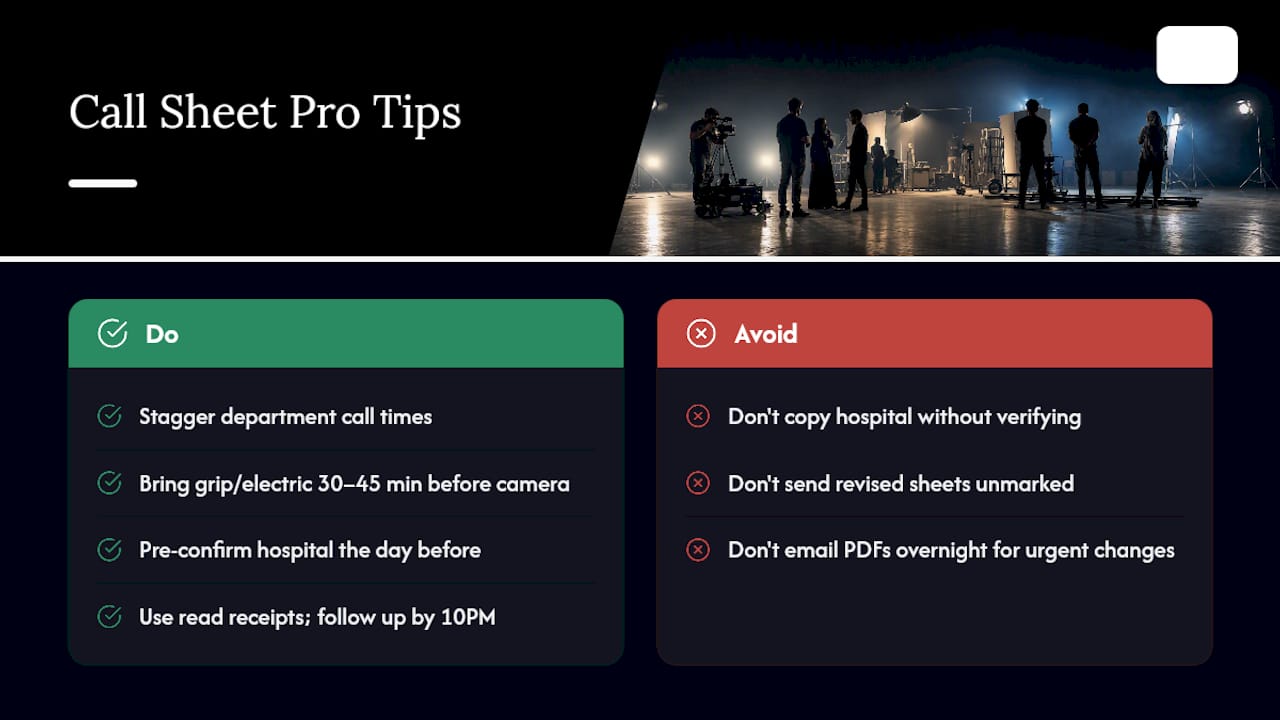
Stagger department calls deliberately. If every department arrives at the same time, the parking lot becomes a bottleneck and setup takes longer. Bring grip and electric in 30–45 minutes before camera, and camera before cast. Build those offsets into the sheet, not as a verbal instruction.
Pre-confirm the hospital the day before. Do not copy the hospital from yesterday’s sheet without verifying it. On location shoots, the nearest 24-hour facility can change with every new address. Call or check the facility’s website the afternoon before.
Version discipline is non-negotiable. The moment you send a revised sheet without marking it “REVISED,” you have two active versions in circulation. Someone will work from the wrong one. Mark every revision clearly and update the timestamp before it leaves your outbox.
Pro Tip: Add a one-line “advance note” at the bottom of the call sheet: “Tomorrow: [Location], [Scene range], expected call [Time].” Crew with children or long commutes will use this to arrange their morning before they even open tomorrow’s sheet.
Call, don’t re-send, for urgent overnight changes. If the weather forecast shifts significantly after the sheet is distributed, call affected departments directly rather than issuing a new version at midnight. A phone call reaches people. A PDF sent at 1 AM does not.
Use read receipts when the platform allows. Digital tools that track opens and confirmations let you see exactly who has not acknowledged the sheet by 10 PM. That list becomes your follow-up call list, not a guessing game at 6 AM.
A field note on what a call sheet actually feels like to use
Every morning on a working set, the call sheet is the first thing people reach for. Not the script. Not the shot list. The call sheet. It answers the three questions everyone has before coffee: where am I going, when do I need to be there, and what are we shooting? When the document is precise and consistent, the morning has a rhythm. When it is vague or late, the day starts with friction that compounds through every department.
The top third of the page does most of the work. General call, location, parking, weather. Crew read those four fields and make their morning decisions. Everything below is detail they return to as the day unfolds. That is why visual consistency across every shoot day is not a design preference. It is a functional requirement. A crew that has worked with you for two weeks has memorized where to look. Change the layout and you break that reflex at the worst possible moment.
Where to get trusted templates, examples, and deeper reading
The resources below cover every format and production scale, from a student short to a union feature.
-
StudioBinder’s call sheet guide: A thorough written breakdown of what a call sheet is, who prepares it, and how to read one. Includes a downloadable template and a step-by-step build guide suited to most production scales.
-
NeedaCrew’s free 2026 PDF template: A ready-to-use 12-section template you can download, fill in, and distribute. Includes the confidentiality label and next-day preview field pre-built.
-
Production Slate’s step-by-step guide: Covers the build process from shooting schedule to final PDF, with specific advice on visual consistency and overnight revision protocol.
-
First Read Studio’s call sheet population guide: Focused on how to pull scene data from the master schedule and translate page counts into eighths for the scene table.
-
FSU Film Handbook on call sheets: Authoritative guidance on versioning, revision labeling, and the binding nature of a distributed call sheet. Particularly useful for student productions building professional habits early.
-
Jungle Software’s complete filmmakers’ guide: Covers the call sheet’s role in protecting schedule and budget, with a free template download and notes on adapting the format for indie versus studio productions.
When choosing a template, match the format to your production’s scale. A Google Sheet works for a two-day student shoot. A locked PDF with a 12-section layout is the minimum for any production with a union cast or crew. If your production falls under a guild or union agreement, check the applicable rules for meal breaks and turnaround times before finalizing call times in the template.