
How to Build an Event Staffing Plan That Works
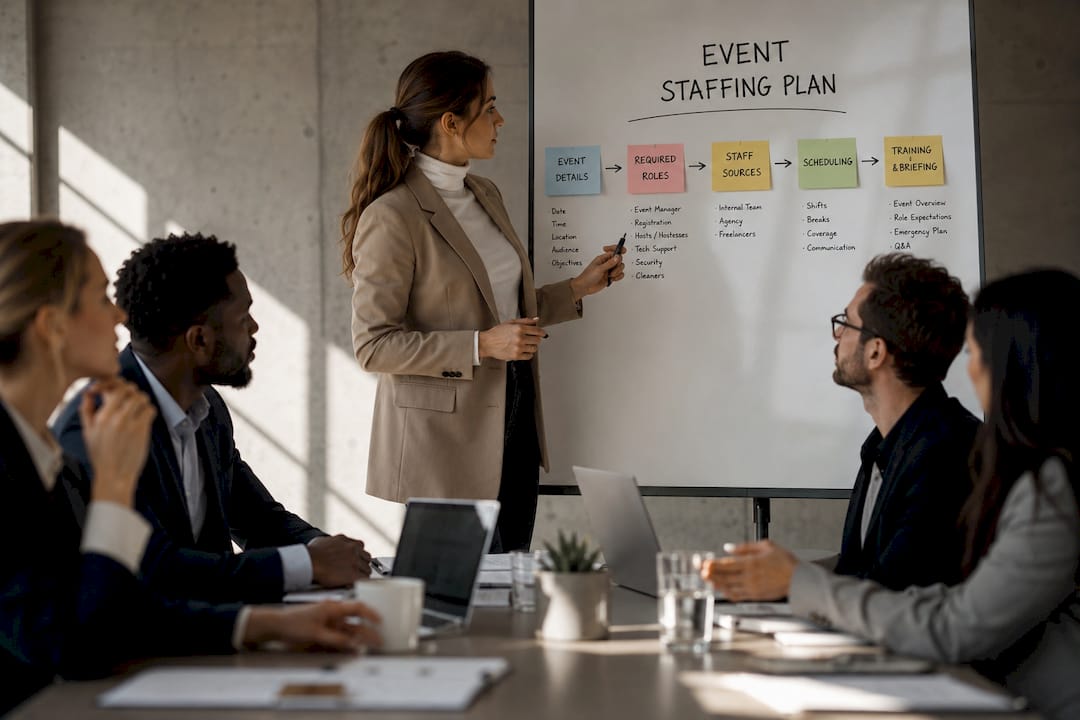
An event staffing plan is a documented operational roadmap that matches the right people to the right moments across every phase of your event. Get it right, and the experience flows with the kind of precision that feels effortless to guests. Get it wrong, and even a flawlessly designed venue becomes a pressure point. According to EventStaff’s operational guide, a complete plan defines roles, headcount, schedules, zones, break coverage, and contingency protocols — protecting guest experience, staff performance, and event pacing simultaneously.
The six-step short answer:
-
Goals: Define what staff must protect (guest flow, safety, VIP service, service speed)
-
Roles: Identify every position and write a one-line mission for each
-
Headcount: Calculate numbers from your peak 30-minute windows, not averages
-
Schedule: Build staggered call times, shift overlaps, and break rotations
-
Zones: Assign one owner and one backup to every operational area
-
Backup: Apply the 15–30–60 rule to cover no-shows and surges
The single most important rule: plan for your peak 30-minute windows. Every other decision flows from there.
Key Takeaways
A complete event staffing plan is built around peak 30-minute windows, not average attendance, and every zone must have a named owner, a named backup, and a documented escalation path.
| Point | Details |
|---|---|
| Plan for peak windows | Calculate headcount from your busiest 30-minute window, not total attendance or averages. |
| Define zones with owners | Assign one owner and one backup per zone; document both on the venue map and briefing pack. |
| Apply the 15–30–60 rule | Redeploy floaters at 15 minutes, activate standby at 30, restructure or replace at 60. |
| Brief with specificity | Every job brief must include mission, zone, supervisor, break schedule, and escalation contact. |
| ANT Management | Provides curated, trained talent and full staffing plans built around your event’s pressure moments. |
Table of Contents
-
How do you build a shift schedule that holds under pressure?
-
How do you assign zones so nothing falls through the cracks?
What does a strong event staffing plan start with?
Before you write a single name on a roster, you need to know what your staff must protect. Coverage objectives are not vague aspirations — they are measurable operational targets that determine how many people you need and where they stand.
Start by listing the outcomes that cannot fail: guest flow at entry, queue length at registration, service speed at bars or demo stations, VIP handling, and safety response time. Then assign a measurable threshold to each. A registration desk, for example, might carry a target of no more than a three-minute wait during the arrival surge. A bar station might target a maximum of eight guests per server during peak service. These numbers become the architecture of your staffing strategy.
Booking windows matter here too. Specialized roles — licensed security, certified AV technicians, trained hostesses — require a lead time of several weeks. General event staff can often be confirmed with moderate notice, though availability tightens for weekend dates in peak season. Leaving this to a very short lead time narrows your talent pool and raises costs.
Pro Tip: Identify two or three pressure moments before you build the plan: a primary peak (arrival surge or keynote break), a secondary peak (lunch transition or VIP reception), and a recovery window (post-peak when staff fatigue sets in). Design your coverage around those three moments, and the rest of the schedule writes itself.
Which roles do you actually need for your event?
Different event types break in different places — conferences collapse at registration, trade shows stall at booths, and stadium events fracture at exits. The role mix must follow the event’s pressure points, not a generic template.
Core role categories and their one-line missions:
-
Registration staff: Process arrivals accurately and at pace; requires attention to detail and composure under queue pressure
-
Hospitality hosts/hostesses: Guide guests, answer questions, and maintain the atmosphere; cross-trainable with registration for shoulder periods
-
Bar and catering staff: Serve efficiently and legally; licensed staff are non-negotiable where alcohol is involved
-
AV and technical crew: Operate and troubleshoot production equipment; specialized and cannot be cross-trained on the day
-
Security and crowd management: Control access, manage flow, and respond to incidents; certification requirements vary by jurisdiction
-
Floaters: Redeploy to any zone under pressure; your most experienced generalists belong here
-
Supervisors: Own a zone, manage a team, and escalate decisions; one supervisor per five to eight operational staff is a workable ratio
For each role, the job brief should include: mission statement, required qualifications or certifications, reporting line, zone assignment, radio channel, and three to five example tasks. Briefs written at this level of specificity cut onboarding time and reduce day-of confusion. Cross-train hospitality and registration staff where possible; never cross-train security or licensed technical roles.
Role checklist for every job brief: mission statement, required skills, zone assignment, supervisor name, break schedule, escalation contact, uniform or dress code, and arrival time.
How do you calculate the right headcount?
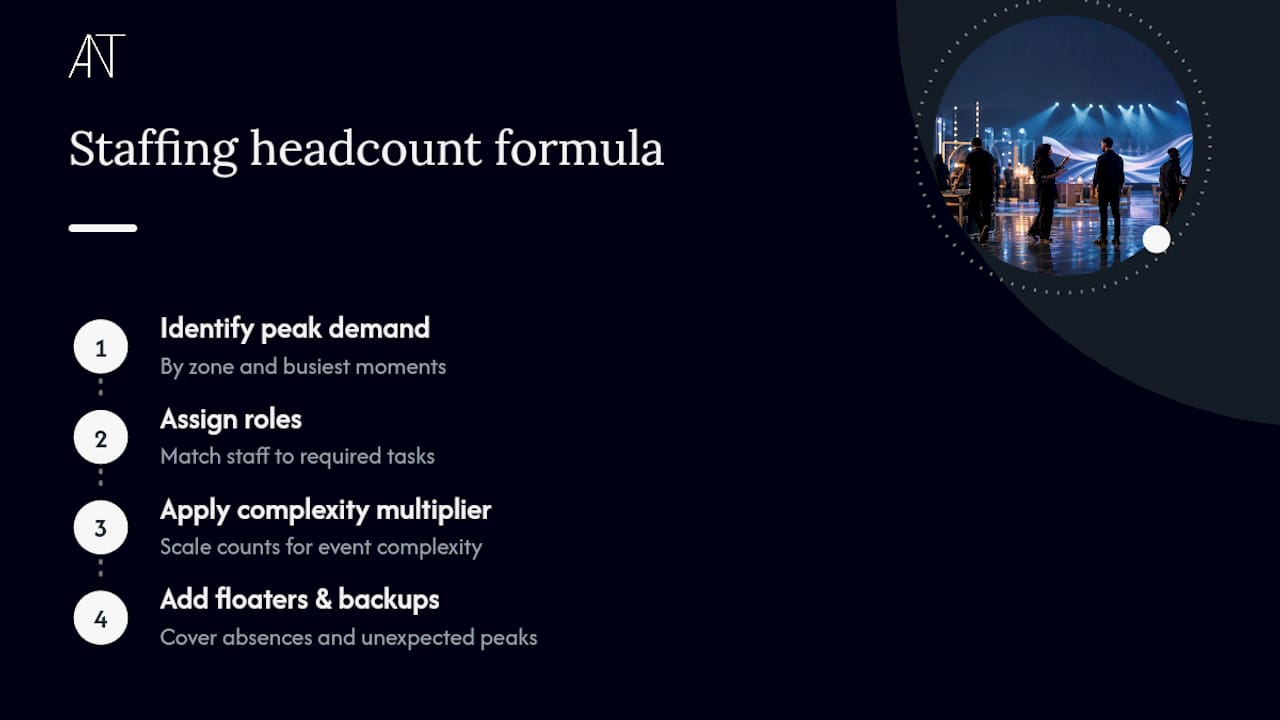
Headcount should be driven by the busiest operational moments, not by average attendance or a flat ratio applied across the whole event. The formula works in four steps: identify peak-moment demand by zone, assign roles to meet that demand, apply a complexity multiplier, then add floaters and backups.
Worked examples
100-person networking reception: Peak moment is the first 20 minutes of arrival. Two registration staff handle check-in, two hospitality hosts circulate, two bar staff cover drinks service, one supervisor oversees the floor, and one floater covers any gap. Total: 8 staff.
500-person conference with registration surge: Arrival window of 45 minutes requires six registration desks running simultaneously. Add four hospitality guides for wayfinding, two AV technicians on standby, two security staff at entry, one VIP handler, two supervisors, and two floaters. Total: 19 staff for the surge window, scaling down to 12 for the main session.
Trade show booth model: Each staffed booth needs one primary presenter and one support host during peak floor hours, with a shared floater across every three booths. A 10-booth show at peak needs 20 booth staff plus four floaters.
| Lead Time | Effect on Cost and Availability |
|---|---|
| 8+ weeks | Full talent pool, standard rates, time for role-specific training |
| several weeks | Good availability, minor premium for specialized roles |
| several weeks | Reduced pool, higher agency fees, limited training time |
| 1 week | Emergency rates, limited vetting, minimal briefing window |
How do you build a shift schedule that holds under pressure?
A shift schedule is not a list of names and times. It is a choreography of arrivals, handovers, and exits designed so that no zone is ever uncovered and no staff member goes without a break. The architecture starts with staggered call times.
Setup crew arrives first, typically 90–120 minutes before doors open. Registration and entry staff arrive 45–60 minutes before guest arrival to complete briefings and test equipment. Peak-phase staff arrive 30 minutes before the primary pressure moment. Teardown crew overlaps with the final hour of the event so the transition is clean.
Shift overlap is where most plans fail. A 15-minute overlap at every handover gives the outgoing staff time to brief the incoming team on zone status, incidents, and any equipment issues. Without that window, critical information evaporates between shifts.
Sample patterns for common event types:
-
Conference day: Setup at 6:00 AM, registration open at 7:30 AM, peak session staff at 8:00 AM, lunch transition floaters at 12:00 PM, afternoon session staff at 1:00 PM, teardown from 5:30 PM
-
Evening reception: Setup at 3:00 PM, hospitality staff at 5:30 PM, bar staff at 6:00 PM, peak coverage 7:00–9:00 PM, close-down from 10:00 PM
-
Festival shift model: Three rotating shifts of six hours each with 30-minute overlaps; floaters assigned to the overlap window, not to a fixed shift
Break rotations belong in the written schedule, not in a supervisor’s memory. Assign break windows by zone, stagger them so no zone drops below minimum coverage, and name the floater who covers each break slot.
Pro Tip: Schedule floaters to arrive just before the primary peak, not at the same time as the main crew. A floater who arrives with everyone else gets absorbed into setup tasks. One who arrives 20 minutes before the surge is free to go exactly where pressure appears first.
How do you assign zones so nothing falls through the cracks?
Venue zoning converts a floor plan into a responsibility map. Every area of the event — registration, main floor, breakout rooms, AV booth, back-of-house, VIP lounge — becomes a named zone with a single owner, a single backup, and a documented escalation path. Documenting zone ownership visibly on the plan and listing a backup for every critical zone reduces confusion during radio calls, when seconds matter.
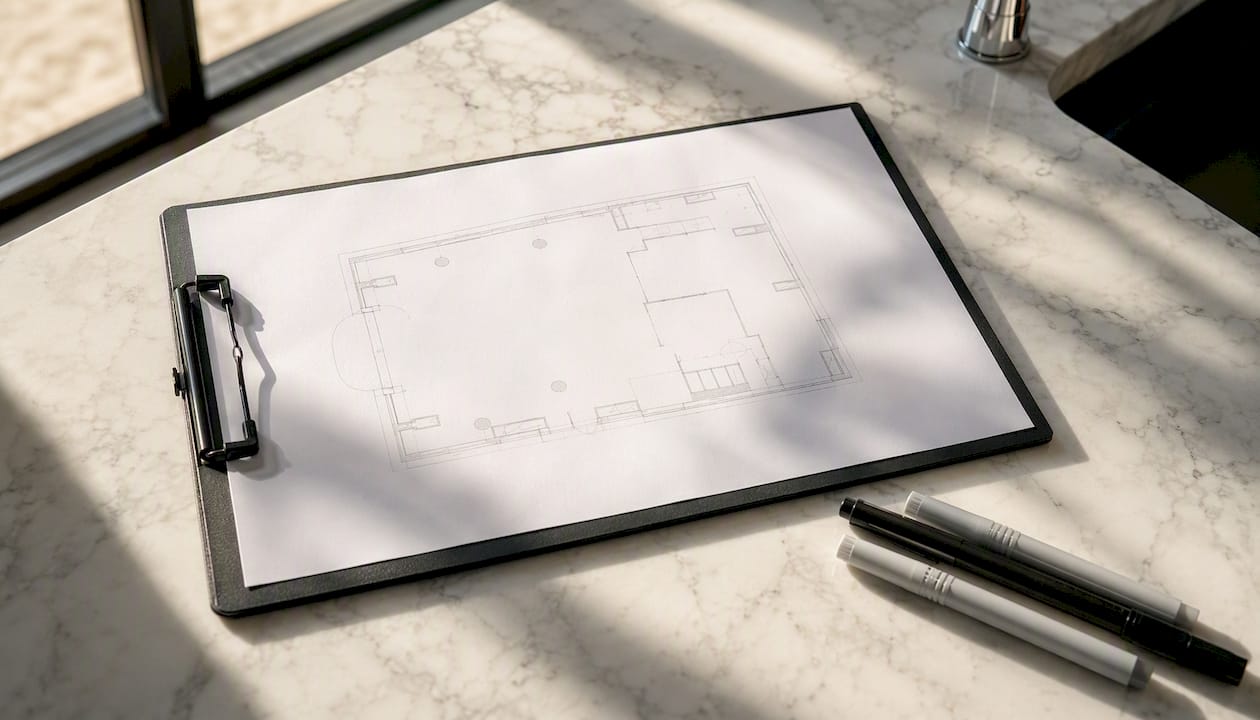
The one-owner model is deliberate. Shared ownership creates diffusion of responsibility; when two people own a zone, neither acts decisively. The zone owner is accountable for staffing levels, guest experience, and incident escalation within their area. Their backup steps in when the owner is on break or pulled to another zone.
A short responsibility matrix for each zone should include: zone name, owner name and radio channel, duties summary, backup name, and escalation contact (event director or operations lead). Post this matrix on the venue map and in the briefing pack so every supervisor can find it without asking.
Pro Tip: Coordinate your zone map with the AV and production layout before finalizing it. PA system placement and production setups directly affect where staff can stand, hear radio calls, and respond to guests — a zone boundary drawn without that information will need to move on the day.
What is the 15–30–60 backup rule?
No staffing plan survives first contact with reality unchanged. No-shows, unexpected surges, and technical failures are not edge cases — they are standard operating conditions. The 15–30–60 Backup Rule gives you a repeatable decision framework.
-
15 minutes: A gap appears. Redeploy the nearest floater to cover the zone. No escalation needed.
-
30 minutes: The gap persists or multiple zones are under pressure. Activate your standby staff — pre-confirmed individuals on call who can arrive within 30–45 minutes.
-
60 minutes: The gap cannot be filled by internal redeployment or standby. Restructure the zone (merge two zones under one supervisor, reduce service points) or call the agency for an emergency replacement.
Standby staffing levels depend on event size and complexity. A 100-person event warrants one or two on-call staff. A 500-person multi-zone event should carry three to five standbys, particularly for specialized roles like security and AV.
Contingency checklist for common failure modes:
-
No-show: Floater covers immediately; standby activated if the role is specialized
-
Mass arrival surge: Pre-positioned floaters absorb the first wave; registration desks expand by pulling hospitality staff temporarily
-
Technical failure: AV technician on standby; supervisor notified within five minutes; guest communication plan activated
-
Medical incident: Designated first-aid contact per zone; escalation to event director within two minutes; venue emergency protocol followed
The decision to restructure a zone rather than wait for a replacement comes down to one question: will the gap last longer than 45 minutes? If yes, restructure. Waiting for a replacement while a zone degrades costs more in guest experience than a temporary reduction in service points.
How do you hire, train, and manage crew on the day?
A hiring brief that screens candidates properly saves hours of day-of correction. The brief should specify: role title, event type and scale, required experience (years and event type), any mandatory certifications, physical requirements, dress code, call time, and pay rate. Vague briefs attract mismatched candidates; specific briefs attract the right ones.
Pre-event training does not need to be long to be effective. A 20-minute briefing at check-in, structured around five items, covers the essentials:
-
Event overview and guest profile
-
Zone assignment and supervisor introduction
-
Escalation protocol and radio channel
-
Break schedule and swap procedure
-
Three most likely guest questions and the correct answers
Tagging staff by skill and rating their performance in scheduling software makes it significantly easier to match experienced staff to critical roles and speeds billing reconciliation after the event. Scheduling tools that automate shift-filling and track hours also reduce administrative overhead and improve fill rates, as documented in published case studies from operators who adopted this approach.
On-site, the supervisor-to-staff ratio of 1:5–8 holds the structure together. Supervisors carry radios, conduct zone check-ins every 30 minutes, and manage welfare: breaks, hydration, and any staff welfare concerns. Workforce retention research consistently shows that investing in staff development and welfare reduces churn and protects operational continuity — a principle that applies as much to event crews as to permanent workforces.
Ready-to-use templates you can copy right now
The staffing table below covers the core fields every plan needs. Adapt the row count to your event size.
500-person conference: schedule matrix for registration surge and lunch transition
The arrival window runs 8:00–8:45 AM with six registration desks active, four hospitality guides on the main floor, and two floaters pre-positioned at the entry. At 8:45 AM, two registration staff transition to wayfinding as the surge subsides. The lunch transition at 12:30 PM is the second pressure point: two floaters move to the catering zone, one registration staff member joins the queue management line, and the AV technician shifts to the breakout room corridor. Production setup blueprints can help you visualize where these transitions happen physically on the floor plan before you finalize zone boundaries.
Three-phase checklist:
-
Pre-event: Roles confirmed, briefs distributed, uniforms checked, radios tested, zone map posted
-
Event day: Check-in completed, break schedule active, floaters pre-positioned, supervisor check-ins running
-
Post-event: Teardown coverage confirmed, incident log collected, staff sign-off completed, debrief scheduled
Adapt the staffing table to smaller events by collapsing zones (combine registration and hospitality under one supervisor) or to larger events by adding zone rows and a second supervisor tier.
How do you evaluate staffing performance after the event?
The debrief is where a good plan becomes a great one. Five KPIs give you a clear picture of staffing performance:
-
Queue time at peak: Did registration or bar service meet the target wait threshold?
-
Incident count by zone: Where did problems concentrate, and which zones were clean?
-
Staffing coverage percentage: What proportion of scheduled shifts were filled as planned?
-
Staff punctuality rate: How many staff arrived on time for their call time?
-
Client satisfaction score: What did the client or internal stakeholders report about service quality?
Collect staff feedback within 24 hours while the experience is fresh. A five-question form covers the essentials: zone assignment clarity, supervisor support, break adequacy, equipment availability, and one thing they would change. Client feedback follows the same logic — brief, specific, and tied to the operational moments that mattered.
Debrief template items to carry into the staffing file:
-
KPI results versus targets
-
No-show count and how gaps were covered
-
Zones that underperformed and the likely cause
-
Training gaps identified on the day
-
Schedule adjustments recommended for the next event
-
Staff ratings and notes for future booking decisions
The debrief file becomes the institutional memory of your staffing operation. Events that skip it repeat the same mistakes; events that use it improve measurably with each iteration.
How ANT Management builds staffing plans for premium events
ANT Management’s approach to event workforce planning follows a four-stage method: talent curation, role-specific briefing, peak-based headcount calculation, and live supervision. Every engagement begins with a detailed intake of the event’s pressure moments — not its total attendance — because that is where the plan either holds or fractures.
The agency’s global network across Europe, the US, and Asia means that role-specific talent (hostesses, brand ambassadors, photographers, stylists, content creators, and stunt coordinators) can be sourced and briefed to a consistent standard regardless of geography. Talent selected through ANT Management’s curation process arrives with verified experience, appropriate certifications, and a role brief they have already reviewed. The ANT Camp training program adds a further layer: talent who have completed ANT Camp carry structured briefing experience and understand the operational rhythm of a live event, which reduces the onboarding burden on the day.
For a recent multi-zone brand activation, the agency deployed a curated team of hostesses and brand ambassadors across several zones, with a dedicated supervisor per zone and floaters pre-positioned for the arrival surge. Service flow remained consistent through the peak window, and the client reported no queue incidents at any staffed station.
Pro Tip: Fashion and commercial talent — models, hostesses, brand ambassadors — can be deployed as premium operational staff at product launches, VIP receptions, and experiential activations. Brief them with the same technical specificity you would give any operational crew: zone assignment, escalation contact, break schedule, and three most likely guest interactions. The result is a staffing layer that elevates the guest experience rather than simply managing it.
What experienced planners know that templates don’t teach
The most durable staffing plans share a quality that no checklist captures on its own: they are written for failure, not for the ideal scenario. Every break swap is named. Every floater has a pre-assigned first destination. Every zone handover has a 15-minute overlap built in, not assumed.
Three non-obvious tactics that consistently make the difference:
-
Write break swaps into the schedule with the covering staff member’s name, not just the time slot
-
Pre-position floaters at the zone most likely to surge, not at a central point where they feel available but arrive late
-
Use a physical handover checklist at zone transitions — a three-item verbal confirmation between outgoing and incoming staff that takes 90 seconds and prevents the most common information gaps
Staff wellbeing on long events deserves the same planning discipline as zone coverage. Hydration stations, a designated rest area away from guest sight lines, and a named welfare contact in the briefing pack are not luxuries — they are retention tools. The Work Institute’s retention research frames this clearly: staff who feel supported perform better and return for future engagements, which directly reduces your hiring and training costs over time.
One more point worth stating plainly: contingency language belongs in contracts and briefing documents, not just in the staffing plan. A clause that specifies standby activation conditions, replacement timelines, and restructuring authority gives the on-site supervisor the mandate to act without waiting for approval. Under pressure, that mandate is worth more than any additional headcount.
ANT Management staffs your event from plan to execution
When the staffing plan is built and the roles are defined, the next challenge is sourcing talent that can actually deliver at that level. ANT Management provides event organizers with a complete staffing solution: a curated roster of trained, briefed, and vetted talent drawn from a global network spanning Europe, the US, and Asia.
Clients receive a structured staffing plan, role-specific talent matched to each zone, on-site supervision, and contingency standby coverage — not just a headcount and an hourly rate. Every talent placed through ANT Management has been selected through a rigorous curation process and, where applicable, trained through ANT Camp, so the briefing time you invest on event day is spent on event-specific details, not on fundamentals. Whether the brief calls for hostesses at a product launch, brand ambassadors across a trade show floor, or a full operational crew for a multi-day conference, the agency builds the team around your pressure moments. Contact ANT Management to request a staffing consultation and receive a tailored plan for your next event.
Sources
The sources below informed the operational guidance throughout this guide: