
Remote Casting: How Actors Audition Without the Room
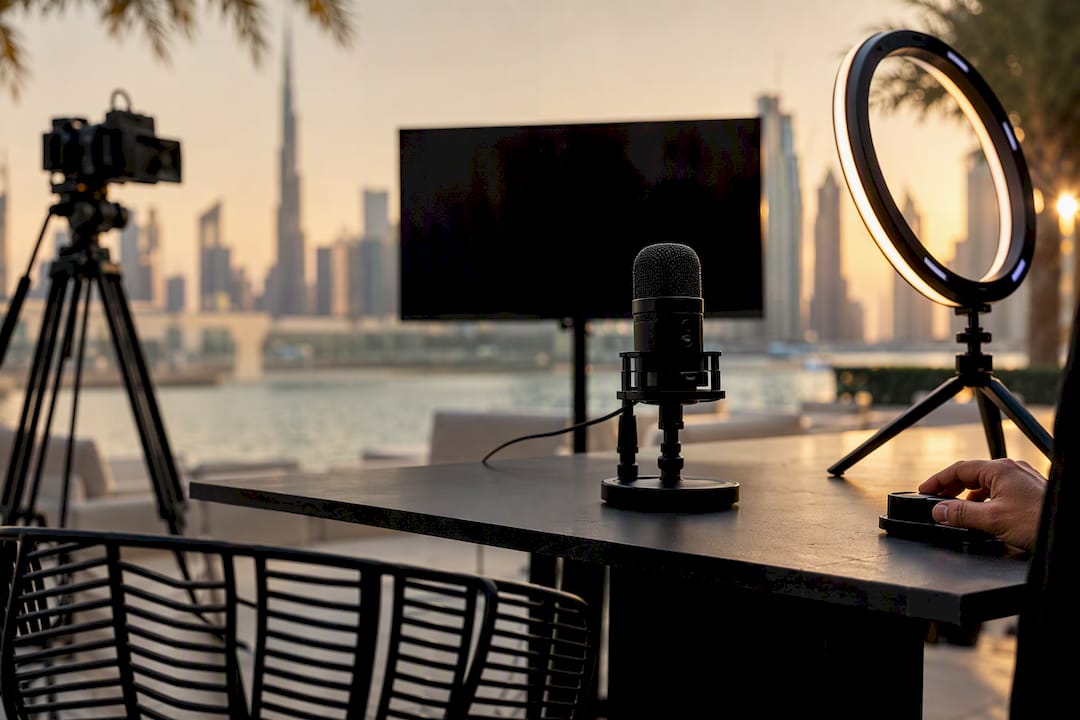
Remote casting is the practice of selecting talent without an in-person audition, using either recorded self-tapes or live video sessions run through a browser or dedicated app. If you’ve been sent a self-tape request, prepare your slate, lighting, and sound before you press record. If you’ve been invited into a live virtual session, treat it like a studio call and expect a director to guide your framing in real time. Professional productions increasingly run these sessions through structured workflows like CLOS, and agencies such as ANT Management now build technical preparation into how they support talent.
Before your next audition, figure out which format you’re dealing with:
- Self-tape: you record alone, on your own time, and submit a file.
- Live virtual session: you join a scheduled call and a director watches, directs, and often captures your read in real time.
- Hybrid: an initial self-tape filter followed by a live callback session.
Key Takeaways
Remote casting succeeds when actors match their preparation to the format they’re actually facing: polished self-tapes for filtering, and studio-ready readiness for live directed sessions.
| Point | Details |
|---|---|
| Know your format | Self-tapes filter widely; live sessions decide final casting, so prepare differently for each. |
| Test your setup first | Check lighting, sound, and upload speed with a sample clip before any live slot. |
| Expect camera control | Directors or platforms may control your phone’s camera to standardize footage across candidates. |
| Verify before you join | Confirm session invitations and app permissions to avoid scam listings and oversharing access. |
| Get agency-grade prep | ANT Management trains talent through ANT Camp and prepares production-ready digitals ahead of live sessions. |
Table of Contents
- What Is Remote Casting and How Does It Differ From a Self-Tape?
- How Do You Prepare for a Remote Audition Step by Step?
- Browser Calls vs Dedicated Virtual Casting Platforms
- What Happens Inside a Professional Live Remote Casting Session?
- Where Do You Find Remote Casting Calls?
- What Privacy and Security Steps Should You Take Before a Remote Session?
- Why Most Actors Are Preparing for the Wrong Format
- How ANT Management Prepares Talent for Remote Casting
- Sources
What Is Remote Casting and How Does It Differ From a Self-Tape?
A self-tape is asynchronous. You record on your own schedule, review your best take, and submit a file, with no director watching or reacting in the moment. A live virtual casting session is synchronous. You join a room at a scheduled time, and a casting director or associate directs you in real time, much like an in-person callback, except the room is virtual.
Productions use these formats for different jobs. Self-tapes handle wide filtering, since dozens or hundreds of actors can submit without anyone booking studio time. Live sessions handle callbacks and final decisions, where a production needs to see how a performer takes direction and adjusts on the spot.
- Self-tape: you control lighting, retakes, and pacing, but there is no feedback loop, and quality varies wildly from actor to actor.
- Live session: a director sees your work unfold, but you get one shot at each note, with no editing safety net.
- Hybrid pipeline: self-tape first, live callback second, which is how most film, TV, and commercial bookings are now decided.
The practical gap between the two matters more than most actors realize. Self-tapes scale for initial filtering but produce uneven results, while live sessions give real direction and generate consistent, production-ready footage. Most casting teams now use self-tapes to narrow the field and live sessions to make the final call. Knowing which stage you’re in changes how you should prepare.
How Do You Prepare for a Remote Audition Step by Step?
Your gear does not need to be expensive, but it needs to be reliable. A mid-range smartphone from the last three or four years, fully charged with at least 50% battery before you start, mounted on an actual tripod rather than propped against a stack of books, covers the technical baseline most casting teams expect.
Here is the full pre-audition checklist, worth running through every time:
- Device and stability: use a tripod or a solid, immovable surface. Handheld footage reads as amateur before you’ve even said a line.
- Connectivity: test your upload speed before a live session; a slow or unstable connection is the fastest way to derail a director’s read on your performance.
- Lighting: position a window or a soft lamp in front of you, not behind, and keep your background plain and uncluttered so nothing competes with your face.
- Sound: record in the quietest room in your home, close the mic distance if you can, and do a ten-second test clip to catch echo before the real take.
- Wardrobe: choose simple, solid colors that contrast with your background; skip patterns, logos, and anything that pulls focus from your face.
- Slate: state your name, your representation if you have any, and the role, clearly and without rushing, before you launch into the read.
Casting professionals consistently point out that clear expectations around framing, lighting, and sound are what separate submissions that get watched in full from ones that get closed after ten seconds. On the day of a live slot, log into the virtual room five to ten minutes early, keep your energy warm between takes, and hold your frame the instant a director asks you to, without adjusting your own camera unless told to.
Pro Tip: Record a throwaway test clip an hour before any live session and watch it back with the sound off. If you can still read your emotion from the visual alone, your framing and lighting are doing their job.
Browser Calls vs Dedicated Virtual Casting Platforms
Not every remote audition happens the same way technically, and the platform matters more than most actors expect. A standard video call app gives you a face on a screen and not much else. Dedicated virtual casting tools add scheduling, virtual waiting rooms, and automatic recording, which is why the industry is shifting away from plain video conferencing toward purpose-built systems.
Some of these platforms go further and remotely control the resolution and settings on your phone’s camera during the session, capturing full-resolution stills and video directly, rather than relying on whatever compression a video call app applies. That means the file a casting team reviews afterward can be broadcast-quality, not a screen-recording of a chat window. Systems like the Casting Workbook virtual casting room build in check-in flows and matched uploads so an entire casting team can review the same session together.
Expect one of two setups when you get booked:
- Browser link: you click and join, no download required, typically used for simple video calls.
- Dedicated app install: required for platforms that need deeper camera access; install it a day ahead, never five minutes before your slot.
Fifteen minutes before any live slot, run a fast check: confirm your camera and mic are recognized, test your upload speed, and record a one-minute sample to verify your framing and audio are clean.
What Happens Inside a Professional Live Remote Casting Session?
Professional casting teams don’t wing live sessions. They run a repeatable workflow, and knowing the five moves ahead of time takes the guesswork out of your side of the call.
- The brief. A casting director or associate writes a short brief covering the role, the specific beats they want to see, and any wardrobe or prop notes.
- The room. You’re invited into a browser room or app at your scheduled slot, often batched into short, back to back windows so one operator can move quickly through many actors in a single session.
- Camera control. The director or their system takes control of your device’s camera settings, standardizing exposure and framing so every actor is judged on the same visual footing.
- The directed capture. You read, get a note, adjust, and read again, with the platform capturing full-resolution stills and video during the process itself.
- Review and delivery. Selects get pulled and shared with the wider creative team through cloud delivery almost immediately after your slot ends.
The camera control step is deliberate, not a privacy overreach. When a director holds those settings, they can request a precise retake instead of asking you to fumble with your own phone’s settings mid-call, which keeps the session moving and keeps every candidate’s footage comparable.
The best asset a live session produces isn’t a tape that gets sent off for someone to review later. It’s a finished, production-ready capture made the moment you performed it, which is exactly what lets a team decide same-day instead of requesting round after round of follow-up tapes.
Bring studio energy to that room. Accept single-step direction without over-explaining your choices, keep your energy consistent between takes even when you’re waiting for a note, and treat the five to ten minutes you’re given exactly like a callback in a real casting office.
Where Do You Find Remote Casting Calls?
Casting opportunities surface across a handful of predictable channels, and actors who check them consistently outperform actors who wait for calls to land in their inbox.
- Casting platform listings: sites like Backstage aggregate open remote casting calls across film, TV, and commercial work.
- Agency submission pages: representation submits you directly for roles matched to your type, often before a casting call ever goes public.
- Professional social channels: many casting directors post time-sensitive breakdowns on industry-specific social accounts.
- Industry newsletters: breakdown services and union newsletters compile daily or weekly listings by category and location.
Once you find a listing, the application itself has its own set of rules that get overlooked far too often. Name your files exactly as instructed, with your name and the role in the filename, not “final_take3.mov.” Respect stated runtime limits; a two-minute cap means two minutes, not two minutes and forty seconds. Slate clearly at the start of every file. Submit in the exact format requested, whether that’s a direct upload link or an email to a casting associate, and if you have representation, always submit through your agent rather than duplicating the submission yourself.
Follow-up should stay rare and brief. A single polite check-in after a reasonable window has passed is fine. Repeated messages read as pressure, not enthusiasm, and casting teams remember which actors respected their process.
What Privacy and Security Steps Should You Take Before a Remote Session?
Remote casting requires you to hand over a level of access to your device and your image that an in-person audition never did, and that trade-off deserves a little more caution than most actors give it.
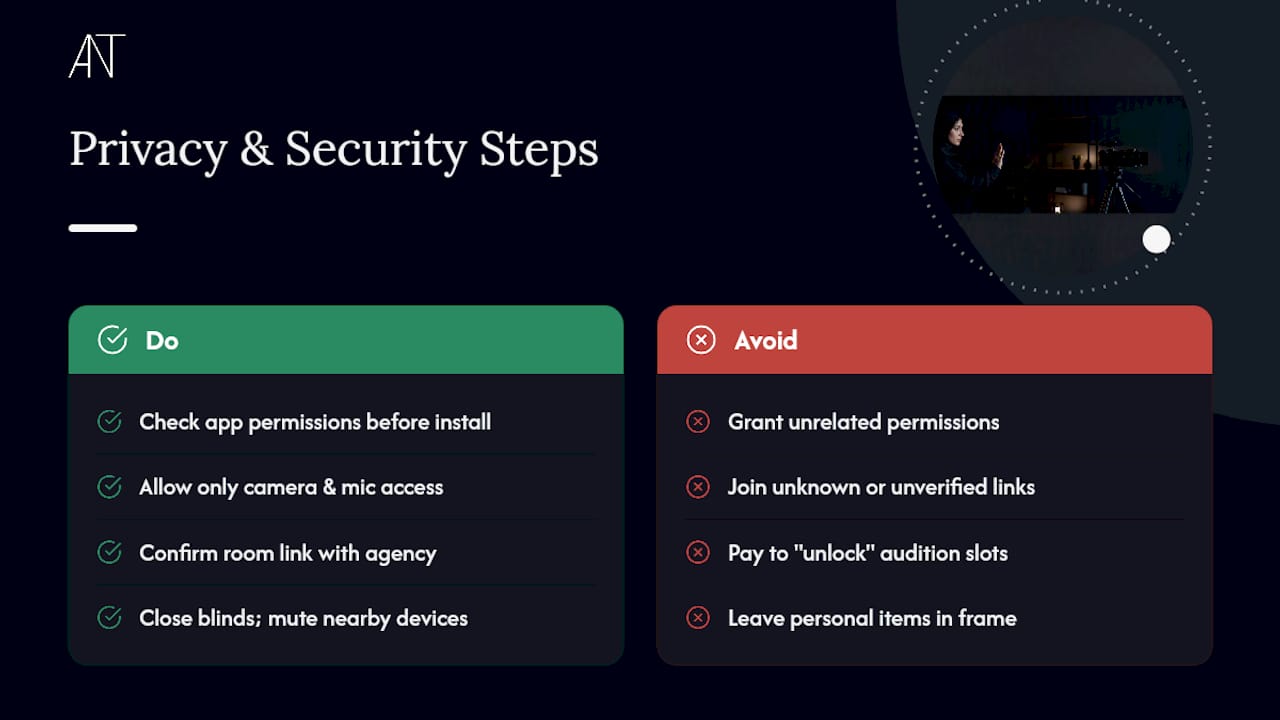
Before installing any casting app, check what permissions it requests. A legitimate virtual casting platform needs camera and microphone access to run the session, but it has no reason to ask for your contacts, your photo library, or your location. If an app requests more than the session requires, that’s worth questioning before you agree.
Verify who you’re actually joining before a live slot. Confirm the room link or app invitation came from the casting contact or agency you expect, particularly if the audition was arranged through a listing rather than a direct agency submission. Scam postings that mimic real casting calls do circulate, and asking for a fee to “unlock” an audition slot is a reliable red flag.
Think about your background, too. Live sessions put your actual living space on camera, so close blinds, mute notifications on nearby devices, and keep anything personally identifying out of frame if the call is being recorded and stored on a platform’s servers.
Finally, know where your footage lives afterward. Reputable platforms store captures on secured cloud systems with access limited to the production team, rather than emailing raw files around unprotected. If a session’s terms don’t say anything about how long your footage is retained or who can view it, it’s fair to ask before you join.
Why Most Actors Are Preparing for the Wrong Format
The conventional advice around remote auditioning treats every submission like a self-tape problem: better lighting, better sound, better slate. That advice isn’t wrong, but it’s incomplete, and it misses where the industry is actually headed. Live, directed virtual sessions are becoming the format that decides bookings, not just the format that filters them. An actor who’s polished their self-tape setup but has never rehearsed taking live camera direction over a video call is optimizing for the wrong half of the process.
What’s overrated is chasing a perfect home studio. What’s underrated is rehearsing how you take a note, adjust, and deliver again inside a five-minute window, because that’s the skill live sessions actually test. The reader’s real priority should be simulating that pressure before it’s real, not buying another ring light. Practice with a friend directing you over video call using the same one-note, one-adjustment rhythm a casting director uses. That rehearsal matters more than your equipment ever will.
How ANT Management Prepares Talent for Remote Casting
Getting cast remotely isn’t about owning better equipment than the actor auditioning after you. It’s about walking into that virtual room already knowing how the session runs, and that’s the gap ANT Management closes for the talent it represents. As a Dubai-based agency with a network spanning Europe, the US, and Asia, ANT Management builds technical readiness directly into how it manages talent, rather than leaving actors to figure out framing and lighting on their own.
![cta_image]
Through training programs like ANT Camp, talent get coached on brief interpretation, camera-ready framing, and how to hold energy across a directed session, the same fundamentals covered above. Representation also means submissions go out through channels casting teams already trust, and production-ready digitals get prepared before an opportunity even lands. If you want structured, agency-led support behind your next remote audition instead of guessing your way through it alone, visit the ANT Management casting page to learn more about representation and current opportunities.
Sources
- Virtual Casting Sessions & Live Casting Calls | CLOS