
Casting Call Process: A Playbook for Brands and Marketers

Run a casting call in this order: write a specific brief, pick the sourcing channel that fits your budget and timeline, pre-screen every submission against a rubric, hold focused auditions, sign usage-ready contracts, and confirm shoot-day logistics before anyone books a flight. Agencies like ANT Management build this sequence around standard industry payment practice, typically a 50% deposit on confirmation, and conduct expectations drawn from frameworks like the Model Alliance Respect Program.
Copy this into your project brief before you post anything:
- Write role specs, usage scope, and compensation in one document
- Choose agency, marketplace, direct outreach, or open call
- Pre-screen submissions against a scoring rubric
- Run auditions with a fixed time budget per talent
- Lock contracts, deposits, and shoot-day logistics before travel is booked
Key Takeaways
A professional casting call succeeds when the brief, sourcing channel, and contract terms are locked before auditions begin, not negotiated afterward.
| Point | Details |
|---|---|
| Brief first, always | A precise brief with usage scope and compensation prevents mid-production renegotiation. |
| Match channel to complexity | Use agencies for high-budget or multi-role projects, marketplaces for speed and volume. |
| Screen before you audition | A scoring rubric and minimum asset checklist cut wasted callback slots. |
| Lock terms in writing | A 50% deposit on confirmation and clear usage tiers protect both sides. |
| Consider agency support | ANT Management manages sourcing, contracting, and on-set logistics as one service for brands needing international reach. |
Table of Contents
- Before You Start: The One-Page Essentials Checklist
- Step 1: Plan the Casting With a Brief That Filters Correctly
- Step 2: Choose Sourcing Channels That Match Your Timeline
- Step 3: Accept Submissions and Pre-Screen Efficiently
- Step 4: Run Auditions and Go-Sees That Reveal On-Set Reliability
- Step 5: Make Offers and Lock Usage Rights
- Step 6: Prepare Shoot Day Logistics and Contingencies
- Step 7: Wrap Post-Casting Payments and Deliverables
- How Long Casting Takes and What It Costs
- Managing Callbacks and Prioritizing Talent Selection
- Handling Last-Minute Cancellations and No-Shows
- Communication Templates and Guidance for Talent Updates
- Diversity and Inclusion Best Practices During Casting
- Legal Compliance and Labor Regulations Specific to Casting Calls
- What an Agency Adds to the Casting Call Process
- Let ANT Management Handle the Casting Call Process for You
- Sources
Before You Start: The One-Page Essentials Checklist
Every renegotiation mid-shoot traces back to a decision nobody made upfront. Fix these before the casting call goes live.
- Project snapshot: campaign goal, deliverables (stills, video, both), primary audience, and how the assets will be used
- Compensation framework: day rate versus buyout tiers, travel and overtime rules, deposit schedule
- Key dates: holds, fittings, rehearsals, shoot day, with a buffer day built in
- Legal essentials: a conduct reference like the Model Alliance Respect Program, a right-to-publish checklist, and any location permits
Pro Tip: Attach a mood board and one sample reference frame to your brief. It cuts the number of off-brand submissions dramatically, because talent and agents can self-select before they apply instead of after you’ve reviewed their portfolio.
Step 1: Plan the Casting With a Brief That Filters Correctly
A vague brief produces a flood of irrelevant submissions. A precise one does the filtering for you before a single application lands in your inbox.
Open with a two to three sentence project snapshot: campaign objective, tone, target audience. Then get specific about the role itself, looks, age range, required skills, wardrobe notes, mobility or stunt needs, and how the talent should behave on screen. Usage scope deserves its own callout, because it drives everything downstream. Spell out the channels (social, print, broadcast, out-of-home), the geography, the duration, and whether you’re buying a limited license or a full buyout, since fee expectations shift substantially between the two.
Structured brief templates covering project snapshot, visual references, and a usage matrix cut briefing time substantially and raise submission relevance. Build your brief around these blocks:
- Project snapshot and tone references
- Role specs and wardrobe or mobility requirements
- Usage and territory matrix
- Key dates and hold rules
- Compensation and materials requested
- Submission deadline
A brief without a usage matrix is an unfinished contract. You’ll end up negotiating usage terms mid-production instead of before anyone shows up on set.
Step 2: Choose Sourcing Channels That Match Your Timeline
The channel you pick determines how fast you move and how much risk you absorb. Traditional agencies handle fully managed contracts while online platforms optimize for speed and transparency, and booking windows swing from days to several weeks depending on which route you take.
- Traditional agencies: best for high-budget or multi-role campaigns needing contracts, clearances, and chemistry testing
- Online marketplaces: fastest for volume hires and straightforward briefs with clear deliverables
- Direct outreach: efficient for rebooking known talent or hiring influencers you already follow
- Open calls or community sourcing: strongest for reach and a wider range of looks, at the cost of more screening time
Weigh budget, creative complexity, contract needs, and deadline pressure before you commit to a channel.
Pro Tip: Escalate to an agency the moment a project involves multi-role chemistry testing, complex buyouts, or family casting units. Those are the scenarios where administrative overhead multiplies fastest.
Step 3: Accept Submissions and Pre-Screen Efficiently
Every unqualified submission that reaches your callback list costs you a slot someone better suited could have filled. Set the bar at intake, not at the audition table.
Require a minimum submission package: current digitals, a full-body shot and headshot, a simple walk or movement clip, an availability grid, and accurate measurements. Then screen against a short checklist:
- Portfolio relevance to the brief’s tone and category
- Prior commercial experience or comparable production credits
- Reel or self-tape quality
- Right-to-work confirmation where the project requires it
Watch for red flags before you invest more review time: missing usage consent, measurements that don’t match the portfolio, vague availability, or slow, unprofessional responses. Time-box your review sessions, score submissions against a shared rubric so multiple reviewers stay consistent, and automate confirmation emails so nobody is left guessing whether their submission arrived.
Step 4: Run Auditions and Go-Sees That Reveal On-Set Reliability
A portfolio shows you what talent looked like on someone else’s set. An audition shows you how they take direction on yours.
Match the format to the stakes. Live go-sees and in-studio walk-ins work for volume roles. Scheduled callbacks suit finalists. Remote self-tapes save everyone travel time on early rounds. First-round auditions typically run five to fifteen minutes each, while callbacks that involve wardrobe and director input take longer.
Build a short battery of tests into callbacks:
- A movement test
- Product interaction
- A brief reading or improv moment
- A simple direction-following task
Plan fitting slots, arrival instructions, and call-room protocol in advance, and schedule chemistry pairings back to back so you’re not waiting on talent to reshuffle between takes.
Step 5: Make Offers and Lock Usage Rights
The offer stage is where casting calls either turn into bookings or stall out in back-and-forth email. Move fast, but don’t skip the details that prevent disputes later.
An offer needs confirmed dates, the fee, usage scope, territory and duration, exclusivity or conflict windows, and cancellation terms. The contract itself should spell out scope of work, deliverables, precise usage licensing, a payment schedule, and insurance or safety clauses where the shoot calls for them.
- Confirmed shoot dates and hold windows
- Fee and payment schedule
- Usage scope, territory, and duration
- Exclusivity or conflict-of-interest terms
- Cancellation and rebooking fees
Clear terms signal professionalism, and late payment or vague usage language is one of the fastest ways to lose access to top-tier talent on future projects. Day rates commonly vary depending on assignment size, with hourly bookings reflecting market rate levels, and buyouts add to that baseline depending on how broadly you plan to use the footage. Present buyout and limited-usage options side by side so the client understands exactly what each rate covers.
Step 6: Prepare Shoot Day Logistics and Contingencies
Shoot day runs smoothly when the call sheet does the thinking for everyone. Build one that covers arrival times, a full contact list, exact camera and wardrobe windows, parking and catering notes, and a named on-site lead talent can find immediately.
Fittings and rehearsals need their own time allocations, plus clarity on what the client provides versus what talent brings, and who has final sign-off on wardrobe choices.
- Backup talent on hold for at least one key role
- A travel delay contingency for out-of-town talent
- A weather backup plan for any location shoot
Pro Tip: Set clear on-set expectations in writing before the call sheet goes out: arrival readiness, a mobile phone policy during takes, and how final image approval will work. Ambiguity here is where shoot days lose hours.
Step 7: Wrap Post-Casting Payments and Deliverables
The casting call process doesn’t end when the camera stops rolling. Close it out properly and you protect both the relationship and your legal position.
Run through a post-shoot checklist: final invoices, usage confirmations matching the signed contract, file delivery sign-off, and completed release forms. Record buyout terms clearly so a renewal or extension later doesn’t require reopening the entire negotiation.
Pro Tip: Pay promptly and keep your strongest performers on a standing shortlist. Fast payment is one of the simplest ways to secure their availability the next time you need talent on short notice.
How Long Casting Takes and What It Costs
Plan around the pool you’ll actually have access to. Shoots booked well in advance have access to the broadest talent pool; last-minute bookings often face availability constraints and higher rates.
A typical eight-step casting workflow, brief, sourcing, pre-screen, auditions, offer, contract, logistics, shoot, generally completes in one to three weeks depending on project scale and how many roles you’re filling simultaneously.
- Agency-sourced talent: fastest for complex or high-budget roles, since vetting is already done
- Marketplace sourcing: quick for volume but needs more screening time on your end
- Direct rebook: fastest overall when you already know who you want
Budget levers include usage scope, exclusivity, and scale, and every one of them moves the day rate up or down. Rush timelines compress every stage at once, which is exactly why short-notice bookings carry a premium instead of a discount.
Managing Callbacks and Prioritizing Talent Selection
Callbacks exist to answer one question a first-round audition can’t: how does this person perform under direction, next to other talent, more than once. Treat the callback list as a shortlist, not a formality, and keep it tight. Inviting back everyone who was merely acceptable in round one wastes a studio day and dilutes your ability to compare finalists side by side.
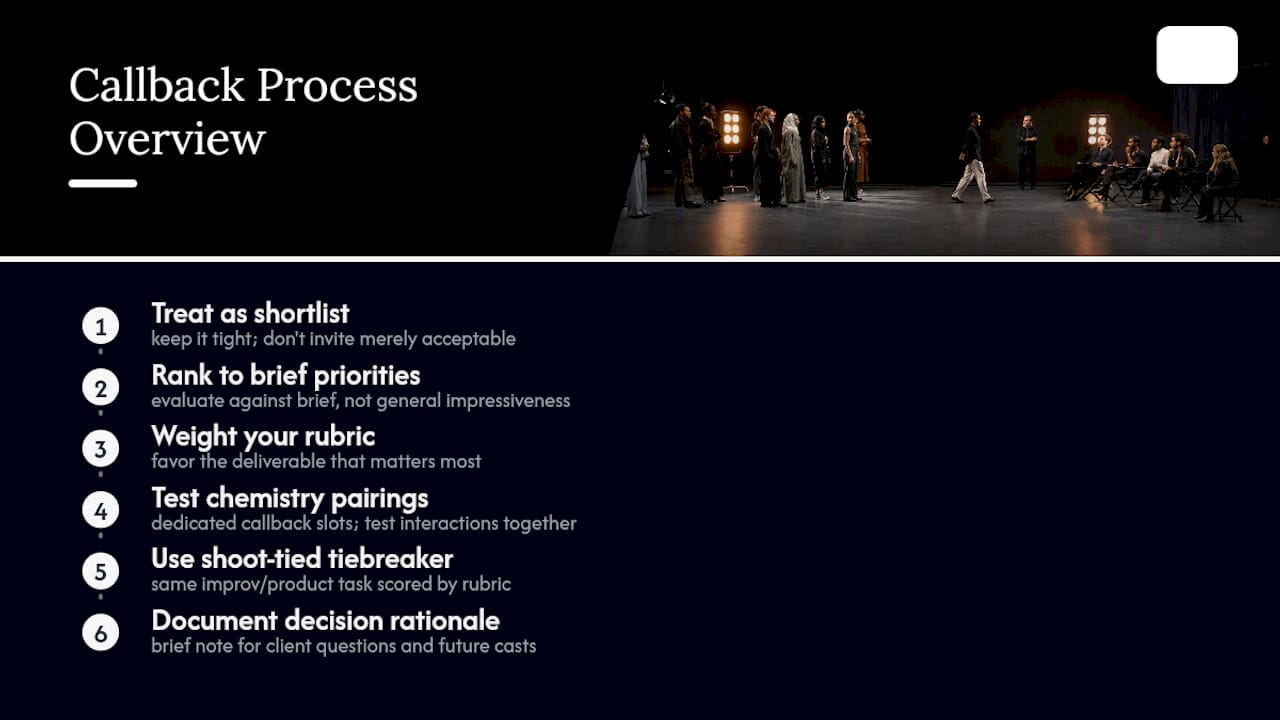
Rank candidates against the brief’s actual priorities, not general impressiveness. A model with striking portfolio work who reads flat on camera direction is a weaker choice for a video-heavy campaign than someone with a thinner book who takes direction naturally. Weight your rubric toward the deliverable that matters most: movement and expression for video, stillness and precision for print, timing and warmth for on-camera dialogue.
Chemistry pairings deserve dedicated callback slots rather than last-minute pairing on the day. If two or more roles need to interact convincingly, test those combinations in the callback round itself, not for the first time on set. Testing performers together on movement or product interaction during a go-see reveals adaptability portfolios simply can’t show.
When two finalists are genuinely close, resolve it with a tiebreaker task tied directly to the shoot, not a subjective gut call. Ask both to run the same short improv or product interaction and score them against the same rubric your screening team already used. Document the decision rationale briefly. It matters when a client asks why one talent was chosen over another, and it speeds up the next casting call with the same brief.
Handling Last-Minute Cancellations and No-Shows
Every casting call eventually loses talent at the worst possible moment. Build the contingency before it happens, not after.
Keep at least one backup on hold for every role that carries schedule risk, confirmed in writing with the same deposit and cancellation terms as your primary booking. This is standard enough in agency-managed casting that clients rarely notice the backup exists unless it’s needed. When a cancellation does hit, notify your backup immediately with the original call sheet and any wardrobe notes already prepared, so the swap costs you minutes, not hours.
Cancellation fees written into the original contract protect you financially, but they also set a tone. Talent and agents take your bookings more seriously when they know a confirmed date carries real weight on both sides. A clear cancellation clause, paired with prompt payment history, tends to reduce no-shows over time because reliable brands attract talent who value repeat work.
For no-shows on audition day specifically, build a small buffer into your schedule rather than back-to-back slots with zero margin. A fifteen-minute cushion every few appointments absorbs the inevitable late arrival or gap without collapsing your whole session. Track no-show patterns per source, agency, marketplace, or open call, since a channel with a chronic reliability problem is worth reconsidering regardless of how strong its talent pool looks on paper.
Communication Templates and Guidance for Talent Updates
Casting calls generate a high volume of repetitive correspondence, confirmations, schedule changes, rejections, and standardizing that communication protects your reputation as much as it saves time.
For submission confirmations, a short automated reply acknowledging receipt and stating your review timeline prevents the flood of follow-up emails that clogs inboxes during open casting calls. For callback invitations, include the exact time slot, location or self-tape instructions, what to bring, and a named contact for day-of questions, since ambiguity here is what causes late arrivals.
Rejection communication deserves more care than most brands give it. A brief, respectful note thanking talent for their time, without vague promises about “future opportunities” unless you mean them, preserves goodwill in a small industry where the same names resurface project after project. Talent and agents remember which brands communicated clearly and which went silent after a submission.
For confirmed bookings, send a consolidated update whenever shoot details change, rather than several fragmented messages. One clear email beats three partial ones. Keep a simple log of every talent update sent per project. It becomes invaluable if a dispute arises later about what was communicated and when, and it makes handoff to a production coordinator far smoother on multi-week campaigns.
Diversity and Inclusion Best Practices During Casting
A casting call that reaches the same narrow pool every time isn’t just a missed creative opportunity, it’s a measurable business risk as audiences increasingly expect campaigns to reflect the markets they’re sold into.
Start with the brief itself. Age range, body type, ability, and cultural background should be defined as genuine creative requirements tied to the campaign’s audience, not defaulted to whatever the last casting call specified. Open calls and community sourcing channels tend to widen the applicant pool fastest, particularly when a brief has historically skewed toward a narrow look.

Screening rubrics need a check against unconscious bias as much as talent scoring. If your callback list consistently narrows to one body type or background despite a diverse submission pool, that’s a signal to revisit how submissions are being scored, not evidence the pool lacked qualified candidates. Blind first-round review, evaluating digitals and reels before names or agency affiliations are visible, helps catch this pattern before it becomes habitual.
Accessibility matters at every stage, not just in casting outcomes. Audition locations should be reachable for talent with mobility needs, self-tape options should be offered as a standard alternative rather than an exception, and call sheets should account for accommodations agreed upon in advance. Working with an agency that curates a genuinely international, varied roster, which is a core part of how ANT Management approaches talent representation, gives brands a wider starting pool without needing to build that reach from scratch on every project.
Legal Compliance and Labor Regulations Specific to Casting Calls
Casting calls sit at the intersection of contract law, labor regulation, and industry conduct standards, and the rules that apply shift depending on the talent’s age, location, and employment classification.
Minor talent brings the strictest requirements. Work-permit rules, mandated break schedules, chaperone requirements, and trust-account provisions for earnings vary significantly by jurisdiction, and a casting call involving child models needs legal review specific to where the shoot takes place, not a generic template borrowed from an adult booking.
Right-to-work verification matters whenever a shoot crosses borders or hires international talent, and it should be confirmed during the screening stage, not discovered on shoot day when a visa issue surfaces. Independent contractor classification is another area worth confirming with counsel, since misclassifying talent as contractors when local labor law treats them as employees can expose a brand to liability well after the campaign wraps.
Conduct standards deserve equal weight alongside contract terms. Referencing a framework like the Model Alliance Respect Program in your casting brief signals to talent and agents that harassment prevention isn’t an afterthought, and it gives everyone on set a shared standard to point to if a concern arises. Usage rights, likeness clearances, and model release forms round out the legal essentials, and none of them should be treated as boilerplate. A right-to-publish checklist confirmed before the shoot, not negotiated after, is what separates a clean campaign launch from a costly mid-production dispute.
What an Agency Adds to the Casting Call Process
An experienced partner absorbs the administrative weight: curated talent pools, contracting, on-set management, and development programs like ANT Camp. That translates into fewer no-shows, pre-vetted talent, and one less legal risk for your team to carry. Agencies are especially effective on high-budget or complex briefs precisely because they’ve already solved these problems on someone else’s production.
Let ANT Management Handle the Casting Call Process for You
Running every step above in-house works fine for a single small shoot. It gets expensive fast once you’re casting multiple roles, negotiating buyouts, and chasing signatures across three time zones. ANT Management removes that overhead by managing the entire sequence, briefing, sourcing, audition coordination, contracts, and on-set support, as one continuous service instead of five separate vendors you have to stitch together yourself.
That matters most for brands running campaigns with international reach, where finding the right look across European, American, and Asian markets usually means juggling multiple local contacts. ANT Management’s network spans those regions already, curated talent, standard usage-rights contracting, and a training pipeline through ANT Camp that keeps the roster performance-ready. If your team wants predictable bookings without building a casting department from scratch, request a tailored casting quote from ANT Management and get a scoped plan back before your next shoot date locks in.
Sources
- How to Book Models for Trade Shows, Runway and Content | Influencer Marketing Hub
- Casting Brief Templates 2025: Save Time & Get Perfect Models | Artfolio
- How Brands Conduct Casting for Commercial Shoots in UAE | Gulf Gotta Talents
- How to Cast the Right Talent for Commercial Content | Novus Nine