
A Creative Brief for a Shoot Should Fit on Two Pages
A working creative brief for a shoot delivers one measurable objective, a defined audience, a shot list, deliverable specs, and usage rights on a document short enough that no one has an excuse to skip it. The best briefs run one to two pages, because length limits force clarity that longer documents let you avoid. Before a single light gets set, confirm your brief covers:
- One measurable objective, stated as a single sentence
- The audience who will actually see the images, and where
- The single-minded message the imagery must carry
- A moodboard with references and anti-references
- A must-have shot list, separated from optional shots
- Logistics: date, arrival window, parking, permits, backups
- Deliverable specs: formats, crops, resolution, color profile
- Usage rights: platforms, duration, exclusivity
Keep it to two pages. A brief that sprawls past that length usually hides an unresolved objective, not extra useful detail.
Key Takeaways
A creative brief for a shoot succeeds when it forces one measurable objective, a defined audience, and complete deliverable specs onto a document short enough that no one skips reading it.
| Point | Details |
|---|---|
| One objective only | Pressure-test the goal sentence; split into separate briefs if you find more than one. |
| Keep it to two pages | Length limits force decisions instead of deferring them to shoot day. |
| Annotate the moodboard | Include 5 to 10 images with lighting, color, and anti-reference notes. |
| Budget realistic time | Plan roughly 15 to 20 minutes per portrait setup, with buffer for changes. |
| Name one approver | A single sign-off point prevents conflicting notes and scope drift. |
Ready to move from brief to booked talent? ANT Management connects brands and producers with fashion, commercial, and kid models, influencers, and full production crews across its global network, so the brief you just wrote has a team ready to execute it.
Table of Contents
- What Is a Creative Brief for a Photoshoot?
- What Should Every Photoshoot Creative Brief Include?
- How Do You Build a Moodboard That Actually Guides the Shoot?
- How Do You Turn the Brief Into a Realistic Shot List?
- What Mistakes Most Often Derail a Photoshoot?
- Creative Brief Template You Can Copy
- Who Does What on Set: Roles and Accountability
- How Do You Manage Client Expectations Before the Shoot?
- Studio Versus Location: When to Expand the Brief
- Frequently Asked Questions
- Sources
What Is a Creative Brief for a Photoshoot?
A photoshoot creative brief is the strategic document that tells everyone on set why the images exist, not just what to point the camera at. It differs from a shot list, which is the execution plan for the day, and from a creative treatment, which sells a concept before it’s approved. The brief sits above both: it defines the goal, the audience, and the constraints, then hands those decisions down to the shot list and the treatment.
Get this document right and the benefits compound fast:
- One objective everyone can repeat back to you, unprompted
- Vendor and photographer quotes that actually match final costs
- Fewer reshoots, because ambiguity gets resolved before call time
- Stakeholders who stop relitigating decisions mid-shoot
Structured briefs that front-load strategic context, audience insight, and production detail measurably reduce rework across creative teams.
Pro Tip: The single most common failure mode is a vague objective. “Make it feel premium” is not an objective. “Position the product as the expert choice for architects, using cool lighting and negative space” is. If the photographer can’t tell you what a successful frame looks like after reading your objective sentence, rewrite it before you send the brief.
What Should Every Photoshoot Creative Brief Include?
Every field in a brief exists to prevent one specific type of confusion on set. Skip a field and you’re not saving time, you’re moving the confusion to shoot day, when it costs more to fix.
Project name, owner, and objective. Name the project, name who owns final approval, and write one measurable objective. Pressure-test it: if you can list two or three separate goals, you don’t have one brief, you have two shoots. A brief carrying multiple primary objectives dilutes the creative outcome and usually needs to split.
Single-minded message. This is the one idea the imagery has to communicate, distinct from the objective (which is business outcome) and the concept (which is visual execution). “This studio makes technical training feel human” is a message. It should survive being read aloud on set.
Audience. Who sees these images, on what platform, in what state of mind? A LinkedIn audience scrolling during a commute needs different crops and tonal warmth than a landing-page visitor already considering a purchase. Audience definition is one of the handful of components every effective brief needs, alongside objective and usage rights.
Deliverables and specs. List exact quantities, formats (JPEG, TIFF, RAW), aspect ratios, color profile (sRGB versus Adobe RGB), and resolution minimums. “High-res” is not a spec.
Shot list. Separate must-have frames from optional ones, and structure each setup by location, lighting, wardrobe, and required frames.
Logistics. Date, arrival window, parking, access notes, permits, and a contingency plan for weather or equipment failure.
Usage rights. State platforms, duration, and whether exclusivity applies. This determines licensing cost and whether talent needs a separate agreement.
Budget, timeline, and approver. Name one approver. Two approvers means two sets of notes and a longer shoot day.
Moodboard annotation. Note what to borrow (lighting quality, color grade, framing) and what to explicitly avoid.
| Brief Field | What to Specify |
|---|---|
| Objective | One sentence, one measurable outcome |
| Audience | Who, where they’ll see it, their mindset |
| Deliverables | Quantities, formats, aspect ratios, resolution, color profile |
| Shot list | Must-have vs. optional, grouped by setup |
| Usage rights | Platforms, duration, exclusivity |
Documenting constraints like brand colors, file formats, and legal deadlines explicitly as mandatory fields, rather than assuming they’re understood, is what keeps the deliverable usable on the first pass.
How Do You Build a Moodboard That Actually Guides the Shoot?
Five to ten images is the workable range for a moodboard. Fewer and you haven’t shown enough range; more and the photographer can’t tell which references matter most. Curated boards in that range, annotated with lighting and framing notes, do more work than a Pinterest dump of forty loosely related images.
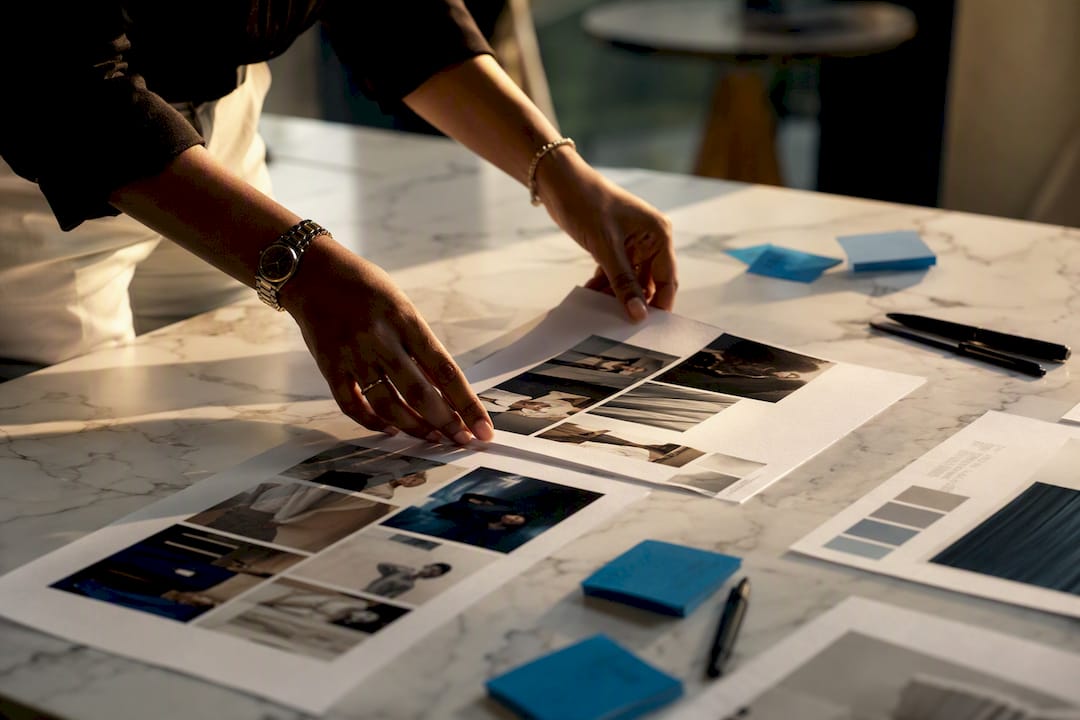
Annotate each reference with what to borrow: lighting direction and quality, color treatment (warm film tones versus clean digital), focal length or framing cues, and what to leave out. Anti-references matter as much as references. Showing an image and writing “not this: avoid this flat, overlit look” resolves a disagreement in seconds that would otherwise surface as a reshoot request.
Host the board somewhere everyone on the team can open without asking for access. A shared folder or workspace link, dropped directly into the brief, beats an email attachment nobody can find on the day.
Pro Tip: Prioritize annotating the references that map to your first three setups on the shot list. Those early frames set the visual language for the rest of the day, so that’s where ambiguity is most expensive.
How Do You Turn the Brief Into a Realistic Shot List?
Break the shoot into setups, where each setup is a distinct combination of location, lighting, and wardrobe. Every setup change costs time even when the concept stays similar, and 15 minutes per setup is a realistic comfortable minimum for straightforward single-subject portraits. Five-minute setups look efficient on paper and rarely survive contact with an actual shoot day.
Plan crops before you shoot, not after. If deliverables include typical aspect ratios for banners and social posts, frame wide enough on set to crop down rather than discovering in post that nothing fits vertically.
| Setup Type | Estimated Time | Typical Deliverables |
|---|---|---|
| Headshot | 15 to 20 minutes | 2 final frames |
| Half-body | 20 minutes | 3 final frames |
| Full-body / environmental | 30 minutes | 4 final frames |
- Build in 15 to 20 minutes of buffer between setups for wardrobe or location changes
- Shoot wider than the tightest crop you need so you can reframe later
What Mistakes Most Often Derail a Photoshoot?
The recurring failures are predictable: no single stated objective, usage rights left vague, an incomplete shot list, no named approver, unrealistic timing, and technical specs buried or missing entirely. Each of these directly causes inaccurate vendor quotes and unplanned reshoots, which is a more expensive fix than writing one extra paragraph up front.
Run this checklist the day before call time:
- Brief and moodboard shared with the full team, not just the photographer
- Contact list distributed, including backups for key roles
- Contingency plan confirmed for weather or equipment failure
- Batteries, cards, and backup gear checked and packed
- Wardrobe and prop notes confirmed with whoever is bringing them
- Arrival time and setup order agreed with the photographer
Pro Tip: Do a final call with the photographer the evening before, not the morning of. Anything unresolved at that point should be flagged with enough runway to fix it before the crew arrives.
Creative Brief Template You Can Copy
Paste this into a shared document, fill it in, and send it 48 to 72 hours before call time so the team has time to flag gaps.
- Project name and owner:
- Objective (one sentence, measurable):
- Single-minded message:
- Audience (who, where, mindset):
- References and anti-references (link to moodboard):
- Must-have shots (versus optional):
- Logistics (date, arrival, parking, permits, contingency):
- Deliverables and specs (formats, crops, resolution, color profile):
- Usage rights (platforms, duration, exclusivity):
- Timeline and budget:
- Approver:
Worked example, brand portrait shoot: Objective: “Build three executive headshots that read as approachable authority for the company’s new leadership page, launching in Q2.” Message: “Confidence without stiffness.” Audience: Site visitors researching leadership before a B2B purchase decision. References: two warm-lit editorial headshots to emulate, one flat corporate headshot flagged as an anti-reference. Deliverables: three retouched JPEGs at 4:5 and 1:1, sRGB, minimum 3000px on the long edge.
Who Does What on Set: Roles and Accountability
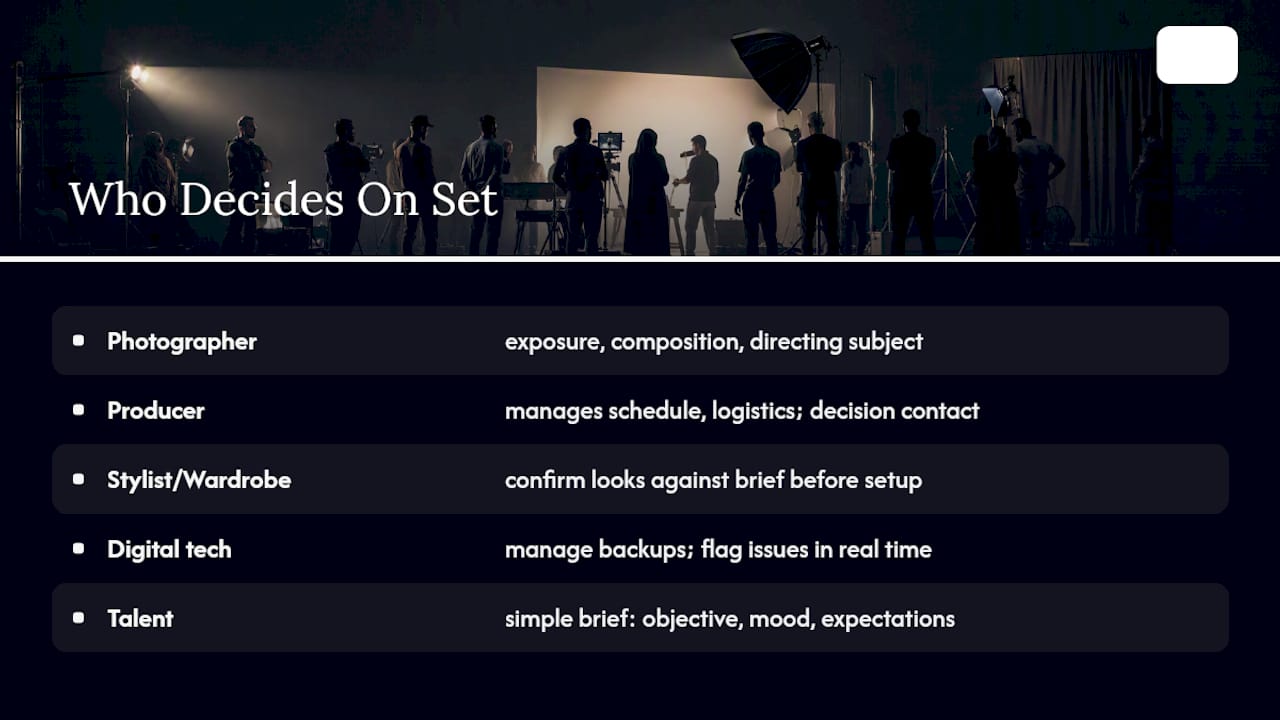
A brief only works if every person on set knows which decisions belong to them. The photographer owns technical execution: exposure, composition, and directing the subject inside the parameters the brief sets. The producer owns the clock, the location logistics, and any live problem that threatens the schedule, from a late arrival to a permit dispute.
Stylists and wardrobe leads confirm looks against the brief’s wardrobe notes before the subject is on set, not during a setup change. A digital tech or assistant, when present, manages backups and flags technical issues (a corrupted card, an underexposed frame) in real time rather than after the crew has wrapped. Talent, whether a model or an executive being photographed, should receive a simplified version of the brief in advance: the objective, the mood, and what’s expected of them, without the deliverable specs that aren’t their concern.
Name a single point of contact for on-set decisions that fall outside anyone’s defined role, usually the producer or the client’s designated approver. Without that, small ambiguities (Do we have time for one more setup? Is this crop acceptable?) get resolved by whoever is loudest, not by whoever the brief actually authorized. Writing roles into the brief itself, even as a short list of names and responsibilities, removes that friction before it happens.
How Do You Manage Client Expectations Before the Shoot?
Client expectations get managed in the brief, not on set. Gather input through a structured questionnaire or a short call built around the brief’s own fields: objective, audience, references, and constraints. Open-ended questions like “what do you want it to feel like” produce vague answers; asking a client to react to five to ten specific reference images produces usable direction fast.
Clarify contradictions before the shoot, not during it. If a client’s stated objective doesn’t match the references they’ve chosen, that gap is worth a follow-up conversation while it’s still cheap to resolve. Once the brief is signed off, treat it as the agreed scope. New requests that surface on set, an unplanned extra setup, a different wardrobe direction, should be logged as changes to timeline or budget, not absorbed silently into the existing schedule.
Send the finished brief back to the client for explicit approval, with one named approver, before the shoot is booked. A brief that’s been discussed but never formally approved is the single most common source of “that’s not what we asked for” after delivery.
Studio Versus Location: When to Expand the Brief
Studio shoots need extra technical detail: lighting diagrams, power requirements, grip needs. Location shoots need extra logistics: permits, parking, local contacts, weather contingencies. ANT Management adjusts kit lists and buffer time based on environment and talent requirements accordingly.
Frequently Asked Questions
What is a creative brief for a shoot? It’s a one- to two-page document defining the objective, audience, message, shot list, logistics, deliverables, and usage rights for a photoshoot, so every team member can execute without guesswork.
How long should a creative brief for a shoot be? One to two pages. Longer documents usually signal an unresolved objective rather than genuinely useful extra detail.
What’s the difference between a creative brief and a shot list? The creative brief explains why the shoot exists and defines strategy; the shot list is the execution plan naming specific frames, setups, and order for the day itself.
How many reference images should a moodboard include? Five to ten high-quality images, each annotated with lighting, color, and framing notes, works better than a large, unannotated collection.
How much time should I budget per setup? Fifteen to twenty minutes per setup is realistic for straightforward portraits; product and editorial setups often run longer, and buffer time should always be added for changes.
Sources
- Photography brief template (HelloBonsai)
- Creative photography briefs (VSCO Learn)
- Working to a photography brief (Visual Education)
- AMA creative brief template and toolkit
- How to write a video brief (Storyflow, 2026)