
50% Upfront, 25–200% Usage: Negotiate Content Creator Contracts

Every content creator contract worth signing does three things: it puts the deal in writing, it licenses your work instead of assigning it away, and it prices usage as its own line item, not a courtesy folded into your base fee. Before you sign anything, scan for deliverables, payment terms, usage rights, exclusivity scope, approval windows, FTC disclosure language, and termination conditions. Those seven clauses decide whether a brand partnership pays fairly or quietly drains your leverage.
TL;DR:
- Usage rights should be limited to specific platforms, durations, and should include separate fees for paid promotion or whitelisting to prevent unlimited use.
- Payment should be triggered by content posting or approval, with deposits of at least 50%, and longer net terms (beyond 30 days) require higher fees or late fees to offset delays.
- Contracts must specify deliverables in precise terms, including format, quantity, specs, and deadlines, with vague language posing risks of scope creep.
- Exclusivity clauses should be carefully evaluated for scope and duration, as broad or long-term restrictions significantly lower your earning potential and require higher premiums.
- Creators should prefer licensing content rather than granting full ownership or work-for-hire rights, and negotiate tiered usage rights to maximize revenue and control.
Table of Contents
- The Seven Essential Content Creator Contract Clauses
- What Should You Charge, and How Should Payment Work?
- License, Assignment, or Work-for-Hire: What Should You Actually Sign?
- How Should You Handle Exclusivity Clauses?
- Negotiation Checklist: Red Flags and Scripts That Work
- Building a Contract Workflow That Actually Scales
- How Agencies Structure Contracts Differently
- Representation Handles the Contract So You Do Not Have To
- Sources
The Seven Essential Content Creator Contract Clauses
A brand contract is a negotiation disguised as paperwork. Most creators read it once, skim for the fee, and sign. That is exactly how usage rights get signed away for free and exclusivity clauses lock up a creator’s entire niche for a year. Here is what each core clause actually needs to say, and what to counter with when it does not.
Deliverables. This clause should name the format (Reel, static post, TikTok, YouTube integration), the exact quantity, technical specs (aspect ratio, length, resolution), the deadline for each asset, and any required captions, hashtags, or account tags. Vague deliverables language (“social content promoting the brand”) is a trap: it lets a brand demand endless variations under one fee. Push for specificity before you push for anything else.
Payment terms. The contract needs a total fee, a deposit amount, what triggers invoicing (contract signing versus content posting), net payment terms, a late fee, and a kill fee. If any of these are missing, assume the brand wrote the contract to leave payment timing in their favor.
Usage rights. This is where most creators lose money without realizing it. A usage-rights clause needs to name the platforms, the duration, whether use is organic or paid, whether the brand can edit your content, and whether they can sublicense it to a third party. “In perpetuity across all platforms and derivative works” is a request for unlimited use at a one-time fee. Counter with a defined term (typically 6 to 12 months) and a separate line item for paid promotion.
IP mechanics. Three terms get used loosely and mean very different things. A license lets the brand use your content for a defined purpose while you keep ownership. Assignment transfers ownership entirely, permanently. Work-for-hire language treats the brand as the legal author from the start, as if you never owned the content at all. Creators own copyright the moment they hit record, and giving that up should never happen by accident in dense contract language.
Approval and revisions. Look for a defined review window (48 to 72 hours is standard), a cap on revision rounds (two is typical), and a deemed-approval clause stating that silence past the review window counts as sign-off. Without a cap, “just one more round of feedback” can stretch a single deliverable across six weeks.
FTC and disclosure responsibilities. The FTC requires clear and conspicuous disclosure of any material connection with a brand, and the contract should specify exactly where that disclosure goes: in-video mention, on-screen text, or the platform’s built-in paid partnership tag. Brands that ask you to bury disclosure in a caption’s fifth line, or skip it entirely, are asking you to absorb their legal exposure.
Termination and liability. This clause should spell out kill fees by production stage, the difference between termination for cause (breach) and termination for convenience (the brand just changes its mind), and basic indemnity language protecting you if the brand’s claims about their product turn out to be false.
- Deliverables: format, quantity, specs, deadline, caption/tag requirements
- Payment: total fee, deposit, invoice trigger, net terms, late fee, kill fee
- Usage rights: platforms, duration, organic vs. paid, editing, sublicensing
- IP mechanics: license vs. assignment vs. work-for-hire
- Approval: review window, revision cap, deemed approval
- Disclosure: required placement and platform tools
- Termination: kill fees, cause vs. convenience, indemnity
What Should You Charge, and How Should Payment Work?
Deposits protect you from disappearing brands. The industry standard is 50% upfront on signing, with the remainder due on final approval or on posting, whichever the contract specifies as the invoice trigger. That trigger matters more than it looks: if payment is tied to “posting” rather than “approval,” a brand that delays approval indefinitely can delay your paycheck indefinitely too.
Net terms are where creators quietly lose cash flow. Net-30 is reasonable. Net-60 or net-90 without a corresponding bump in your fee is not, since you are effectively financing the brand’s marketing budget for two or three months. If a brand insists on longer terms, raise your rate to offset it, and add a late fee (1.5% to 2% monthly is common) so the terms carry a real consequence.
Kill fees scale with how much work has already gone into the deliverable. A cancellation before you have shot anything justifies a lower fee than a cancellation after the content is filmed, edited, and awaiting brand approval.
Kill fee ranges of 25% to 100% depending on production stage are consistent enough across the industry to use as a negotiating anchor, even when a brand pushes back.
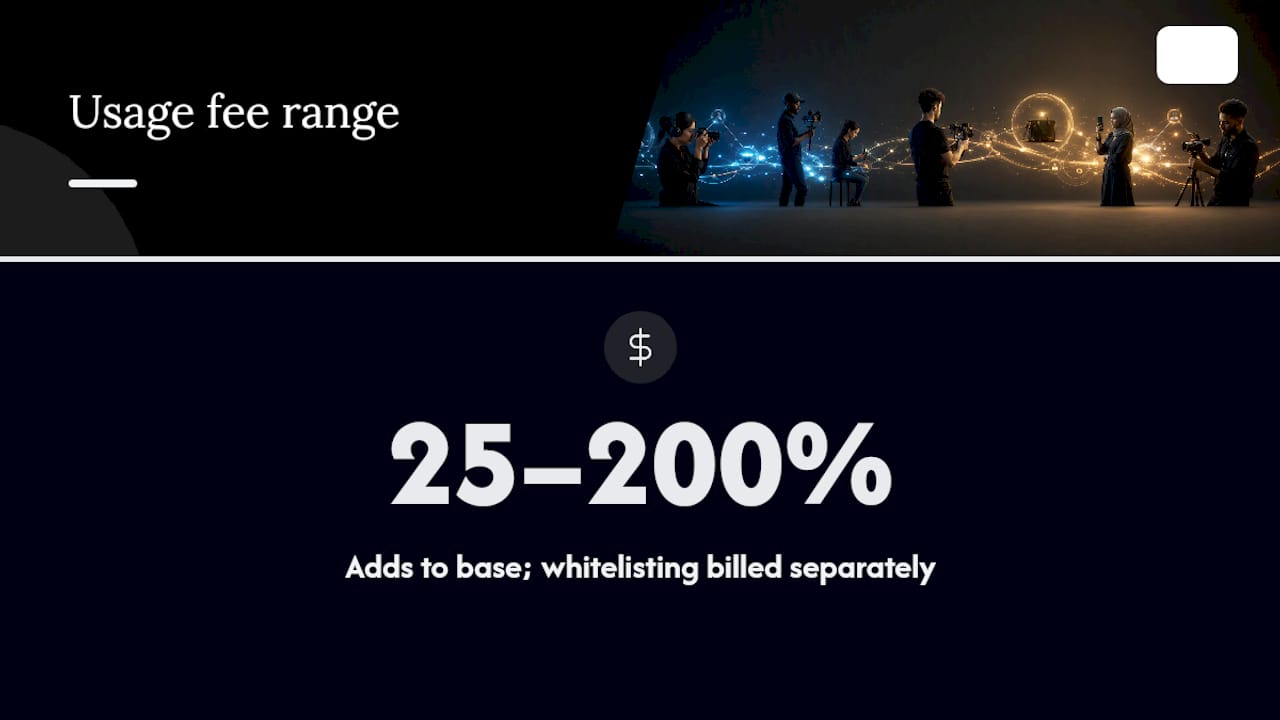
Usage fees follow their own logic entirely separate from your base creation fee. Usage rights typically add 25% to 200% on top of the base rate, depending on how long the brand keeps the rights and how broadly they use them. Whitelisting or paid-ad access, where a brand runs your content through their own ad account under your handle, commonly carries its own separate usage extension fee rather than getting bundled into the original rate.
A large majority of brands now require written contracts, yet only a minority of creators actually have one in place. That gap is the single biggest reason underpricing happens: creators without written agreements have no documented usage terms to point to when a brand’s use of their content expands past what was originally discussed.
License, Assignment, or Work-for-Hire: What Should You Actually Sign?
You own the copyright to your content automatically, the moment you create it. A contract only changes that if it explicitly assigns ownership or invokes work-for-hire language, and creators should generally push for a license rather than an assignment, since licensing preserves both revenue potential and creative control over how the work gets reused.
Instead of one blanket usage grant, propose a tiered structure and price each tier separately:
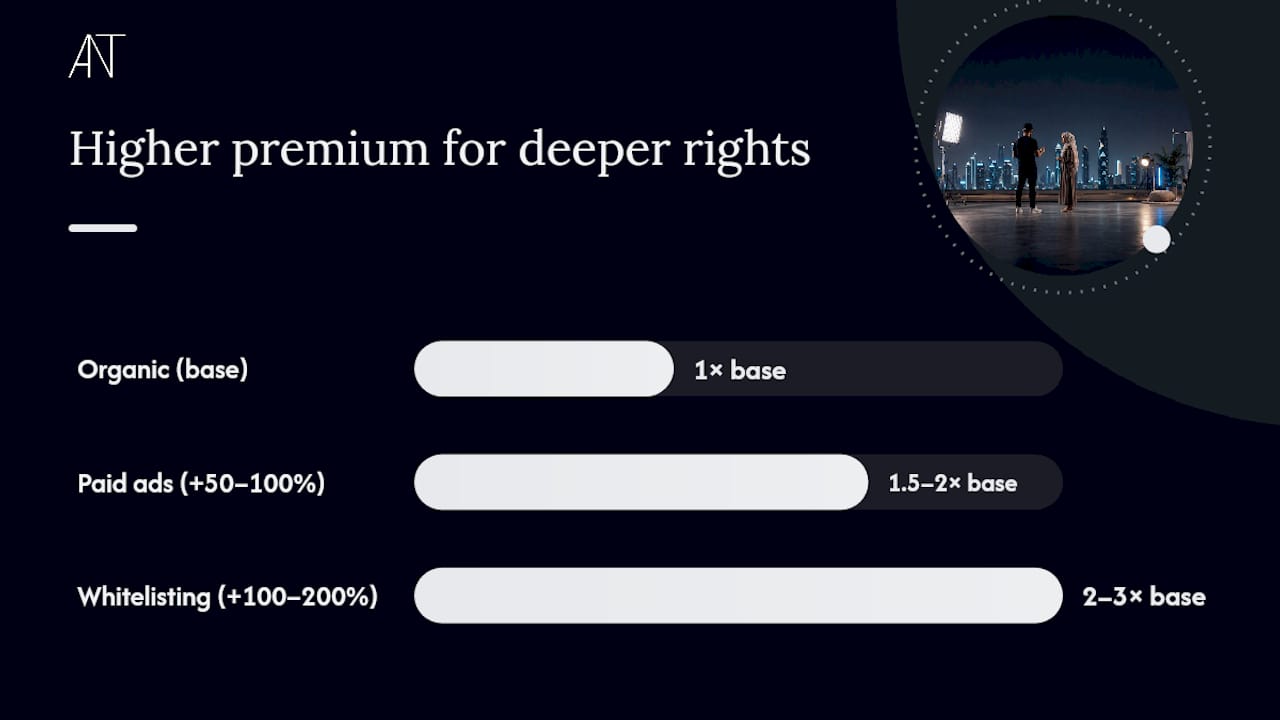
- Organic only: the brand can repost your content on their own owned social channels, no paid distribution. Base fee covers this.
- Paid ads: the brand can boost your content as a paid ad, typically for a defined window (30 to 90 days). Charge an added 50% to 100% of base rate.
- Whitelisting: the brand runs ads directly through your handle, using your account’s targeting and social proof. This carries the highest premium, often 100% to 200% of base, since it affects your own account’s ad relevance and audience data.
- Buyout or perpetual rights: the brand owns unlimited, indefinite use. Price this at a multiple of your base rate, not a modest bump, since you are giving up all future licensing revenue on that asset.
When proposing changes, language like “usage limited to Instagram and TikTok for 12 months, organic use only, no third-party sublicensing” gives you far more protection than accepting whatever the brand’s template already says.
Pro Tip: If a brand insists on full assignment or a buyout, treat it as a different transaction than a standard sponsored post, and price it at a multiple of your normal rate to reflect the full ownership transfer. You are not selling a post anymore. You are selling the asset outright.
Assignment can make sense in specific cases, like stock content licensing deals or work explicitly created for a brand’s own campaign from the ground up. In those cases, the fee should reflect full ownership transfer, not a standard sponsorship rate with an ownership clause quietly attached.
How Should You Handle Exclusivity Clauses?
Exclusivity clauses restrict who else you can work with, and the scope of that restriction varies enormously between contracts. Reading it carefully before you sign matters more here than almost any other clause, because exclusivity limits your income from other brands, not just this one.
- Check the scope first. Campaign-only exclusivity (no other competing content during this specific campaign window) is the easiest to accept. Named-competitor exclusivity (you cannot work with three specifically listed brands) is reasonable and negotiable. Category-wide exclusivity (no skincare brand at all, for any reason) is the broadest and should command the highest premium.
- Evaluate the duration. Campaign length plus 30 to 90 days is typical and defensible. A 12-month category lockout for a single sponsored post is disproportionate unless the fee reflects a full year of lost opportunity in that category.
- Negotiate carve-outs. Ask for exceptions covering pre-existing deals signed before this contract, and consider a regional carve-out if you create content for audiences across multiple countries.
- Price the premium. A rough matrix: campaign-only exclusivity adds little to no premium, named-competitor exclusivity adds 10% to 25%, and category-wide exclusivity beyond 90 days should add 50% or more of your base fee.
Negotiation Checklist: Red Flags and Scripts That Work
Some clauses deserve an immediate pushback, not a polite question. Full IP assignment with no additional fee, in-perpetuity usage rights attached to a one-time payment, no kill fee anywhere in the contract, exclusivity beyond 12 months, and a locked, non-editable PDF are all signals that the brand’s legal team wrote this contract assuming no one would push back.
- “I can move forward once a deposit is included. My standard is 50% on signing.”
- “I don’t see a usage fee for paid distribution. Whitelisting and paid ads are billed separately at [rate].”
- “Twelve months of category exclusivity is broader than I can agree to at this rate. Can we scope it to 90 days post-campaign, or adjust compensation?”
- “This clause transfers full ownership. I’d prefer to license usage for 12 months instead, keeping the fee the same.”
If a brand sends a locked PDF, that does not mean the terms are final. Attaching a one-page addendum listing your proposed changes, kill fee percentage, license duration, payment trigger, and requiring a countersignature works even when the base contract itself cannot be edited.
Pro Tip: Never negotiate verbally over email in a way that leaves your changes undocumented. If a brand agrees to a revised term on a call, follow up in writing and get it initialed before you start work.
For deals involving full assignment, ambiguous indemnity language, or regulated industries like pharma and finance, involve a lawyer before signing rather than after a dispute starts.
Building a Contract Workflow That Actually Scales
Templates work for the majority of standard brand deals, but only if you customize the clauses that matter most before you sign, not after.
- Fill out a one-page deal summary first: brand name, fee, deliverables, deadline, and usage scope, before touching the full contract.
- Set your deliverable specs precisely, matching format and quantity to what you actually agreed to verbally or over email.
- Add your usage tiers (organic, paid, whitelisting) with pricing attached to each, even if the brand only requested organic use initially.
- Adjust the payment trigger, kill fee percentage, and exclusivity scope to your standard terms before signing.
- Sign, archive the fully executed copy, and log key dates: posting deadline, usage expiration, and payment due date.
Reserve a lawyer for deals above roughly $10,000, any clause involving full IP assignment, ambiguous indemnity language, or contracts tied to regulated industries like pharmaceuticals or financial products. Below that threshold, a well-customized template covers most standard sponsorship deals.
How Agencies Structure Contracts Differently
Agencies rarely treat a brand deal as a single transaction. Recurring partnerships get structured as phased campaigns, with renewal and multi-phase language built into the original agreement so a strong first phase leads naturally into the next, rather than restarting negotiations from zero each time.
Operationally, that means a deal summary page for every campaign, an archive of every approved asset with its usage terms attached, and a clear timeline for when whitelisting access opens and closes. Representation shifts negotiation leverage too: a brand negotiating with an agency knows the next conversation, and the next booking, depends on how fairly this one goes.
— ANT
Representation Handles the Contract So You Do Not Have To
Reading clause language line by line, calculating usage premiums, and drafting counteroffers takes real time away from the work that actually grows your audience. ANT Management represents creators and talent across fashion, commercial, and digital campaigns, and that representation includes negotiating usage tiers, payment schedules, and exclusivity terms on your behalf before you ever see a locked PDF.
Representation makes the most sense once deals move beyond occasional one-off posts, particularly for creators managing recurring brand relationships, international campaigns, or whitelisting arrangements where paid-ad terms need careful pricing. ANT Management’s teams across Europe, the US, and Asia manage exactly this kind of campaign logistics and payment protection so creators can focus on the content itself, not the fine print. If you’re ready to have contract negotiation and campaign management handled for you, explore representation with ANT Management and start the conversation about what your next brand deal should actually pay.
Sources
- FTC: Disclosures 101 for Social Media Influencers
- Brand deal contract guide for creators — StarGuard Law
- Content Creator Contract Guide: 8 must-know clauses — Promote Blog
- Who actually owns your sponsored content? — Contractiv8 / StarGuard Law insight