
Green Production Practices for Small Shoots, Brands, & Talent Managers

The highest-impact green production practices for photoshoots, campaigns, and events start before a single light is rigged: name an Eco Supervisor, cast and crew locally to cut travel, right-size your power, and eliminate single-use plastics on set. Run every idea through a feasibility filter first, because a plan that only works for a six-figure campaign helps nobody on a two-day shoot. A modeling agency can build local, low-travel talent rosters into that plan from the first call.
TL;DR:
- Assign a dedicated Eco Supervisor before location scouting to ensure sustainability is integrated into decision-making from the start.
- Budget an additional 1% to 3% of the production cost for green practices, escalating only for zero-waste or carbon-neutral requirements.
- Prioritize local talent, remote fittings, and digital communication to significantly reduce travel-related emissions and logistical complexity.
- Track real on-set waste diversion, fuel use, and transportation data daily to enable accurate, meaningful sustainability reporting.
- Use certified, industrial-grade compostable serviceware, verify vendor claims in writing, and build sustainability clauses into every supplier contract.
Table of Contents
- How Do You Plan Sustainability Into Pre-Production?
- Setting Up a Production Office That Runs Green by Default
- What On-Set Habits Cut Waste and Wasted Energy?
- Sourcing Wardrobe, Props and Set Materials Sustainably
- Reducing Food Waste in Catering and Craft Services
- What’s the Right Power Strategy for a Shoot?
- Cutting Travel Emissions for Talent and Crew
- How Do You Measure and Report on a Green Shoot?
- Who Owns Sustainability on Set?
- How Do You Get the Crew to Actually Follow Green Protocols?
- Choosing Vendors and Suppliers Who Actually Deliver
- How Do You Keep Improving After the First Shoot?
- ANT Management’s Role on Sustainable Productions
- Ready to Book a Sustainability-Minded Crew?
- Where to Go Deeper on Green Production Standards
- Sources
- FAQ
How Do You Plan Sustainability Into Pre-Production?
Sustainability fails when it arrives as a memo on day one of the shoot. It works when it is written into the call sheet, the crew brief, and the budget line before anyone books a flight. Integrating sustainability during initial production design rather than bolting it on later is consistently more effective and cheaper per outcome, according to Meeting Professionals International’s planner guidance.
Start with a single owner. Every set needs one person, an Eco Supervisor or green lead, who briefs department heads before the shoot and has authority to push back on wasteful choices during it.
- Nominate the Eco Supervisor during location scouting, not on load-in day.
- Budget for it: Green The Bid suggests adding 1% to 3% to the production budget when a client’s sustainability ambitions exceed the default plan, and escalating further only if the brief demands zero-waste or carbon-neutral claims.
- Apply a feasibility filter to every proposed action: is it affordable, is the supply chain available locally, can the crew execute it without specialist training?
- Set one measurable target per department (waste diverted, liters of fuel saved, flights avoided) with a named owner.
Pro Tip: Post a daily green tally on the call sheet, plastic bottles avoided, miles saved by local casting. Crews engage with small visible wins far faster than they engage with a policy document.
Setting Up a Production Office That Runs Green by Default
The production office sets the tone for everything downstream. Get procurement and communications right here, and the rest of the shoot inherits good habits automatically.
- Build a preferred-supplier list and write sustainability clauses into every vendor contract: compostable serviceware, return or donation terms for unused stock, no polystyrene.
- Go digital-first for call sheets, contracts, and moodboards, and issue reusable kit, water stations and aluminum bottles instead of pallets of bottled water. Digital-first communications and modular staging cut per-shoot material waste noticeably at scale, per HubSpot’s sustainable events research.
- Add carbon-relevant line items to the accounting sheet from day one: flights, fuel, and waste-hauler invoices, so nothing gets estimated after wrap.
- Give every department head a one-page sustainability brief before pre-production wraps, not a slide deck buried in a shared drive.
What On-Set Habits Cut Waste and Wasted Energy?
Most on-set waste happens in the last two hours of a shoot day, when everyone is tired and sorting bins feels optional. Build the discipline in before that point arrives.
- Run three-stream waste stations (landfill, recycling, compost) with clear signage, and staff them during lunch and wrap, the two peak-contamination windows.
- Spot-check bins mid-shoot. Contamination habits set in fast and are much easier to correct at hour three than at hour ten.
- Enforce a strict no-idling policy for all production vehicles, and assign one person to enforce it, because a written rule nobody owns gets ignored.
- Design sets for disassembly: screws instead of glue, modular flats that store and rebuild, so today’s build becomes next month’s asset instead of tomorrow’s skip.
- Default to LED lighting, zone your power so idle departments aren’t drawing current, and keep an approved equipment list so gaffers aren’t improvising with whatever the rental house had spare.
The PGA Green Production Guide’s unified best practices recommend exactly this combination: an accountable Eco Supervisor, planned waste diversion, and a compiled report at wrap rather than a scramble for numbers after the crew has scattered.
Pro Tip: Assign one crew member to call out the day’s diversion number at wrap. A visible score, even a rough one, does more for buy-in than a full-page policy nobody reads.
Sourcing Wardrobe, Props and Set Materials Sustainably
Buying new should be the last option, not the first instinct. Rental houses, curated resale, and industry swaps cover most wardrobe and prop needs for a commercial shoot without a single new tag getting cut.
- Prioritize rental and resale over new purchases, and keep a shared swap list across productions you run repeatedly.
- Log every asset, on loan, purchased, or donated, so nothing gets lost between the truck and the return window.
- Plan the wrap before the shoot starts: decide now whether wardrobe gets donated or resold, and keep receipts for the sustainability report.
- If new materials are unavoidable, specify certified stock, FSC-certified timber for set builds, for instance, rather than whatever the lumber yard has in stock.
- Coordinate with talent managers on remote fittings and digital look approvals to cut courier trips and last-minute size swaps.
Reducing Food Waste in Catering and Craft Services
Catering is where good intentions meet a table nobody planned portions for. Fixing that takes procurement decisions, not willpower on the day.
- Require plant-forward menu options and enforce realistic portion counts against the actual call sheet headcount, not a padded estimate.
- Source locally and seasonally wherever the shoot location allows it.
- Write a separate food-waste stream into the catering contract, alongside compostable serviceware that meets ASTM D6400 or EN 13432 standards, so “compostable” claims actually hold up at the facility that receives them.
- Set up a donation pathway for surplus food before day one, and weigh what goes out the door so the number is real, not estimated.
A ten percent cut in fuel use across a season of shoots adds up the same way a ten percent cut in food waste does: small, consistent reductions compound faster than one dramatic gesture. Track the surplus weight and put it in the wrap report.
What’s the Right Power Strategy for a Shoot?
Generators are the single biggest emissions line on most location shoots, and most of them run wildly underloaded. A generator running at 20% capacity burns fuel almost as inefficiently as one running empty.
- Run a power audit before booking equipment, and size the generator to run at 60% to 80% load, its efficient range, not “the biggest one available.”
- Use solar-battery systems for base loads (monitors, charging stations, comms) and treat HVO or biodiesel as the interim fuel where grid power or renewables aren’t accessible on location.
- Book battery and solar vendors early. Availability, not price, is usually the real constraint during peak shoot season.
| Diesel reduction | Estimated annual savings |
|---|---|
| 10% cut across a season of shoots | Comparable to the 1 million+ liters of diesel UK summer festivals would save with the same percentage cut |
That figure comes from live events, not film sets specifically, but the mechanism is identical: right-sized generators plus a modest fuel cut produces outsized savings, because most rigs are oversized to begin with.
Cutting Travel Emissions for Talent and Crew
Flights are usually the largest single emissions source on a campaign shoot, and they’re also the easiest to cut without touching creative quality.
- Cast locally first. A talent agency with genuine reach across multiple markets, rather than one market, can usually find the look the brief needs without flying someone across three time zones.
- Run fittings and casting remotely wherever the brief allows it, and save the in-person trip for the shoot day itself.
- Consolidate equipment deliveries into fewer, fuller trips, and prefer low-emission vehicles for local transport once everyone’s on location.
- Set a no-idling policy for crew vehicles and consider small incentives, a transport stipend, for staff who carpool or use transit to reach set.
Record every flight and mile driven. That data becomes the backbone of the wrap report, not a guess reconstructed from memory after everyone’s gone home.
How Do You Measure and Report on a Green Shoot?
A sustainability report that gets written from memory after wrap is worthless. Track the real numbers as you go, and the report writes itself in an afternoon.
- Log flights, vehicle mileage, fuel use, waste weights by stream, and energy draw for every shoot day, not just the big ones.
- Run the numbers through a basic carbon calculator for routine tracking, and budget separately for a full third-party audit only when a client specifically requests one.
- Publish a short wrap report with receipts for donations and a clear diversion percentage. Micro and small productions make up the majority of the events sector, at 91% by one industry estimate, so keep the report proportionate to the shoot’s actual size rather than modeling it on a studio tentpole.
- Aim to measure annually, and treat independent verification as the long-term goal. The Green Events Code of Practice recommends annual measurement by 2025 with independent verification targeted by 2030, a realistic runway rather than an overnight mandate.
- Feed what you learn back into your preferred-supplier list and procurement contracts before the next shoot, not six months later.
Who Owns Sustainability on Set?
Sustainability collapses the moment it’s “everyone’s job,” because everyone’s job means no one’s job when the schedule gets tight. Assign it the way you’d assign any other department: with a name, a line on the call sheet, and real authority.
The Eco Supervisor or green lead sits above individual departments and holds the overall target, waste diversion, fuel use, whatever the shoot’s priority metric is. Below that, each department head owns their own slice. The gaffer owns power zoning and generator load. The art department owns disassembly-friendly builds and material sourcing. Wardrobe owns rental logs and donation plans. Locations owns the no-idling policy and parking layout. Craft services owns portion control and the food-waste stream.
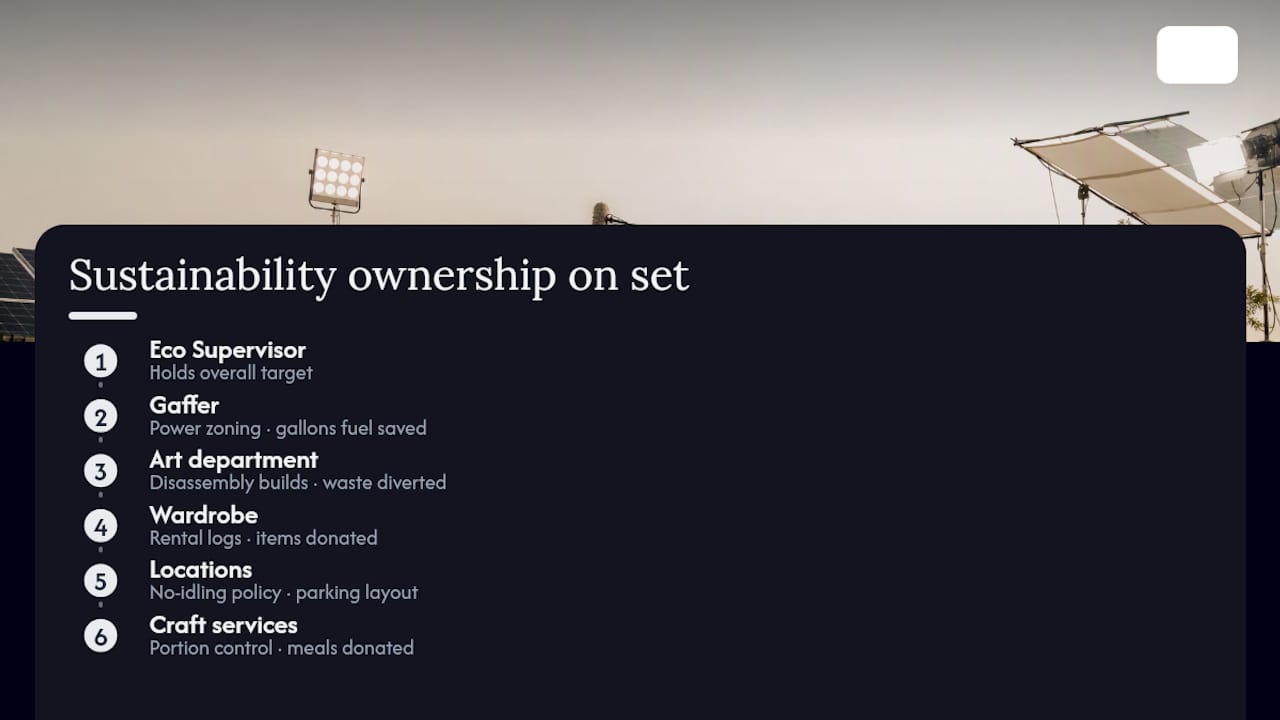
That structure only works if the roles are named before the shoot, not improvised on the day. A clear breakdown of production crew roles makes it far easier to slot sustainability ownership onto existing positions instead of inventing a new title nobody budgeted for.
Give each owner one number to report at wrap: pounds of waste diverted, gallons of fuel saved, meals donated. Vague ownership produces vague results. A named owner with one metric produces a report you can actually publish.
How Do You Get the Crew to Actually Follow Green Protocols?
Protocols fail on set for a boring reason: nobody explained why a rule exists, so tired crew members skip it under deadline pressure. Training fixes that, but only if it happens before call time, not during a lull on day one.
Keep the pre-production briefing short. Fifteen minutes on the specific three or four rules that apply to this shoot, no-idling, three-stream sorting, which bins go where, beats a thirty-page sustainability policy nobody opens. Department heads should repeat the relevant rules in their own toolbox talks, because a rule that only comes from the Eco Supervisor reads as someone else’s problem.
Engagement holds up better than compliance alone. Daily or weekly green memos with a small, visible number, plastic bottles avoided, pounds diverted that day, tend to motivate a crew more reliably than a top-down rulebook, since people respond to a scoreboard faster than a directive. Celebrate the wins publicly at wrap, even the small ones.
Build training into onboarding for repeat crew, not just for new hires. A gaffer who’s worked green sets before will run power zoning correctly without being told twice; a first-timer needs the fifteen-minute version every time until the habit sticks.
Choosing Vendors and Suppliers Who Actually Deliver
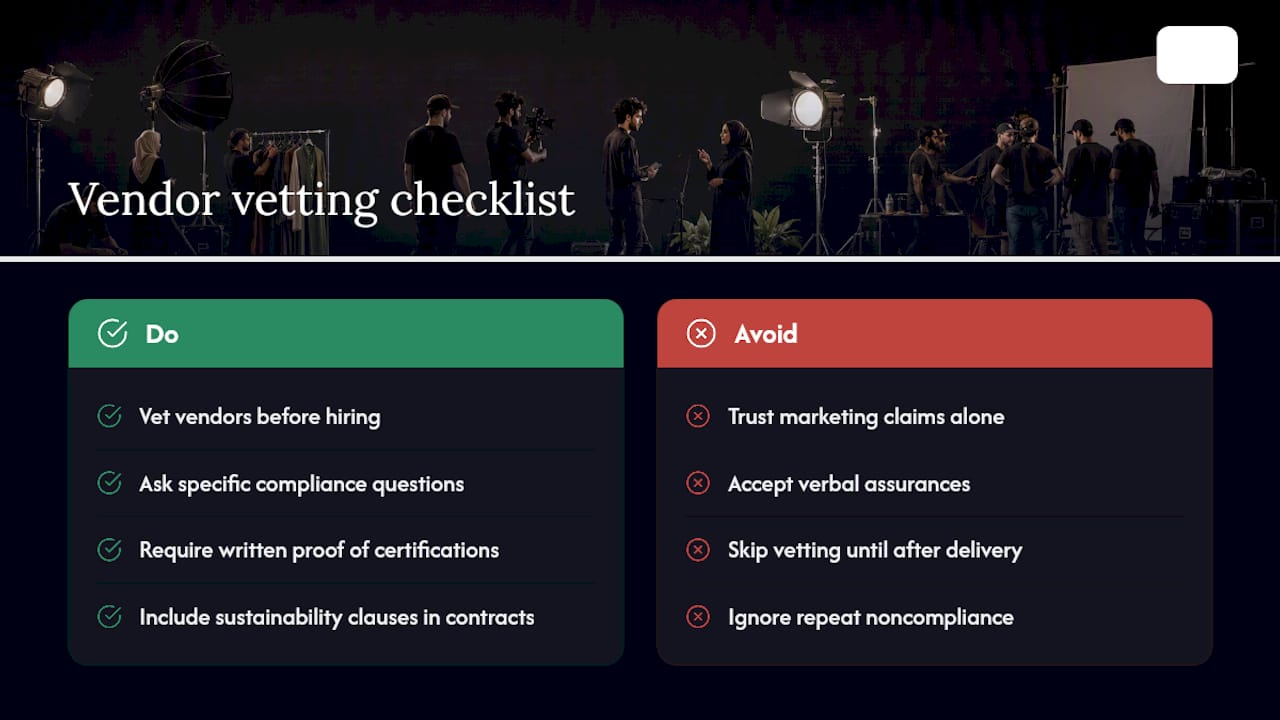
A preferred-supplier list is only useful if the vendors on it actually meet the bar you set. Vet before you commit, not after the compostable serviceware turns out to be laminated cardboard that won’t break down at the receiving facility.
Ask specific questions before signing: does the caterer offer plant-forward options at the volume you need? Does the rental house take back unused wardrobe? Does the waste hauler actually separate compost, or does it all get landfilled together despite the labeled bins? A supplier’s marketing claim isn’t a certification. Request the actual standard, ASTM D6400 or EN 13432 for compostable serviceware, FSC certification for timber, and confirm it in writing in the contract, not a verbal assurance from the sales rep.
Build sustainability clauses into every vendor agreement, not just the ones flagged as “green.” That includes return and donation terms, packaging requirements, and delivery consolidation so trucks aren’t making four half-empty runs to the same location.
Score vendors after each shoot, not just once a year. A supplier who nailed the brief on a small shoot and then missed every clause on a bigger one needs to be flagged before the next booking, not remembered vaguely at the next production meeting.
How Do You Keep Improving After the First Shoot?
The first green shoot is never the best one. It’s the baseline. Treat the wrap report as a working document that changes your next production, rather than a compliance file that gets archived and forgotten.
Compare each shoot’s numbers, waste diversion, fuel use, flights avoided, against the last one on the same scale. A production that improved its diversion rate by even a few points quarter over quarter is doing more than one that hit an arbitrary target once and plateaued.
Run a short debrief with department heads while the shoot is still fresh: what worked, what got skipped under time pressure, which vendor clause actually held up. Feed that directly into the preferred-supplier list and the next pre-production brief. A feasibility filter that worked for a two-day shoot might not hold for a five-day campaign with a bigger crew, so revisit it rather than assuming last quarter’s plan still fits.
Small numeric goals beat sweeping annual resolutions. Set the next shoot’s target as a specific, achievable improvement over the last one, not a company-wide pledge that nobody on set can act on directly.
ANT Management’s Role on Sustainable Productions
Coordinating talent across multiple markets means fewer flights and fewer last-minute crew substitutions. Working with an agency that has genuine reach across Europe, the US, and Asia lets producers cast locally by default rather than defaulting to the same handful of overseas faces out of habit.
ANT Camp, ANT Management’s training program, prepares talent for exactly the workflows a low-impact shoot demands: remote fittings, digital look approvals, and tight, efficient set behavior that respects a production’s waste and energy targets.
— ANT
Ready to Book a Sustainability-Minded Crew?
ANT Management gives you a shortcut past the biggest carbon line item on most shoots: cross-market travel. Rather than defaulting to the same overseas roster out of habit, you get access to a curated, international network of talent and full production crews across Europe, the US, and Asia, so local casting is the easy option, not the compromise.

Beyond talent booking, ANT Management handles event staffing for campaigns and activations where a green pre-production plan needs hands on the ground who already understand waste sorting, no-idling rules, and portioned catering. If you’re building a shoot around a feasibility filter and need talent selection, coordination, and briefing handled by people who’ve done it before, get in touch with ANT Management to request a sustainable crew profile or a green pre-production checklist for your next booking.
Where to Go Deeper on Green Production Standards
For templates and frameworks beyond this guide, start with the Green Events Code of Practice and Vision for Sustainable Events’ climate action list. Green The Bid covers budgeting specifics, and the PGA Green Production Guide remains the standard reference for on-set waste and reporting checklists.
FAQ
What Is the Single Most Feasible Green Practice to Start With?
Naming an Eco Supervisor or green lead before pre-production begins is the most feasible first step, because every other action, from waste sorting to power audits, needs someone with the authority to enforce it. It costs nothing beyond a role assignment and pays off across the entire shoot.
How Much Extra Budget Should a Green Shoot Plan For?
Green The Bid’s guidance suggests adding 1% to 3% to the production budget when a client’s sustainability ambitions go beyond baseline practices, with room to escalate if the brief demands zero-waste or carbon-neutral claims specifically.
Does ANT Management Help Reduce Travel Emissions on Shoots?
Yes. ANT Management’s international network across Europe, the US, and Asia lets producers cast local talent and crew by default instead of flying the same overseas roster to every market, cutting one of the largest emissions lines on a typical campaign shoot.
What Should a Wrap Sustainability Report Include?
A credible wrap report tracks flights, vehicle mileage, fuel use, waste weights by stream, and energy draw, alongside receipts for any donations made. The PGA Green Production Guide recommends compiling this at wrap rather than reconstructing it from memory weeks later.
How Do I Know if a Compostable Serviceware Claim Is Legitimate?
Ask the vendor to confirm certification to ASTM D6400 or EN 13432 in writing in the contract, not just on the packaging. Many products labeled “compostable” only break down at industrial facilities, so confirm the local waste hauler actually accepts that category before relying on the claim.