
Hiring Managers: Negotiate Talent Rates With Line Item Offers & BATNA

Anchor the conversation with a written, line-item offer, and never enter a room without knowing your walk-away number. That single discipline (a documented rate sheet paired with a firm BATNA) does more to protect your budget and your relationship with talent than any clever line you could say out loud. Industry benchmarks and usage-rights premiums give that number its backbone. Everything below (prep, scripts, contracts) builds from that one move.
TL;DR:
- Building a detailed, line-item rate sheet that separates base fee, usage rights, and exclusivity is essential to prevent haggling and maintain control over costs.
- Know your maximum, target, and walk-away numbers before negotiations, including hidden costs like agent fees and licensing, to avoid unfavorable deals.
- Structuring offers with tiered packages and separate usage pricing provides flexibility and helps avoid unattractive discounts or scope creep.
- Timing, demand, and regional negotiation norms significantly influence leverage, with off-peak periods and longer lead times offering better bargaining power.
- Hiring through agencies can simplify international and complex rights negotiations by providing comprehensive management and clear, line-item quotes.
Table of Contents
- Top Tactics at a Glance: A Quick Checklist for Negotiators
- How to Prepare: Budgets, BATNA, and Market Benchmarks
- How to Structure the Offer: Line Items, Usage, Exclusivity, and Bundles
- Scripts and Anchoring Tactics: What to Say in Email and In Person
- Closing the Deal: Payment, Contracts, and Red Flags
- When to Use an Agency vs. Handle Negotiations Directly
- Preserve the Relationship: Fairness, Red Flags, and When to Walk Away
- Understanding Market Rate Differences by Talent Type and Experience Level
- Psychological Negotiation Techniques Specific to Talent Engagement
- Cultural Considerations in Talent Rate Negotiations
- Impact of Timing and Demand on Negotiation Leverage
- A Short Note on Playing the Long Game
- How ANT Management Handles the Negotiation for You
- Sources
Top Tactics at a Glance: A Quick Checklist for Negotiators
Before a single dollar figure gets spoken, run through the moves that separate a confident negotiator from one who leaves value on the table. Talent negotiation rewards structure over improvisation, and the checklist below reflects what actually works when the budget is real and the clock is ticking.
- Anchor high when you hold leverage; ask for budget only when the talent or their agent clearly expects it.
- Build a written rate sheet with distinct line items: base fee, usage rights, exclusivity, and revisions.
- Offer tiered packages so the talent negotiates within your pricing architecture, not outside it.
- Price usage rights separately from the base fee, since usage rights commonly add a significant premium to the base rate depending on platform and duration.
- Treat exclusivity as its own premium line, never a bundled afterthought.
- Require a deposit or staged payments before production begins.
Each of these tactics works better in combination than alone. A rate sheet without a deposit clause still leaves you exposed; a strong anchor without tiered flexibility can stall a deal that a little structure would have saved.
How to Prepare: Budgets, BATNA, and Market Benchmarks
Preparation is where most hiring managers lose the negotiation before it starts. Walking into a call with a single target number and no fallback is a rookie mistake dressed up as confidence.
- Set three numbers before you talk to anyone: your hard ceiling, your target fee, and your BATNA (the walk-away price below which the deal no longer makes sense).
- Add the hidden costs into your math, including agent commissions, travel buyouts, and licensing fees, since these regularly stretch a “final” number by 15 to 20 percent.
- Validate your range against real benchmarks. Upwork’s guidance on setting freelance rates recommends starting from an income goal divided by realistic billable hours, then layering in taxes, expenses, and nonbillable time, a method that translates directly to talent budgeting.
- Decide your sequencing strategy in advance. Do you ask the talent’s asking price first, or do you name your budget upfront? That choice depends entirely on who holds the leverage in this specific deal.
Pro Tip: Speaker and event bookings often allocate fees as a fixed share of the total event budget, and bundling additional services into one contract tends to improve the cost-per-unit value for organizers, so calculate your ceiling against the whole event, not the talent line alone.
Mid-tier influencers, for context, commonly command a mid-range fee per campaign before usage and exclusivity premiums apply, a range worth knowing before you make an opening offer.
How to Structure the Offer: Line Items, Usage, Exclusivity, and Bundles
A single lump-sum number invites haggling. A line-item quote invites negotiation on your terms, because every reduction the talent asks for now has a visible trade-off attached to it.
- Break the offer into distinct components: base fee, production or booking costs, usage rights, exclusivity, and revision allowances.
- Price usage rights by platform, duration, and whether paid media will amplify the content, not as a flat add-on.
- Offer two or three package tiers so a client who balks at the top price has a lower tier to land on without a raw discount.
- Use travel buyouts or flat “travel envelopes” to remove line-by-line logistics arguments from the table.
Pro Tip: Ad Age’s creator negotiation worksheet treats the rate sheet as the negotiation tool itself, not a document you produce after the deal closes. Send it early, and let the talent negotiate against your structure rather than your instinct.
Usage rights deserve special attention. Separating production fees from licensing keeps your base rate stable while giving you room to flex on scope, which is almost always cheaper than flexing on the fee itself. If your campaign involves paid amplification, review how whitelisting affects usage pricing before you quote a number you’ll regret.
Scripts and Anchoring Tactics: What to Say in Email and In Person
Words matter less than sequence. Say the right thing at the wrong moment, and even a fair offer sounds like a lowball.
- Decide who names a number first. If you have strong leverage (multiple qualified candidates, a flexible date), anchor with your offer. If the talent has unique reach or scarcity works against you, ask for their rate before revealing your budget.
- Script your counter before the call. A simple structure works: acknowledge the ask, name one specific trade you’re offering (extended usage window, faster payment, multi-project commitment), then restate your number.
- Use silence deliberately. After stating a figure, stop talking. Resist the urge to soften a number with an apology; a nervous “but that’s just where we are” signals room to push.
- Prepare for outlier numbers on both ends. An unexpectedly high quote is often a test of your seriousness, not a hard floor. An unusually low quote deserves a direct question about scope, since underpriced talent frequently discovers gaps later and resents the deal.
Closing the Deal: Payment, Contracts, and Red Flags
Verbal agreements collapse under pressure. Everything you negotiated needs to survive contact with a contract, or it never actually happened.
- Standard terms include a deposit (commonly 30 to 50 percent) plus a balance due on delivery, or Net 15/30 for established agency relationships.
- Contracts must specify deliverables, timeline, usage rights, a revision cap, kill fees, and the payment schedule in plain language.
- Watch for red flags: a client who resists putting anything in writing, a request for “unlimited revisions,” or a demand for all-rights ownership at a base-fee price.
Pro Tip: Send a written recap email within hours of any verbal agreement, listing every number and term you discussed. It costs five minutes and prevents the single most common source of talent disputes: two people remembering the same call differently.
When to Use an Agency vs. Handle Negotiations Directly
Direct negotiation works for a single local booking with a known talent and a simple usage grant. It stops working the moment a project touches multiple markets, multiple currencies, or licensing terms that need legal precision.
- International or multi-market bookings benefit from agency representation because cross-border compliance and rights management get complicated fast.
- Multi-day series and campaigns with paid amplification need someone tracking usage windows across platforms, not just the initial shoot date.
- Agency fees typically cover talent curation, contract drafting, rights negotiation, and logistics coordination, work that otherwise falls on your internal team.
- Hiring managers who work with an agency should ask for a line-item breakdown up front, the same discipline you’d apply to a direct negotiation.
For deals spanning several countries, agencies consolidate rights management and local compliance in ways that are difficult to replicate with a spreadsheet and good intentions.
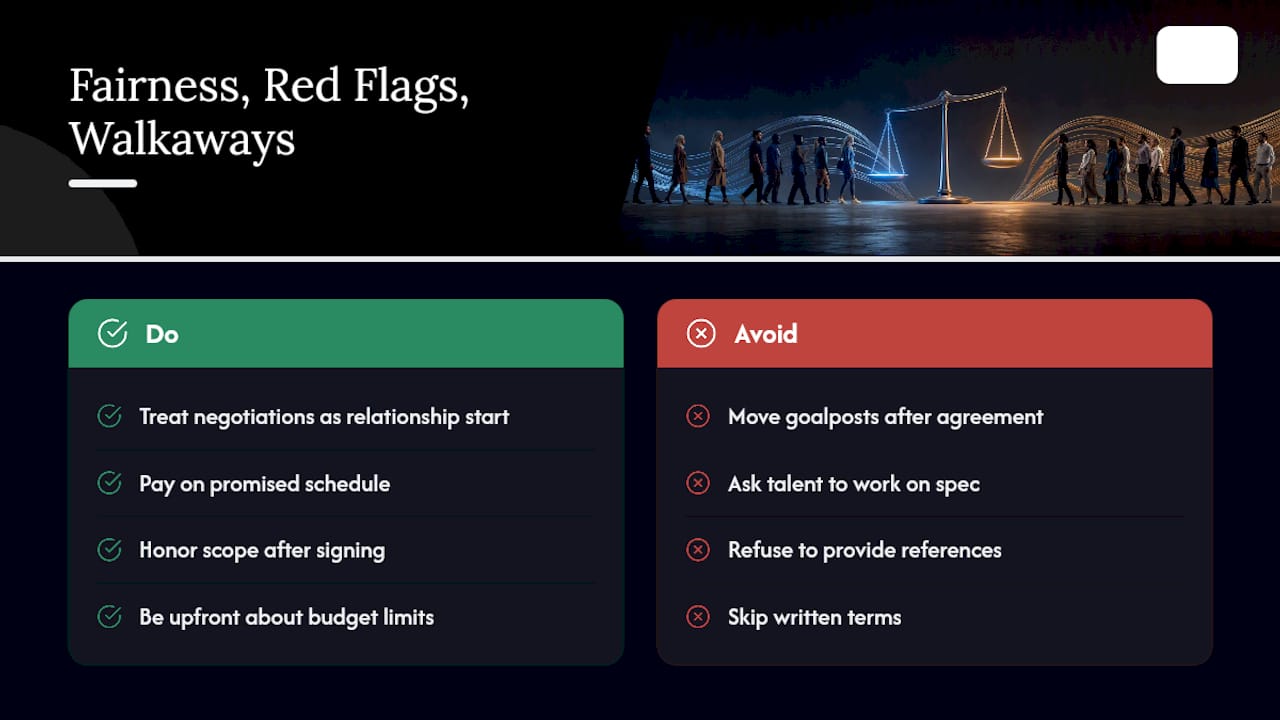
Preserve the Relationship: Fairness, Red Flags, and When to Walk Away
A negotiation you win by squeezing every dollar out of talent is a negotiation you’ll have to repeat from scratch next time, because that talent won’t take your next call. The best hiring managers treat rate negotiation as the start of a working relationship, not a one-time transaction to be won outright.
Fairness shows up in specifics: paying on the schedule you promised, not adding scope after the contract is signed, and being upfront when your budget genuinely can’t stretch to match a fair ask. Talent remembers who negotiated in good faith and who nickel-and-dimed them on revisions after the fact.
Red flags run in both directions. Watch for clients who keep moving the goalposts after verbal agreement, who ask talent to work on spec “to prove fit,” or who frame every counter as the talent being difficult. On the talent side, watch for representatives who won’t provide references, who avoid written terms, or who quote wildly inconsistent numbers across conversations.
Knowing when to walk away is a skill most hiring managers underdevelop. If a negotiation requires you to abandon your BATNA more than once, that’s not a negotiation anymore, it’s a concession spiral, and the deal that results from it usually costs more in resentment than it saves in dollars. Sometimes the right move is ending the conversation respectfully and returning to your shortlist. That decision protects your budget this quarter and your reputation with the talent pool for years afterward, since talent communities talk to each other more than most hiring managers assume.
Understanding Market Rate Differences by Talent Type and Experience Level
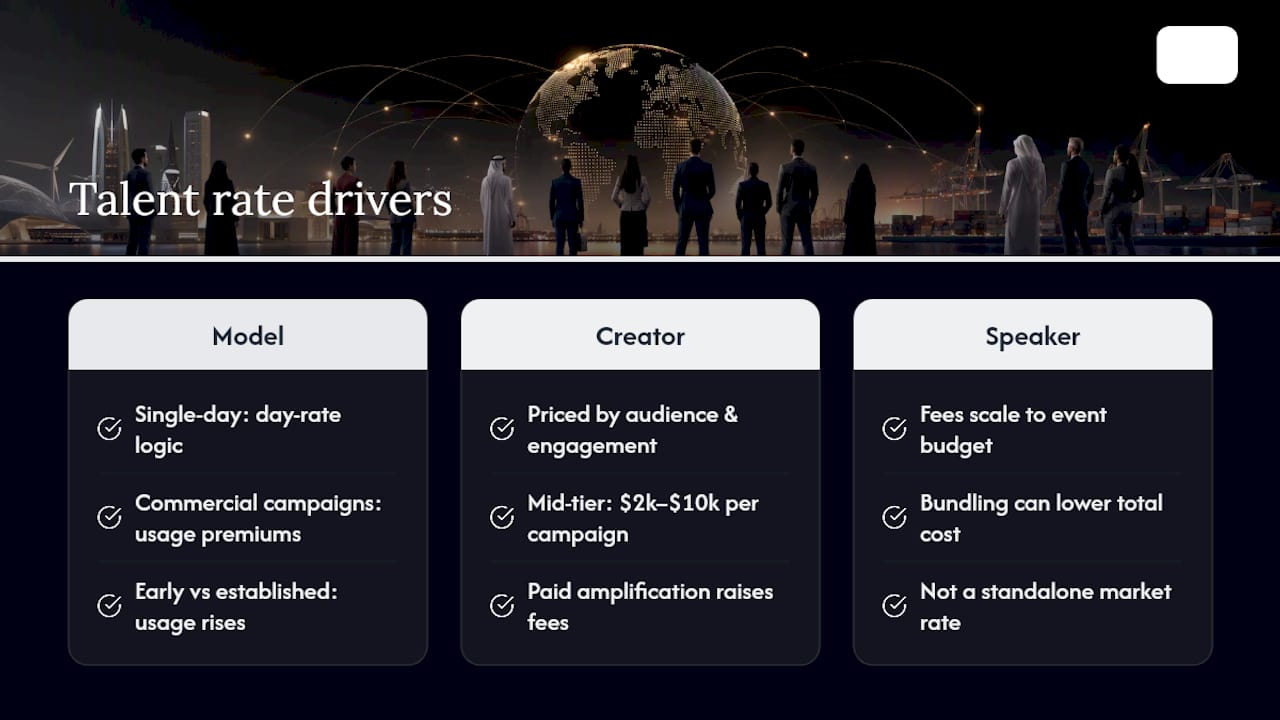
Rates vary enormously depending on who you’re booking, and treating a model, a keynote speaker, and a micro-influencer as interchangeable line items is where budgets go wrong. A fashion model booked for a single-day editorial shoot operates under a completely different rate logic than a commercial model whose face ends up on a national paid-media campaign for six months.
Experience level shifts the math further. Early-career talent often prices closer to day-rate norms because they haven’t yet built the leverage to demand usage premiums. Established talent, by contrast, treats usage and exclusivity as the primary revenue driver, sometimes worth more than the base booking fee itself.
Influencer and creator rates follow their own logic entirely, tied to audience size, engagement rate, and platform. Mid-tier creators commonly land in the $2,000 to $10,000 per-campaign range before usage rights are added, a figure that shifts substantially once paid amplification or exclusivity enters the conversation. Speaker fees, meanwhile, tend to scale against the overall event budget rather than a standalone market rate, which is why bundling speaker services with other event talent can shift the total cost picture favorably for organizers.
The practical lesson: build a separate benchmark for each talent category you book regularly. A single “talent rate” spreadsheet that lumps models, speakers, and creators together will consistently mislead you on what’s actually fair for any one of them.
Psychological Negotiation Techniques Specific to Talent Engagement
Talent negotiation carries an emotional layer that commodity procurement doesn’t. You’re not negotiating over a shipment of parts, you’re negotiating over someone’s face, voice, or creative output, and that distinction changes what tactics actually land well.
Reciprocity works quietly in your favor when you lead with something concrete: a clear brief, a fast payment timeline, or a specific usage window instead of vague terms. Talent representatives notice when a hiring manager has done the preparation work, and that noticing often translates into more flexibility on price than any hard-nosed tactic would produce.
Framing your first offer around value rather than budget constraints changes the tone of the entire conversation. “Here’s what this project is worth to us and why” lands very differently than “here’s all we have to spend,” even when the number is identical.
Loss aversion cuts both ways. Talent often responds more strongly to losing a specific perk (exclusivity, a usage extension, a favorable payment schedule) than to gaining an equivalent dollar amount. If your budget is genuinely fixed, offering a concession on terms rather than fee frequently closes the gap faster than pushing harder on the number itself.
Anchoring remains the single most researched psychological lever in negotiation, and it applies here exactly as it does anywhere else: the first credible number spoken tends to define the range everything else gets measured against. That’s precisely why a written, line-item offer matters more than a verbal figure. It anchors the entire conversation before anyone has a chance to improvise.
Cultural Considerations in Talent Rate Negotiations
Rate negotiation norms shift meaningfully across regions, and applying one market’s playbook globally is a fast way to alienate talent or overpay unnecessarily. In some markets, direct discussion of numbers early in the conversation is standard and expected. In others, that same directness reads as aggressive, and rapport needs to build before figures enter the room at all.
Payment timelines carry different cultural weight too. Net 30 terms that feel routine in one market can feel disrespectful in a market where same-day or next-day payment for talent work is the norm. Hiring managers booking across multiple regions need to check local expectations before assuming their standard contract terms will transfer cleanly.
Negotiating through agents versus talking directly with talent also varies by market and by talent category. In some regions, going around an established agent relationship, even with good intentions, damages trust with the entire representation network, not just that one negotiation.
For hiring managers running international campaigns, this is where working with an agency that already operates across those markets pays for itself. Rather than learning each region’s negotiation norms through trial and error, a partner with established regional relationships can flag the mismatches before they become expensive mistakes.
Impact of Timing and Demand on Negotiation Leverage
Timing changes leverage more than almost any other factor in talent negotiation, and it’s the variable most hiring managers ignore until it’s working against them. Booking talent during a peak season (fashion month, major conference calendars, year-end campaign pushes) means you’re competing against every other brand trying to lock the same names, and rates climb accordingly.
The opposite is equally true. Off-peak booking windows give hiring managers real negotiating room, because talent calendars have open dates that need filling. Asking a model, speaker, or creator to work during a traditionally slow period often unlocks flexibility on rate that simply doesn’t exist during high-demand months.
Demand spikes tied to a talent’s own trajectory matter too. A creator whose audience just tripled after a viral moment holds dramatically more leverage this month than they did last month, and rate cards that were accurate a quarter ago may already be stale. Hiring managers who negotiate off outdated benchmarks routinely get surprised by how much a rate has moved.
Lead time itself is a lever. Booking talent with short notice for a rush project removes your ability to negotiate on price, because you’ve signaled that this deal must close regardless of terms. Building in a longer runway before your event or campaign date preserves your ability to walk away, which is the entire foundation of a strong BATNA in the first place.
A Short Note on Playing the Long Game
Rate negotiation is not a contest to win once. It’s the opening move in a relationship you’ll likely return to, project after project, and the terms you set now shape how that talent, or their agency, remembers working with you.
How ANT Management Handles the Negotiation for You
Some agencies offer hiring managers the option to skip negotiation complexity by handling rate structuring, usage-rights calculations, and cross-border logistics. Booking talent across fashion, commercial work, influencer campaigns, and events can become complicated once usage rights, exclusivity clauses, and multi-market contracts are involved, highlighting the value of an agency curation process.
ANT Management’s services cover talent curation, contract management, rights negotiation, and the logistics of booking across international markets, so your team gets a line-item quote without building one from scratch. If your next project touches the Gulf region specifically, explore the Kuwait talent agency page or the Saudi Arabia booking page for market-specific support, or check current availability and get a quote through the main ANT Management site to see how a managed negotiation compares to handling it in house.
Sources
- How to Negotiate Speaker Fees: A Master Checklist for Event Planners in 2026
- Creator negotiation worksheet and pricing chart - Ad Age
- How to set your freelance rate - Upwork
- How to Negotiate Creator Rates | Complete 2026 Guide