
What Determines Photo Licensing Fees and How to Price Them

A photo licensing fee is set by usage, not by how long the shoot took or how many frames the photographer edited. Four variables decide the number: the media where the image runs, the territory it covers, the duration of use, and whether the license is exclusive. Change any one of those, and the price moves with it.
For quick calibration, common jobs tend to land in these bands:
- Local business web and social use: often within a modest price range per image
- Regional print or digital campaign: typically a moderate fee range
- National advertising campaign: generally commands a higher fee range depending on exclusivity
Before quoting anything, ask the client exactly where the image will appear, for how long, and whether they need to lock out competitors from using the same photographer or shot. Vague usage requests are how photographers end up giving away rights they never meant to sell.
Key Takeaways
Photo licensing fees are set by usage, meaning media, territory, duration, and exclusivity determine price far more than production time or effort.
| Point | Details |
|---|---|
| Usage drives price | Media, territory, duration, and exclusivity are the four variables that set any photo licensing fee. |
| RF vs. RM matters | Choose royalty-free for predictable stock pricing, rights-managed for exclusive brand campaigns. |
| Always set an end date | Undefined duration commonly costs photographers renewal revenue they never collect. |
| Separate creative and usage fees | Itemized quotes give clients clarity and give photographers stronger negotiating ground. |
| Releases unlock advertising value | Model and property releases determine whether an image can be licensed for commercial use at all. |
| Coordinate talent and rights together | ANT Management pairs campaign talent booking with usage rights coordination across global markets. |
Table of Contents
- Understanding Photo Licensing Fees: RF vs. RM
- How Do Media, Territory, Duration, and Exclusivity Change the Price?
- What Are Typical Photo Licensing Fee Ranges?
- How to Calculate a Photo License Fee Step by Step
- Contract Clauses and Negotiation Tactics That Protect Your Fees
- Tools and Fee Schedules for Validating Your Rates
- What Happens Legally When a Photo License Is Violated?
- Does Photographer Reputation Change Licensing Prices?
- Do Modifications or Derivative Works Change the License Fee?
- How Does Image Resolution Affect Licensing Fees?
- Why Do Model and Property Releases Affect Licensing Fees?
- Why Agencies Coordinate Rights Alongside Talent
- Book Talent and Coordinate Usage Rights With ANT Management
- Sources
Understanding Photo Licensing Fees: RF vs. RM
Two licensing models cover almost every commercial photo transaction, and confusing them costs photographers real money.
Royalty-free (RF) licensing charges one fee for broad, often unlimited reuse within the license terms. A client buys the image once and can generally reuse it across multiple projects without paying again, though extended licenses still apply to merchandise, templates, or high-volume print runs, according to DIYPhotography’s breakdown of royalty-free terms. RF suits stock photography, blog imagery, and internal business use where predictable, low-friction pricing matters more than control.
Rights-managed (RM) licensing ties the fee to specific, negotiated usage: this media, this territory, this duration, this level of exclusivity. It costs more per image but gives the client (and photographer) precision. A luxury brand running a six-month European campaign wants RM rather than RF because RM lets the photographer restrict competitors from licensing the same image.
The market has shifted meaningfully toward RF as stock libraries scaled and photo licensing fees became commoditized for everyday content, notes Depositphotos’ guide to royalty-free licensing. RM has not disappeared. It persists specifically where brands need exclusivity or bespoke production, which is exactly the terrain high-end commercial and campaign photography still occupies.
Quick reference:
- Choose RF for: stock imagery, blogs, internal decks, low-stakes social content
- Choose RM for: brand campaigns, exclusivity requirements, high-value ad placements
- Watch for: RF terms that still require an extended license for merchandise or resale products
How Do Media, Territory, Duration, and Exclusivity Change the Price?
Every image licensing fee traces back to four dials. Learn to turn each one and you can defend nearly any quote.
- Media. Usage value climbs roughly in this order: web and social, then print, then out-of-home (OOH) like billboards, then broadcast and video. A billboard campaign commands more than a blog post because it reaches more people with less control over exposure.
- Territory. Local use costs the least. Regional, national, and global rights each step up the price, often by a meaningful multiplier rather than a flat add-on. A national buyout can run several times a local-only rate for the same image.
- Duration. A one-month license costs less than a one-year license, and a one-year license costs less than an indefinite one. Renewals should be priced as their own transaction, not folded silently into the original fee.
- Exclusivity. Granting exclusive use, meaning the photographer agrees not to license the same image to competitors, carries a real premium. Buyouts (full, often perpetual rights) commonly price at 3 to 5 times an annual license fee, according to ShootCost’s commercial licensing framework.
Pro Tip: Never let a client’s request for “just a quick web version” quietly expand into broadcast or OOH use later. Write the media type into the contract explicitly, and price any expansion as a new license, not a favor.
Stack these dials multiplicatively, not additively, when a job spans more than one variable. A national, one-year, exclusive campaign license is not “national plus one year plus exclusive” added together; it is a compounding premium on the base usage value.
What Are Typical Photo Licensing Fee Ranges?
Numbers ground negotiations better than adjectives. Here is what photo usage rights pricing tends to look like across common scenarios, drawn from representative market data and published institutional fee schedules.
- Small business web/social use: $150 to $600 per image, reflecting limited reach and low production risk.
- Regional campaign (print or digital): $500 to $2,500, scaling with the size of the geographic footprint and channel mix.
- National advertising campaign: commercial photographers commonly charge $2,000 to $5,000+ for national or higher-value campaign usage, with pricing tables and forum consensus confirming this range according to Patrick Fore’s analysis of commercial licensing fees.
- Perpetual buyout: typically priced at 3 to 5 times the equivalent annual license rather than as a discount for “simplicity.”
- Museum and institutional use: Getty’s published fee schedule lists tiered rates by use case, including separate charges for publication interior placement, cover use, exhibition display, and special handling, according to Getty’s image request fees schedule. The Museo Nacional del Prado publishes a comparable structure, with distinct per-image and per-use tariffs for its image bank fees.
These figures are starting anchors, not rigid rules. A photographer with a strong portfolio in a competitive niche can justify the top of a range; a client with a modest, single-channel need has grounds to negotiate toward the bottom.
How to Calculate a Photo License Fee Step by Step
Separate the creative fee from the usage fee before you do anything else. The creative fee covers your time, equipment, and production costs. The usage fee is what the client pays to use the finished image. Bundling them together is what leads photographers to undercharge, since the usage fee is the part that should scale with the client’s actual commercial benefit.
A workable formula looks like this:
- Set a base usage value for a single-channel, local, one-year, non-exclusive license.
- Apply a media multiplier (web stays near baseline; broadcast or OOH multiplies significantly higher).
- Apply a territory multiplier (local stays at 1x; national might run 3 to 6x; global higher still).
- Apply a duration adjustment (shorter than a year reduces the fee; multi-year increases it).
- Add an exclusivity premium if the client wants competitors locked out.
- Add the separate creative/production fee back in for the final itemized quote.
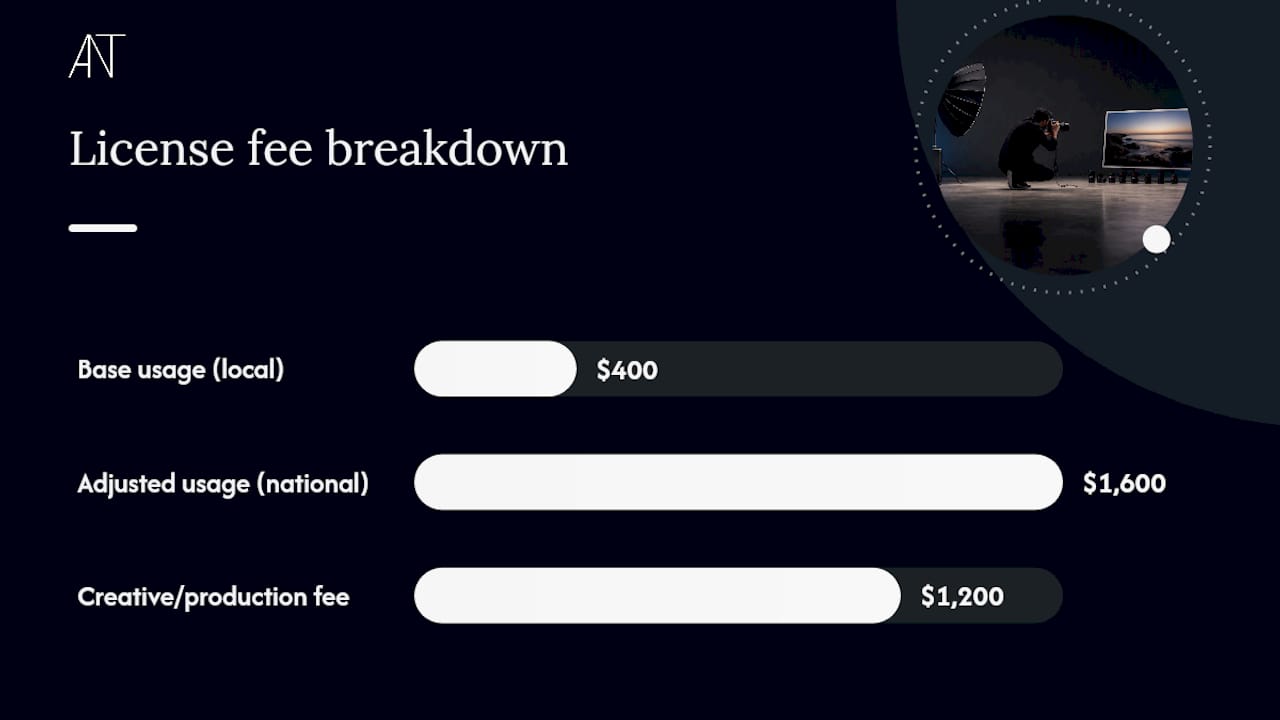
Worked example: Base usage value of $400 for local web use. The client wants national print and digital advertising for one year, non-exclusive. Duration stays at baseline (one year), so no further adjustment. Add a $1,200 creative fee for the shoot itself. Total quote: $2,800, itemized as $1,600 usage plus $1,200 creative.
For multi-channel use (web plus print plus social, for instance), choose the highest-impact multiplier and add smaller increments for secondary channels rather than stacking every multiplier fully. If a client wants everything, everywhere, forever, that is a buyout conversation.
Contract Clauses and Negotiation Tactics That Protect Your Fees
A verbal agreement or a one-line invoice description is where licensing disputes are born. Every commercial license should spell out:
- Defined usage (exactly which media and placements are covered)
- Territory (local, national, or global, named explicitly)
- Duration with a firm end date, since Fstoppers notes that failing to specify an end date is one of the most common ways photographers unintentionally grant perpetual rights
- Exclusivity terms, stated as either exclusive or non-exclusive
- File deliverables (resolution, format, color profile)
- Payment schedule and renewal terms
Watch for red flags in client-drafted contracts: language like “unlimited use,” “perpetual rights,” or vague phrases such as “marketing use” that could mean a single social post or a global broadcast campaign. Agencies that won’t name the end client are another warning sign, since you can’t assess reputational or competitive risk for a brand you can’t identify.
Pro Tip: Anchor negotiations with a high buyout price first. When the client balks, a scoped, time-limited license suddenly looks reasonable, and you’ve protected your ability to relicense the image later.
Offer tiered options rather than a single number. A client choosing between a $1,800 one-year regional license and a $6,000 perpetual buyout is negotiating against your framework, not against you.
Tools and Fee Schedules for Validating Your Rates
You don’t have to price from instinct. The Association of Photographers’ usage calculator converts usage parameters directly into a recommended fee range, and showing the output to a client is a stronger negotiating position than defending a number you pulled from experience alone. ASMP publishes licensing education and contract guidance for working photographers. Getty’s fee schedule offers a public benchmark for institutional and publication pricing, while Depositphotos explains RF terms clearly for stock-adjacent work. Commercial calculators like ShootCost function as a sanity check against your own math.
What Happens Legally When a Photo License Is Violated?
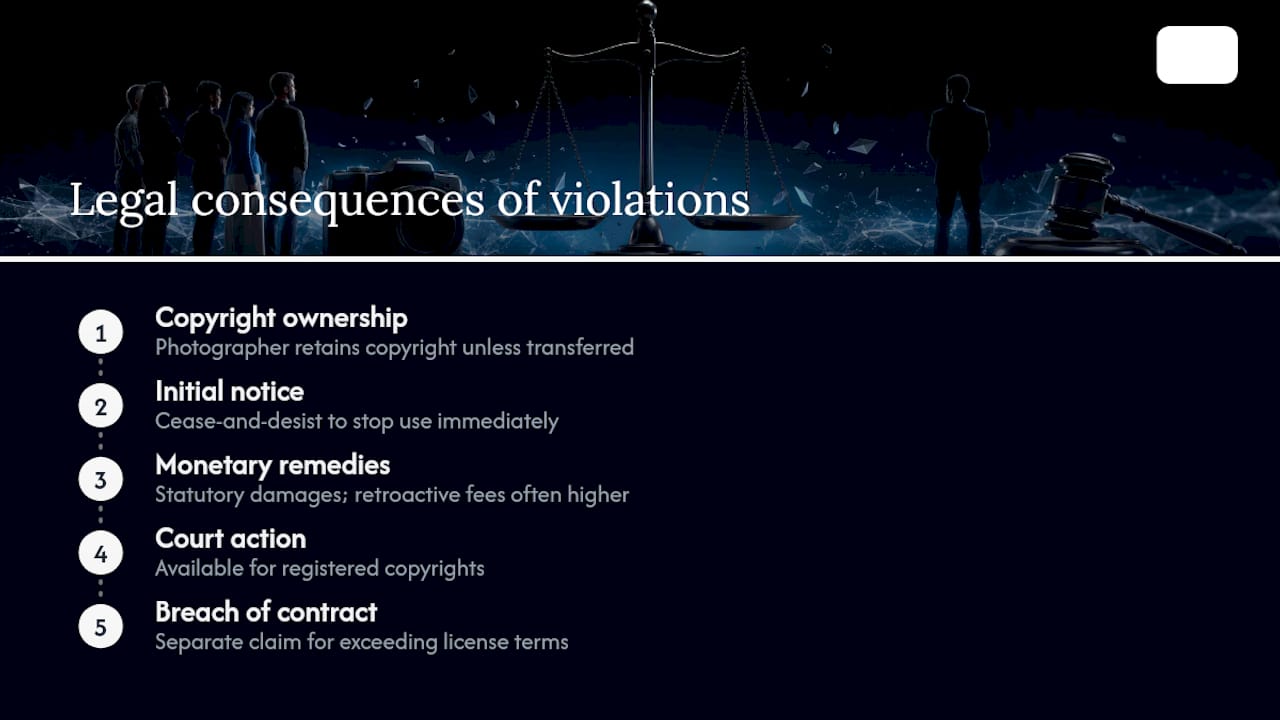
Using an image beyond its licensed terms, whether that’s extending a one-year license into year three or running a web-only license on a billboard, constitutes copyright infringement, not a minor contract slip. Photographers retain copyright ownership unless it was explicitly transferred in writing, and a license only grants specific, defined usage rights.
Consequences for unauthorized use typically escalate through a few stages. First comes a cease-and-desist notice demanding the client stop use immediately. If the unauthorized use continues or the damage is substantial, photographers can pursue statutory damages, back-licensing fees calculated at what the correct usage should have cost, and in cases involving registered copyright, additional legal remedies through court action. Retroactive licensing fees are often priced higher than what the client would have paid upfront, functioning as a penalty for the unauthorized use rather than a simple make-good.
Breach of contract terms, like violating an exclusivity clause or exceeding territory limits, opens a separate legal avenue even when copyright itself isn’t in question. A client who licensed regional use but ran a campaign nationally has breached the license agreement regardless of whether they credited the photographer correctly.
For clients, the practical lesson is straightforward: get everything in writing before publishing, and don’t assume a “similar” past project’s usage terms carry over to a new campaign. For photographers, documentation is your leverage. Save the signed license, the invoice describing exact usage terms, and any email exchange defining scope. Cost of photo permits and licensing fees paid upfront is almost always cheaper than the legal and reputational cost of an unauthorized use dispute later.
Does Photographer Reputation Change Licensing Prices?
Yes, and the effect is larger than most clients expect. A photographer or agency with a recognizable portfolio, awards, or a client roster that includes major brands can charge substantially more for equivalent usage terms than a less established photographer shooting the same brief.
Reputation functions as a risk reducer for the client. A brand hiring a well-known commercial photographer is paying partly for the image and partly for the confidence that the final work will meet a proven standard, reducing the odds of a reshoot or a campaign that underperforms creatively.
Agencies representing photographers add another layer. A boutique or premium agency negotiating on a photographer’s behalf typically holds firmer on rate cards and is less likely to discount usage fees under pressure, since the agency’s own reputation depends on maintaining consistent market pricing across its roster.
For photographers building toward higher rates, the practical path runs through visible, attributable work: published campaigns, credited editorial placements, and case studies that let a prospective client see exactly what their fee buys. For clients, reputation-based pricing is a legitimate cost of reduced risk, not padding, though it’s fair to ask what specifically justifies the premium for a given brief.
Do Modifications or Derivative Works Change the License Fee?
A license for the original photograph does not automatically cover modifications. If a client wants to crop, recolor, composite the image into other artwork, or create a derivative version for a different use, that typically requires either an expanded license or a separate negotiation, because derivative works can extend an image’s commercial life well beyond the original terms.
This matters most in three scenarios. First, when a client wants to use one licensed photo as the basis for multiple creative variations, such as recoloring it for different regional markets. Second, when a photo gets incorporated into a larger composite work, like a billboard design combining several licensed elements. Third, when AI-based editing tools are used to significantly alter or extend an image beyond its original composition, which raises open questions about how far the original license terms stretch.
The contract should state explicitly whether modifications are permitted, and if so, whether that permission is included in the base fee or priced separately. A safe default for photographers is to grant modification rights only for the specifically licensed use case, requiring a new negotiation for any derivative application not named in the original agreement. Clients benefit from this clarity too. Vague modification language creates uncertainty about what a legal team will later approve for reuse, and renegotiating after a campaign has launched is a worse position for everyone than settling terms upfront.
How Does Image Resolution Affect Licensing Fees?
Resolution and format shape licensing fees because they define what the client can actually do with the image, not just how it looks. A web-optimized JPEG at 72 DPI works for a blog post or social media graphic but cannot be enlarged for print without visible quality loss. A high-resolution TIFF or RAW file, by contrast, supports billboard-scale printing, magazine covers, and professional retouching workflows.
Licenses commonly tier pricing by delivered file specification. A lower-resolution web-only license costs less because it restricts the client to digital, screen-sized use. A full-resolution license priced for print or large-format display costs more because it unlocks broader technical capability, even if the actual usage terms (territory, duration) stay identical between the two tiers.
Format matters alongside resolution. RAW files, layered PSDs, or files with extended dynamic range typically command a premium over compressed JPEGs because they give the client editing latitude the compressed version doesn’t allow. Photographers should specify exact deliverable specifications in the contract (resolution, file format, color profile) rather than leaving “high resolution” as an undefined term, since that ambiguity is where scope disputes start. A client who receives a 4000 pixel wide JPEG and later needs a 20 foot banner print will find the file technically insufficient, regardless of what the license terms said about usage rights.
Why Do Model and Property Releases Affect Licensing Fees?
A model release, a signed document where a person appearing in a photo consents to its commercial use, isn’t optional paperwork; it’s often the difference between a licensable commercial image and one restricted to editorial use only. Without a release, an image featuring a recognizable person generally cannot be used in advertising, product packaging, or other commercial contexts, regardless of how good the license terms otherwise look.
Property releases work the same way for private property, distinctive architecture, or branded elements that appear in frame. A photo of a private home or a trademarked storefront may need a property release before a client can use it commercially, particularly for advertising.
This affects photo licensing fees in two ways. First, images with clean, verified releases carry more commercial licensing value because they open the door to advertising and product use, the highest-paying usage categories. Second, photographers who skip releases at the time of shooting often lose access to the most lucrative licensing opportunities later, since retroactively securing a release from a model or property owner months or years after the shoot is difficult and sometimes impossible. Building release collection into the shoot workflow, rather than treating it as an afterthought, protects the image’s full commercial licensing potential from day one.
Why Agencies Coordinate Rights Alongside Talent
Agencies request granular usage terms because a campaign’s value depends on controlling where talent and imagery appear, not just producing them. Photographers who clarify duration, territory, and exclusivity upfront build the kind of trust that leads to repeat bookings. For campaign-level talent and rights coordination, reach out to ANT Management.
Book Talent and Coordinate Usage Rights With ANT Management
ANT Management solves a problem most brands hit only after the shoot: talent and licensing terms negotiated separately, by different people, on different timelines. As a Dubai-based agency with reach across Europe, the US, and Asia, ANT Management coordinates model and talent bookings alongside the usage and exclusivity terms a campaign actually needs, so the creative team isn’t chasing releases and rights clauses after the images already exist.
That matters most on multi-market campaigns, where territory and exclusivity terms for talent need to align with the same variables governing the photo license itself. ANT Management’s curated roster spans fashion, commercial, and kid models, influencers, and creative talent, all vetted through the agency’s own selection process, with training support like ANT Camp behind the scenes for talent development. If your next campaign needs booked talent and coordinated usage terms handled as one process instead of two, visit the ANT Management modeling agency page to start the conversation.
Sources
- A Beginner’s Guide to Royalty-Free Licensing | Depositphotos
- Getty image request fees schedule
- Association of Photographers - usage calculator
- Commercial Photography Licensing Calculator | Price Your Usage Fees — ShootCost™