
Trade Show Staffing That Maximizes Your Booth ROI
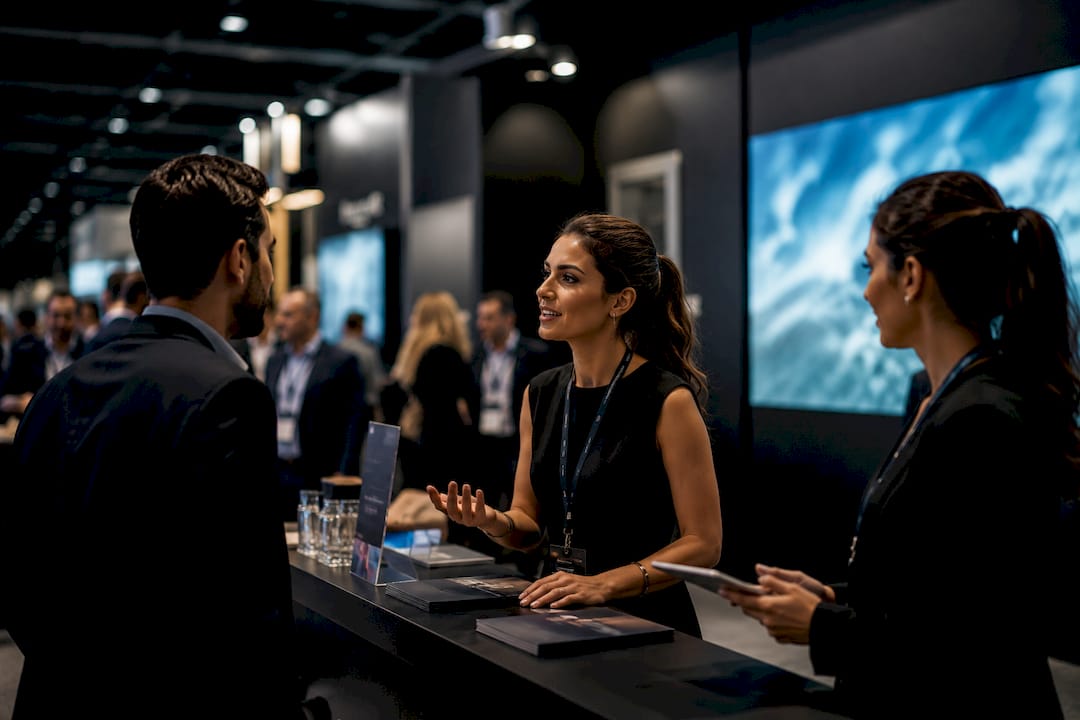
Hire a professional trade show staffing partner before anything else on your pre-show checklist. Specifically, ANT MANAGEMENT offers curated, trained talent with onsite account management and measurable KPI reporting, which means your booth operates as a precision instrument rather than a passive display. Book a consultation at least 8–12 weeks before move-in to secure the right roster, confirm travel logistics, and complete pre-show training on time.
Key Takeaways
Trained, managed trade show staffing is the highest-leverage variable in booth ROI, and booking a professional partner 8–12 weeks out is the single most important scheduling decision you will make.
| Point | Details |
|---|---|
| Book 8–12 weeks out | Staffing availability tightens during peak Q1 and Q4 show seasons; early booking secures the best talent. |
| Use the sq ft ÷ 50 rule | Divide booth square footage by 50 to calculate minimum staff at peak hours; a 10×10 needs two people. |
| Set KPIs before move-in | Define qualified conversations, hot leads per day, and next-step close rate before the show opens. |
| Require contracts and insurance | Every engagement needs a signed statement of work, a backup policy, and a general liability certificate. |
| Partner with Antmgmt | ANT MANAGEMENT provides curated talent, ANT Camp training, onsite account management, and post-show reporting. |
Table of Contents
What does trade show staffing actually cover?
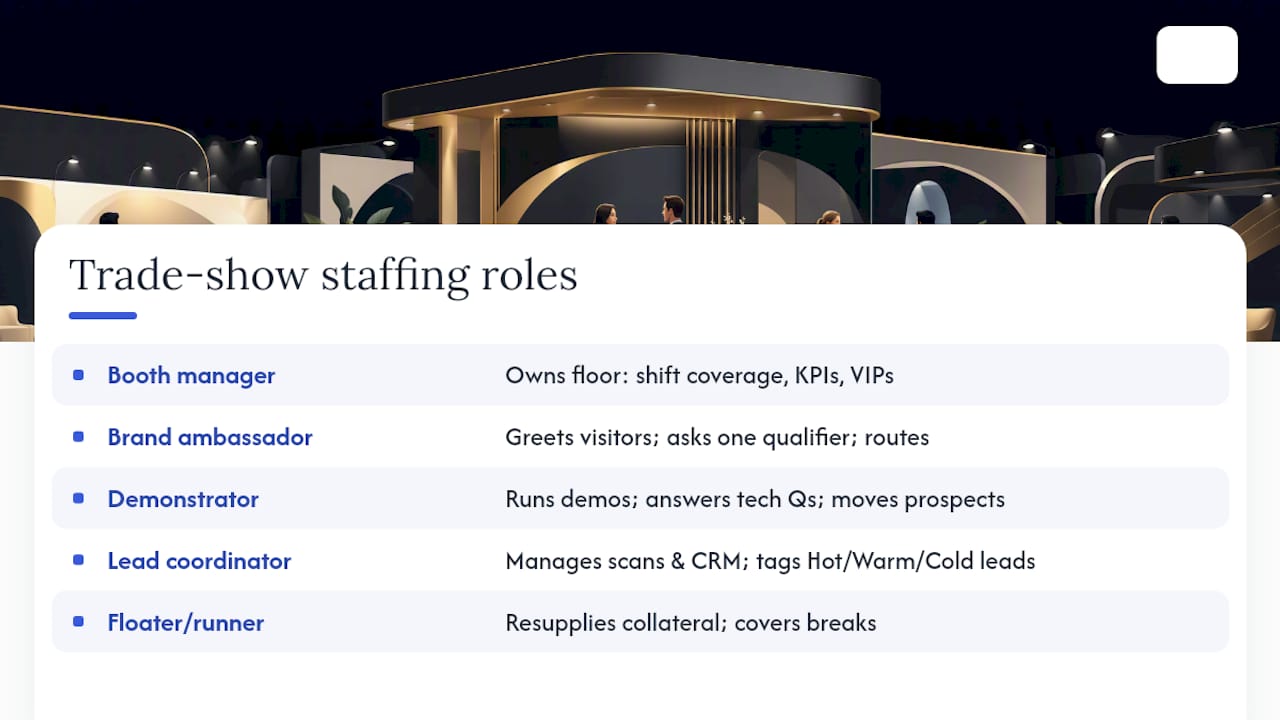
Trade show staffing is a managed service that delivers onsite brand representation, product demonstrations, lead capture, and event logistics support through a curated team of trained professionals. It is not simply “people at a booth.” Each role carries a defined function, and the quality of that function determines whether your booth generates qualified pipeline or just foot traffic.
Booth manager / onsite account manager. This person owns the floor. They coordinate shift coverage, escalate VIP conversations to your internal team, and track real-time KPIs. Success looks like zero coverage gaps and a clean end-of-day lead report.
Brand ambassador / host. The first face an attendee encounters. Their job is to open a conversation with a single, consistent qualifying question, then route the visitor to the right specialist. A single consistent opening question used by every staff member dramatically increases the signal quality of early conversations.
Demonstrator / product specialist. Runs live demos, answers technical questions, and moves prospects from curiosity to conviction. Success is measured in demo completions and next-step close rate.
Lead capture coordinator. Manages badge scanners, CRM inputs, and Hot/Warm/Cold tagging in real time. A missed scan is a missed opportunity, so this role requires both speed and precision.
Floater / runner. Handles resupply, collateral replenishment, and coverage during breaks. Often overlooked, always critical during peak hours.
Registration / guest services. Manages appointment check-ins, VIP arrivals, and hosted meeting logistics at larger exhibits.
AV / content capture. Photographs, films, and clips live moments for post-show content. Increasingly standard at island booths and product-launch activations.
Pro Tip: Assign each staff member a physical zone before move-in day. Clustering near the back of a 10×10 booth reduces visitor ingress and lowers qualified conversations. Zone maps prevent it.
How many staff do you need, and when should you book?
Staffing ratios by booth size
Booth staffing must match booth size and flow: a 10×10 is best served by one to two people, with two being optimal for moderate traffic. Three or more in a 10×10 actively reduces visitor ingress. A practical planning formula: divide booth square footage by 50 to get your minimum staff count at peak times.
| A 30×30 island booth should be staffed with a sizable team to cover all areas efficiently. |
Booking timeline
-
12 weeks out. Request staffing estimates, share booth layout and show objectives, begin agency vetting.
-
8–6 weeks out. Sign contracts, confirm roster proposals, finalize travel and hotel blocks.
-
4 weeks out. Complete background checks, confirm badge registration deadlines with the venue.
-
2 weeks out. Distribute pre-show brief, confirm shift schedules, finalize lead-capture tool access.
-
1 week out. Run a live pre-show briefing, confirm travel itineraries, assign zone maps.
Pro Tip: Plan four-hour shifts as your standard unit. Longer shifts degrade performance; shorter ones create handoff friction. Always schedule 15-minute overlaps between shifts so the outgoing team can brief the incoming one. Build at least one backup per role for shows longer than two days.
What does professional trade show staffing cost?
Pricing structures vary by agency model and show complexity. Hourly rates for trained brand ambassadors vary significantly based on market, experience, and specialization. Day rates for managed teams (including an onsite account manager) are quoted as package fees that bundle talent, coordination, and reporting.
| Budget Line Item | Notes |
|---|---|
| Hourly / day rates | Per staff member, per shift |
| Agency coordination fee | Typically a percentage of total talent fees |
| Travel (flights, ground) | Client or agency arranged; confirm in contract |
| Hotel / per diem | Per staff member, per night |
| Badge and exhibitor fees | Venue-specific; confirm with show management |
| Insurance surcharge | General liability; request certificates |
| Training / pre-brief time | Billed separately or bundled in package |
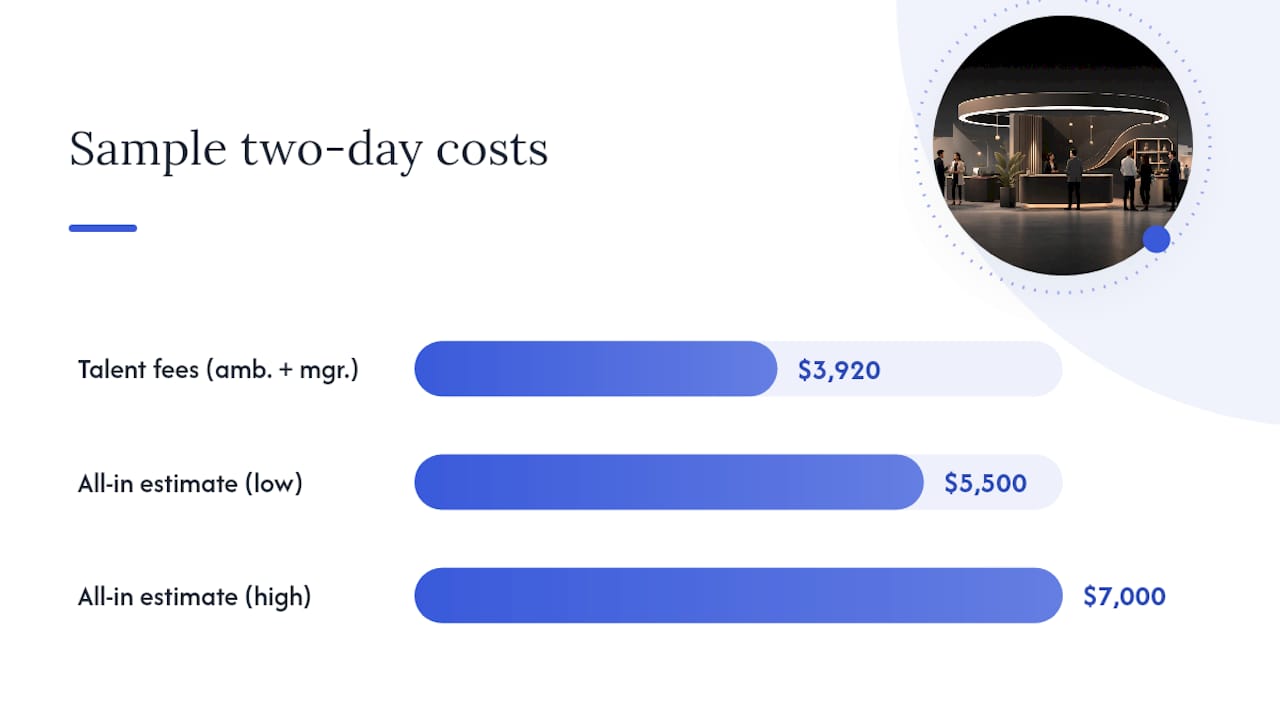
Sample two-day show estimate: Four brand ambassadors at $45/hour for eight hours each day equals $2,880 in talent fees. Add an onsite account manager at $65/hour for the same period: $1,040. Agency coordination, travel, per diem, and badge fees typically add 40–60% on top of base talent costs. A realistic all-in budget for this scenario runs $5,500–$7,000 before any AV or content capture.
Pro Tip: Consolidate travel by booking staff from the host city when the talent pool supports it. Local vetted talent eliminates flights, reduces per diem, and cuts total cost by 20–30% on regional shows without sacrificing quality.
How do you choose and vet a staffing partner?
Decision criteria checklist
-
Structured training program (e.g., ANT Camp) with documented curriculum
-
Background checks and verifiable references for all placed talent
-
Portfolio of case studies from comparable shows and industries
-
Dedicated onsite account manager included in the engagement
-
Written N+1 backup policy covering same-day replacements
-
General liability insurance with certificates available on request
-
Defined KPI reporting delivered post-show
RFP questions to send every vendor
-
Walk me through your standard staffing and vetting process from inquiry to show day.
-
What does your pre-show training program cover, and how is it delivered?
-
What are your standard contract terms, cancellation policy, and force majeure clause?
-
What liability coverage do you carry, and can you provide a certificate of insurance?
-
What is your backup policy if a confirmed staff member cancels within 48 hours?
-
How do you integrate with our lead-capture platform (badge scanner, CRM)?
-
Can you provide two references from shows of similar size and format?
Red flags to watch for
No references, no pre-show briefing protocol, no backup policy, and vague reporting commitments are the four clearest signals that a vendor will underperform when it matters most. A partner who cannot describe their training curriculum in specific terms has no curriculum.
On price versus trust: for strategic shows where qualified pipeline is the primary objective, pay for reliability. For low-stakes regional demos where brand exposure is the goal, a local temp with a solid brief can perform adequately. Never apply the budget-first logic to a product launch or a flagship industry event.
How do you brief, train, and measure staff performance?
The short answer: one consistent opening, defined qualification questions, and a Hot/Warm/Cold framework agreed upon before anyone steps on the floor.
KPI framework for exhibit display staff
| KPI | Definition | How to Measure |
|---|---|---|
| Qualified conversations / day | Conversations that reach the qualification question | Staff tally + lead scan count |
| Hot leads / day | Prospects tagged Hot in the lead tool | CRM export end of day |
| Next-step close rate | % of conversations with a confirmed follow-up | Hot leads ÷ total conversations |
| Presence compliance | % of scheduled shift time on the floor | Real-time check-in tool |
Event measurement frameworks standardize these metrics and improve cross-show comparisons, making it possible to benchmark staff performance across multiple events rather than evaluating each show in isolation.
Pre-show briefing template
Cover six topics in every briefing: show objective and target attendee profile, the opening script every staff member will use, qualification questions and how to listen for buying signals, the lead capture process and tagging protocol, escalation procedure for VIPs and press, and end-of-day handoff expectations.
Sample daily onsite schedule
The day opens with a 15-minute stand-up before doors: account manager reviews the previous day’s lead count, confirms zone assignments, and addresses any script adjustments. Shift one runs through the morning peak; the 15-minute overlap at the midpoint allows the incoming team to absorb any live intelligence. A midday debrief of 10 minutes resets priorities for the afternoon. The day closes with a structured handoff: lead data synced, hot prospects flagged for follow-up, and a brief account manager summary sent to the client contact. Scheduling these touchpoints in fixed 15-minute slots keeps coordination tight without pulling staff off the floor for extended meetings.
U.S. logistics and compliance: what you must handle
Contract checklist
-
Signed statement of work covering roles, hours, and deliverables
-
Cancellation and force majeure clauses with clear fee schedules
-
Payment terms (deposit, balance, and invoice timing)
-
Replacement policy for no-shows and same-day cancellations
-
Confidentiality clause for new product demos and unreleased materials
Insurance and badge checklist
-
Request a certificate of general liability insurance (minimum $1 million per occurrence is standard for most U.S. venues)
-
Confirm whether the venue requires an additional insured endorsement naming the exhibitor
-
Badge registration deadlines vary by show; late registration often incurs surcharges or badge-pickup delays
-
Contractor badges at venues like the Javits Center require advance registration through show management, not the venue directly
Travel and logistics
Staff should arrive in the host city the evening before move-in, not the morning of. Hotel proximity to the venue reduces latency during early load-in. Shared travel arrangements, coordinated by the agency, cut cost and reduce the risk of individual delays cascading into coverage gaps. Confirm in the contract who arranges and pays for travel: client-arranged travel gives more control; agency-arranged travel simplifies logistics but requires clear reimbursement terms.
For shows in major metros, visitor volume context matters. NYC’s 2024 year-end tourism data illustrates the scale of foot traffic that large-city conventions draw, which directly informs how aggressively you staff peak hours. During high-season conference weeks, staffing availability tightens across the market. The Inc. 5000’s 2025 growth data reflects the broader business expansion driving that demand, which is why booking 10–12 weeks out is not a suggestion but a practical necessity during Q1 and Q4 show seasons.
Why trained, managed talent outperforms ad-hoc staffing
The conventional wisdom in event planning treats staffing as a commodity line item: find warm bodies, hand them a product sheet, and hope for the best. That framing misunderstands what a booth actually is. A booth is not a display; it is a live sales environment where every conversation either advances a relationship or ends one. The difference between a trained brand ambassador and an untrained temp is not a matter of polish. It is a matter of whether your qualified leads double or stagnate.
Antmgmt’s approach centers on curation before deployment. Every talent placed through ANT MANAGEMENT is selected through a rigorous process, trained through structured programs like ANT Camp, and supported by an onsite account manager who tracks KPIs in real time. The result is a team that arrives knowing your product, your qualification criteria, and your escalation protocol, not one that learns it on the floor at the cost of your first-day leads.
The measurable outcome of this model is a higher next-step close rate and a cleaner lead file. A booth that captures 200 badge scans with 40% tagged as Hot delivers more pipeline than one that captures 400 scans with no qualification layer. Trained staff create that distinction.
Antmgmt delivers staffed, managed trade show teams
Antmgmt offers the alternative to assembling a booth team from scratch. Rather than sourcing, vetting, training, and managing talent yourself, you receive a fully managed staffing solution: curated brand ambassadors, demo specialists, lead capture coordinators, onsite account management, and post-show KPI reporting, all under one engagement.
The booking process moves in five clear steps. You submit a staffing request with your show details and objectives. Antmgmt returns a roster proposal with talent profiles matched to your brief. Pre-show training is delivered through ANT Camp and a structured briefing session. On show days, an onsite account manager runs the floor and tracks performance in real time. After the show, you receive a post-show report with lead data, KPI results, and recommendations for the next event.
Trust signals built into every engagement include background-checked talent, verifiable case studies, insurance certificates, and a written backup policy. Book your staffing consultation now to confirm availability for your next show.