
Stop Set Shutdowns: On Set Crisis Management That Keeps Shoots Running

When a crisis hits a film set, the incident commander (a preassigned line producer, UPM, or safety officer) takes control within minutes, backed by a scribe logging every decision. The first priority is always people: secure the injured or endangered, contain the hazard, preserve the scene for review, and open an internal communication line. From there, the team activates whichever prewritten response module fits the situation, whether that’s medical, lockdown, or evacuation, and begins hourly stand-ups until things stabilize.
TL;DR:
- The risk assessment matrix helps prioritize hazards based on likelihood and severity to determine the appropriate controls, from elimination to personal protection.
- Scheduling tactics, such as tagging swap-ready scenes and maintaining contingency contacts, enable quick adaptations and prevent delays during disruptions.
- Prewritten, modular response plans with designated owners streamline action during emergencies, reducing confusion and saving valuable response time.
- A core crisis team with preassigned roles and decision rights ensures rapid activation and effective management within the first critical hour.
- Maintaining multiple communication channels, including radios and shared documents, and conducting regular crisis drills improve response consistency and organizational learning.
Table of Contents
- What Counts as an On-Set Crisis, and How Do You Assess the Risk?
- Scheduling Tactics That Absorb the Hit Before It Lands
- Building Modular Response Plans That Activate Fast
- Who Runs the Room: Crisis Team Roles and the First Hour
- Keeping the Message Straight: Command Post and Communication Lines
- Drills, Recovery, and the Post-Crisis Review That Actually Changes Anything
- What Talent Readiness Has to Do With Crisis Prevention
- How ANT Management Helps Productions Stay Ready, Not Just Reactive
- Sources
- FAQ
What Counts as an On-Set Crisis, and How Do You Assess the Risk?
Crisis management on set covers a wide range of incidents: medical emergencies, firearms or pyrotechnic malfunctions, rigging and equipment failures, extreme weather, labor disputes, and hazardous materials exposure. Each carries a different tempo and a different chain of response.
The fastest way to triage any of these is a 5x5 likelihood times severity matrix, a tool borrowed from formal risk assessment practice that scores hazards on how likely they are and how badly they’d hurt if they happened. Once a hazard is scored, apply the hierarchy of controls in order:
- Eliminate the hazard outright when possible (cut the stunt, skip the location).
- Substitute a safer method, prop, or route.
- Add engineering controls like barriers, rigging redundancy, or fire suppression.
- Layer in administrative controls: briefings, permits, restricted zones.
- Fall back on personal protective equipment only after the first four are exhausted.
Scheduling Tactics That Absorb the Hit Before It Lands
The schedule itself is a mitigation tool, not just a production document. Resilient scheduling identifies alternative shoot days and reorderable sequences long before anyone needs them, a discipline that industry analysis consistently flags as decisive when productions have to recover from a disruption.
Build these habits into every shoot day:
- Tag high swap-ability scenes on the call sheet so a location loss or weather delay doesn’t stall the whole unit.
- Use block-shooting and maintain standby cast and equipment lists to absorb last-minute changes without a full stop.
- Keep backup location and vendor contacts on file, and build contingency windows directly into the production timeline.
Pro Tip: Mark swap-ready scenes on your shot list before day one, not after the first disruption. A pre-tagged shot list turns a scramble into a five-minute schedule swap.
Building Modular Response Plans That Activate Fast
A response module is a self-contained plan with a trigger, an owner, a set of immediate steps, and a clear all-clear signal. Formal guidance on crisis response planning recommends building these as interchangeable blocks rather than one monolithic document, since real incidents rarely match a single script.
Common modules every production should have on file:
- Medical module. Trigger: injury or illness on set. Owner: safety/medical lead. Steps: stabilize, call EMS, notify production office, log timeline.
- Evacuation module. Trigger: fire, structural failure, severe weather. Owner: assistant director or safety officer. Steps: sound the signal, clear to muster point, headcount, hold until all-clear.
- Lockdown module. Trigger: security threat, weapon discharge, intruder. Owner: incident commander. Steps: freeze movement, seal access points, contact law enforcement.
- External communications module. Trigger: any incident likely to reach media or social platforms. Owner: communications lead. Steps: hold statement, single spokesperson, no unauthorized comment.
- Safety isolation module. Trigger: equipment or rigging failure. Owner: department head involved. Steps: clear the zone, tag out equipment, inspect before resuming.
An accidental weapon discharge, for example, triggers lockdown, medical, and external comms simultaneously. Only preassigned leads can authorize activation. That rule alone prevents the confusion that costs the most time in a real emergency.
Who Runs the Room: Crisis Team Roles and the First Hour
A small, well-drilled team chosen for judgment beats a larger one chosen for title. The core roles are the incident commander, communications lead, operations or impact lead, safety and medical lead, and a scribe, each with a named backup in case someone is unreachable or too close to the incident to lead.
Decision rights need to be settled before anyone needs them, not during the incident:
- Who has the authority to shut down the set.
- Who approves any public or media statement.
- Who calls external emergency services and coordinates with them on arrival.
A structured incident-command approach assigns these roles and authorities in advance, which removes the debate that otherwise eats the first critical minutes.
The cadence that follows matters as much as the roles. Minute zero to sixty: secure the scene, assess injuries, and activate the matched module. Hours one through six to twelve: hourly stand-ups with the same core team. After that, step the frequency down as the situation stabilizes, usually to twice daily, then once daily.
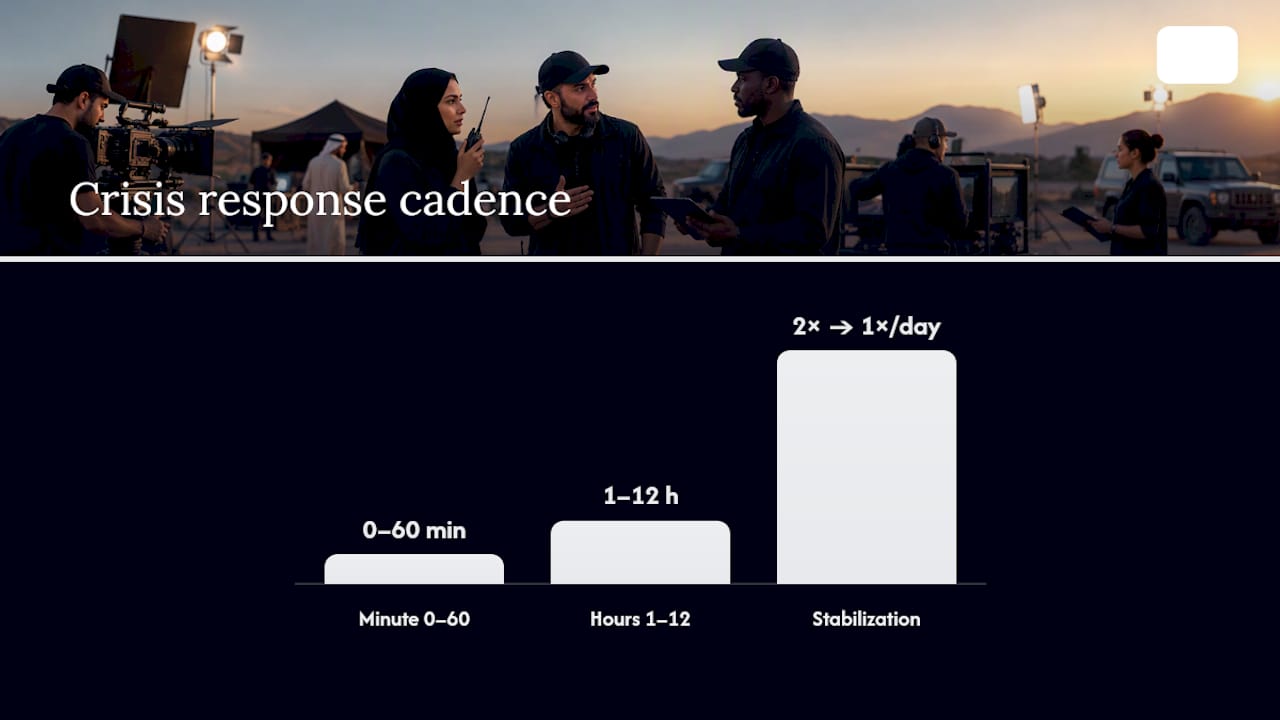
Pro Tip: Preassigned roles and a scribe prevent time loss during initial activation. Write both names on the call sheet every single day, even on shoots with no history of incidents.
Keeping the Message Straight: Command Post and Communication Lines
Every crisis needs three separate messaging tracks, each with a named owner and approver: internal operational updates for cast and crew, external stakeholder updates for financiers and studios, and media or social messaging for public-facing statements. Mixing these tracks is how contradictory information leaks and turns a manageable incident into a credibility problem.
Redundancy protects the message when the primary channel fails:
- Radios as the default, with a phone tree as backup for anyone off-channel.
- A check-in webpage or shared document where crew confirm status without flooding a single line.
- Prewritten templates for the most common incidents, drafted before anyone needs them, not during.
The command post itself needs a checklist: working connectivity, a current contact list, a physical or digital situation board, and an off-site backup location if the primary post becomes unusable. A setup like technical redundancy for live events applies directly here: power and AV backups aren’t optional extras, they’re what keeps the command post functioning when the main system drops.
Drills, Recovery, and the Post-Crisis Review That Actually Changes Anything
Run scenario-driven live drills at least twice a year, and treat role-play exercises built for other high-pressure industries as a model worth adapting for set-specific scenarios like evacuation or medical response.
The recovery period, days four through thirty according to standard crisis action plan formats, is where the real organizational learning happens.
- Remediation. Fix the physical or procedural cause, whether that’s equipment, training, or a location hazard.
- Stakeholder follow-up. Update insurers, studios, and any affected cast or crew members directly.
- Communications wrap-up. Close the loop with any external parties who received a statement during the incident.
- Documentation and training updates. Feed the incident into the next round of briefings and plan revisions.
A disciplined post-crisis review reconstructs the timeline, names the lessons, assigns an owner to each action item, and updates the written plan. Skip this step and the same incident tends to repeat, usually on a different department’s watch.
What Talent Readiness Has to Do With Crisis Prevention
ANT Management has watched confusion on set trace back to the same root cause again and again: talent who show up without a real briefing. A model or performer who understands blocking, safety zones, and the chain of command before cameras roll removes a whole category of near-misses before they start.
Rigorous pre-shoot briefings, documented sign-offs, and a short safety rehearsal cost almost nothing and catch problems paperwork alone never will. As an agency working across production crew roles and global markets, readiness is built into bookings rather than being an afterthought once talent arrives.
— ANT
How ANT Management Helps Productions Stay Ready, Not Just Reactive
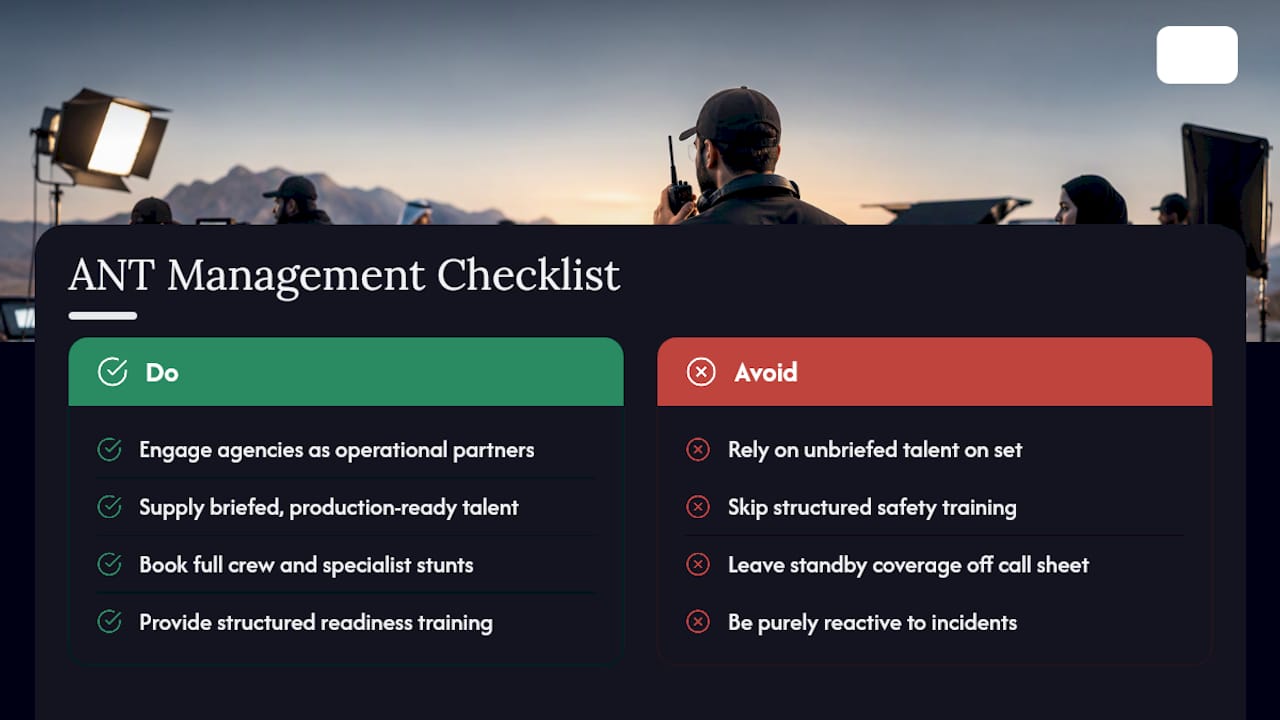
A crisis plan is only as strong as the people executing it, and that’s where staffing choices start paying off long before anything goes wrong. Some agencies work as operational support partners for productions, supplying briefed, production-ready talent alongside full production crew booking and specialist stunts booking for sequences that carry real physical risk.
Some training programs exist specifically to close the readiness gap: talent who’ve been through structured preparation walk onto set already familiar with safety protocols, blocking discipline, and chain-of-command basics, which cuts down on the confusion that turns a minor hiccup into a real incident. Some agencies coordinate event staffing and full crew placement for productions that need reliable standby coverage built into the call sheet from day one.
If your next shoot involves stunts, a large cast, or any elevated physical risk, consider contacting a professional agency to discuss staffing and build a readiness checklist for your specific production before cameras roll.
Sources
For deeper templates, review the ten elements of an effective crisis response plan, a 72-hour to 30-day action plan format, and a workplace risk-assessment template adaptable to any set.
- Your crisis response plan: the ten effective elements (Harvard Business School Working Knowledge)
- Actionplantemplate
- Navigating crises in film production: The power of scheduling (Filmustage blog)
FAQ
What Are the 5 P’s of Crisis Management?
Common versions of the framework cover Prevention, Preparedness, Practice, Performance, and Post-crisis review, though definitions vary by source. On set, this maps to risk assessment, written response modules, drills, first-hour execution, and the disciplined review that follows an incident.
What Are the 5 Steps of Crisis Management?
Most models follow a sequence: identify the risk, assess and prioritize it, activate the matching response module, communicate through controlled channels, and review afterward to update the plan. Each step mirrors the modular response structure outlined for production crews above.
What Are the 5 C’s of Crisis Communication?
Definitions vary across industries, but a widely used version includes Clarity, Consistency, Compassion, Control, and Candor. On a film set, that translates to a single approved spokesperson, one message across all three tracks (internal, stakeholder, and media), and no unauthorized comment while facts are still being confirmed.
What Are the Essential Elements of a Crisis Management Plan for a Film Set?
A working plan needs preassigned roles and backups, a risk matrix for triage, modular response plans with clear activation triggers, redundant communication channels, a command post checklist, and a scheduled post-crisis review. The 72-hour to 30-day format is a practical way to structure the acute response and the recovery phase that follows.
Does ANT Management Help With Crisis Readiness on Set?
ANT Management supports readiness through briefed, production-ready talent, full production crew booking, and stunt coordination for higher-risk sequences. Pricing for these services is available on request through the agency’s booking page.