
Land Paid UGC Creator Work in 30–90 Days, Verify Demand, Shoot 5 Specs
You do not need followers to become a UGC creator. Brands pay for the finished video file, not for your audience, and more than half of UGC opportunities carry no follower requirement at all. The fastest way in: pick one niche tonight, shoot three spec pieces this weekend, put them on a single portfolio link, and start pitching by Monday. Expect starter rates of $75 to $300 per video once that first client says yes.
TL;DR:
- Over 54% of UGC opportunities do not require followers, as brands buy actual content files, not access to an existing audience.
- Demand validation through ad library checks is crucial before shooting, with five or more active brands indicating genuine market interest in a niche.
- Building a portfolio with five core formats and hosting it on a simple link streamlines client assessment and improves hiring chances.
- Beginner rates typically range from $75 to $300 per video, with usage rights and exclusivity commanding additional premiums.
- Consistent pitching and tracking metrics, such as reply rate and deals closed, are essential to scaling from initial gigs to higher rates and direct relationships.
Table of Contents
- What a UGC Creator Actually Does (and Why Followers Don’t Matter)
- How Do You Choose a Niche With Real Brand Demand?
- How Do You Build a Spec Portfolio That Gets You Hired?
- Gear, Audio, and Editing That Make a Phone Shoot Look Professional
- Marketplaces vs. Direct Outreach vs. Agency Rosters: Which Gets You Paid Fastest?
- What Should You Charge, and What Contract Terms Protect You?
- Your 30 to 90 Day Plan to Land Paid UGC Work
- When Does Agency Representation Actually Speed Things Up?
- Treat UGC Like a Small Production Business, Not a Hobby
- Explore Training and Roster Opportunities With ANT Management
- Sources
- FAQ
What a UGC Creator Actually Does (and Why Followers Don’t Matter)
A UGC creator produces raw, native-feeling video content for brands to use in paid ads, on product pages, or across their own social channels, not the creator’s own feed. That distinction matters more than most beginners realize. An influencer sells access to an audience they already built. A UGC creator sells a file. The brand owns the placement; you own the production.
This is why the follower obsession is misplaced. Research on the UGC market found that over 54% of opportunities are open to creators regardless of follower count, because the client is buying a piece of content to run through their own ad accounts or website, not a distribution channel. A brand running Meta ads does not care if you have 40,000 TikTok followers. It cares whether the fifteen-second clip you send them stops a thumb mid-scroll.
What brands actually screen for when they hire a creator with no track record:
- A strong hook in the first three seconds, because platform-native attention drops off fast and a slow opener kills the whole asset.
- Evidence you can read a brief and hit the talking points without sounding scripted.
- Reliability: turning around a revision or reshoot within the agreed window.
- A native feel for whichever platform the content is destined for, since a TikTok-style edit dropped into a Meta feed ad reads as off.
Coursera’s breakdown of the UGC creator role frames the job as closer to freelance production than influencing: storytelling ability, brief literacy, and a simple portfolio matter more than reach. That reframing is the standard industry term worth holding onto: you are not building an audience, you are running a small content production shop.
How Do You Choose a Niche With Real Brand Demand?
Pick a niche based on evidence that brands are already spending money in it, not based on what feels fun to film. Score any candidate niche against three questions before you shoot a single sample: is there live paid demand, do you have a believable reason to talk about this category, and does it produce repeat business rather than one-off gigs?
Checking demand takes fifteen minutes. Open TikTok Creative Center and search your candidate category, looking for spark ads that clearly use creator-style footage rather than polished brand production. Cross-reference with Meta Ad Library, filtering by category and scanning for the same handheld, testimonial-style format. If five or more active brands in a category are running that kind of ad right now, the demand is real, not theoretical.
A quick scoring pass on three common starter niches looks like this:
| Niche | Live ad demand | Your credibility | Repeat potential |
|---|---|---|---|
| Skincare and beauty | High | Medium (needs routine, honest results) | High (subscription products) |
| Home and kitchen gadgets | High | High (anyone can demo) | Medium |
| Fitness supplements | Medium | Medium (needs some fitness context) | High (recurring purchases) |
Pro Tip: Search your candidate niche plus “spark ad” or “creator” directly on the platform’s own search bar before checking any ad library. Half the demand signal is just seeing how saturated the format already is.
A five-step career path outlined by Playcut starts with exactly this: validate demand before you invest a weekend of shooting into a niche nobody is buying for. Pick one to three niches from your scoring pass, not five. Depth beats breadth when you have zero track record.
How Do You Build a Spec Portfolio That Gets You Hired?
Five formats cover almost every paid brief you will encounter, and building one sample in each gives you a portfolio that reads as production-ready rather than amateur. Shoot these five:
- Talking-head review — you, camera, product, honest opinion delivered in under 45 seconds.
- Problem to solution — open on the annoyance, cut to the product solving it.
- Demo — show the product doing the thing it claims to do, nothing staged.
- Unboxing — first impressions, packaging, first use, all in one continuous feel.
- Testimonial — result-focused, framed as “here’s what changed since I started using this.”
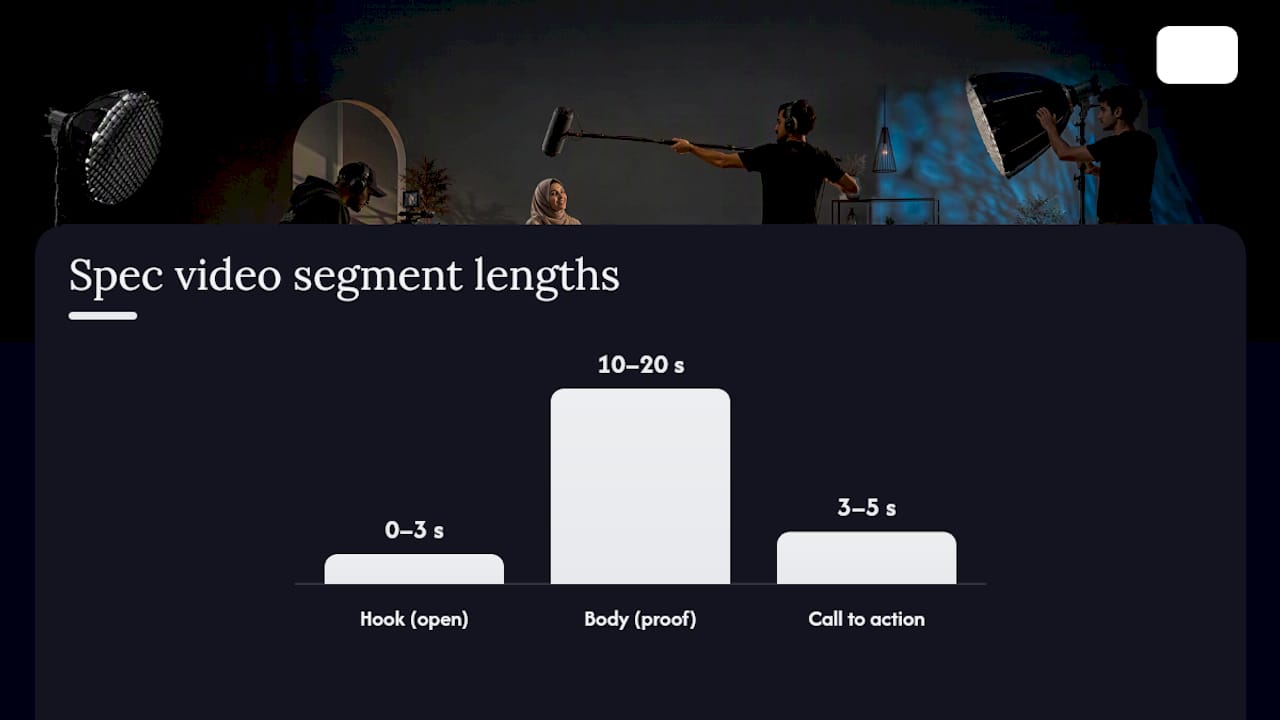
Structure every one of them the same way internally: a hook in the first zero to three seconds that states the problem or makes a bold claim, a body of ten to twenty seconds that delivers the proof, and a clear call to action in the last three to five seconds. Vertical 9:16 covers most briefs, though shooting a quick horizontal crop of your best piece costs nothing extra and covers the occasional YouTube or landing-page request.
Host the finished set (aim for five to ten pieces, per CollabKit’s spec-work guidance) somewhere a brand can scan in under thirty seconds. A single Notion page or a one-page link works better than a polished personal website, because a busy brand marketer is not going to click through five tabs to judge your work. Label anything shot without a real product relationship as spec work, and label any AI-assisted variant clearly as such. Brands that catch an undisclosed AI clip lose trust in the whole portfolio.
Once you land your first paying client, swap that niche’s weakest spec piece for the real, paid deliverable. Your portfolio should always be trending toward proof of actual client work, not a growing pile of unpaid samples.
Gear, Audio, and Editing That Make a Phone Shoot Look Professional
You need less equipment than you think. A smartphone, a $20 to $30 lavalier microphone, and a spot near a window will get you to a professional-looking baseline for under $100 total.
- Audio is the single fastest quality upgrade available. A clipped-on lav mic instantly separates your footage from anything shot on a phone’s built-in mic, which picks up room echo and background hum.
- Shoot facing a window during daylight hours before reaching for a ring light. Natural light from the side, not straight on, gives your footage dimension that a flat ring light flattens out.
- Frame with a simple rule: keep your eyes in the top third of the frame, leave headroom, and check your background for clutter before you hit record.
- Edit in CapCut, using quick jump cuts to remove dead air between phrases. Most brands request a vertical 1080x1920 export in MP4 format.
- Name your files clearly (brand_niche_version_date) and hand off both the raw and edited version when a brief asks for it. Confusing file names are a quiet reason brands don’t call a creator back.
Marketplaces vs. Direct Outreach vs. Agency Rosters: Which Gets You Paid Fastest?
Run all three channels at once rather than picking one, because each solves a different problem in your first ninety days. Marketplaces get you paid fast at lower rates. Direct outreach takes longer to convert but pays significantly more once it lands. Agency rosters sit in between, trading some rate ceiling for consistent booking flow.
Marketplaces (fast entry, lower ceiling):
- Approval is usually quick, often within a few days of applying with your portfolio link.
- Rates tend to sit near the lower end of the starter band, since the platform is optimizing for volume, not premium pricing.
- Good for your first three to five paid jobs and for building reviews you can screenshot into future pitches.
Direct outreach (slower, higher payoff):
- Cold outreach converts at a low rate, which means volume is the job, not a side task.
- A daily outreach cadence of five to ten pitches keeps a pipeline moving instead of stalling out after a slow week.
- Deals landed this way skip the marketplace’s cut and let you negotiate usage rights directly.
Agency rosters (consistency, some rate trade-off):
- Agencies vet creators before adding them, which means gigs arrive with less negotiation but also less searching on your end.
- Brands increasingly hire through vetted creator platforms and rosters specifically because it removes the guesswork of screening cold applicants.
A two-line pitch template that works across all three channels: line one states who you are and what you make (“I create short-form product demo content for skincare brands”), line two states the ask and drops the link (“Here’s my portfolio, happy to send three custom concepts for [brand]: [link]”). Keep it to two lines. A long pitch reads as desperate; a short one reads as someone who already knows what they’re doing.
Pro Tip: Screenshot the actual ad you found on the brand while researching demand, and reference it in your pitch. “I noticed your spark ad running on TikTok, here’s a concept that builds on that angle” converts far better than a generic cold intro.
What Should You Charge, and What Contract Terms Protect You?
Price the video first, then price the rights separately, because those are two different products even though they come from one shoot. Beginner rates typically run $75 to $300 per video, with established creators and direct-deal negotiators commanding $400 to $1,000 or more once they have a track record and case studies to point to.
Package your pricing three ways instead of quoting a single number every time:
- Single video: your base rate, organic usage only, for the brand’s own page or story.
- Bundle: three to five videos at a modest per-piece discount, which brands like because it saves them a second round of briefing.
- Retainer: a monthly volume commitment, priced lower per piece but valuable to you because it removes the outreach grind for that slot.
Usage rights are where real money gets left on the table by beginners. Organic-only usage (the brand’s own social pages) should sit at your base rate. Exclusivity (the brand blocking you from working with competitors in that category) is a separate premium on top of that, not something to give away for free.
Before you sign anything, confirm five contract terms in writing: exact deliverables and formats, turnaround time, payment terms (ideally 50% upfront on larger bundles), number of included revisions, and a licensing clause spelling out where and how long the brand can use the footage. A clear creator brief upfront prevents most of the disputes that show up later over reshoots and scope.
Your 30 to 90 Day Plan to Land Paid UGC Work
Work in weekly blocks rather than trying to do everything in the first seven days. This calendar assumes you’re starting from zero:
- Week 1: Validate your niche using TikTok Creative Center and Meta Ad Library, score your top three options, and lock one.
- Week 2: Shoot three to five spec pieces across the five core formats and build your one-page portfolio.
- Week 3: Apply to two or three marketplaces and start sending five direct pitches per day.
- Weeks 4 to 6: Keep the daily pitch cadence going, track replies in a simple spreadsheet, and take your first marketplace jobs as they land.
- Weeks 7 to 9: Swap your weakest spec sample for a real paid deliverable, and start pitching slightly higher-tier brands with that proof in hand.
- Weeks 10 to 12: Raise your base rate by 20% to 30% once you have three completed paid jobs, and shift more of your time toward direct outreach over marketplace applications.
Track four numbers weekly: pieces produced, pitches sent, reply rate, and paid deals closed. If pitches are going out but replies aren’t coming, the problem is usually the hook in your portfolio’s top sample, not the volume of outreach. Fix the sample before you fix the pitch count.
When Does Agency Representation Actually Speed Things Up?
Representation helps once you’ve proven you can produce and deliver reliably, and it helps less before that point. An agency’s value is in three things: structured training that shortens the learning curve, access to a vetted roster that brands already trust enough to hire from without a cold screening, and project management that handles contracts, licensing terms, and scheduling so you’re not negotiating usage multipliers solo on every deal.

Training programs can close the gap between a creator with a decent phone camera and one who understands lighting, brief-reading, and delivery standards well enough that a brand hires them twice. Beyond training, being on a curated roster changes how brands run their hiring and casting process: instead of you cold-pitching into a crowded inbox, the brand is selecting from a pool that’s already been vetted for reliability.
Representation makes the most sense once you’re past your first handful of paid jobs and hitting a ceiling on rates or deal complexity, particularly around paid-ad usage licensing and exclusivity terms. If you’re still validating a niche or shooting your first spec pieces, staying freelance and building your own pipeline is the faster move. Agencies scale a creator who already has proof; they don’t manufacture proof from nothing.
- Training that compresses months of trial and error into a structured program.
- Roster access that puts you in front of brands actively casting, rather than cold-pitching blind.
- Contract and licensing support on the usage-rights terms that trip up solo creators most often.
Treat UGC Like a Small Production Business, Not a Hobby
The creators who make this work past the first few gigs stop thinking of themselves as content makers and start thinking like a small production business with a pipeline. That mental shift changes daily behavior. You track outreach the way a sales team tracks a funnel: pitches sent, replies received, deals closed. You deliver on the date you promised, every time, because a missed deadline is the fastest way to lose a repeat client in this business.
Ask for a result after every project, not just a payment. Did the ad perform? Did the brand run it longer than planned? That feedback tells you which hooks and formats are actually working, and it’s the fastest way to sharpen your next pitch. Consistency beats intensity here. Five pitches a day for sixty days will outperform fifty pitches crammed into one frantic weekend, because brands respond on their own schedule, not yours.
Experiment, but measure the experiment. Try a new hook style for a week, track the reply rate, keep what works and drop what doesn’t. That’s a production discipline, not a creative one, and it’s the difference between a creator who’s still pitching cold six months in and one who’s raising rates.
— ANT
Explore Training and Roster Opportunities With ANT Management
If the pipeline grind of cold outreach and marketplace applications sounds like a slower path than you want, structured training paired with roster access to brands actively casting for talent and creators can cut out months of the cold-pitching cycle described above.
That combination matters most once you’ve got a few spec pieces done and want feedback and placement rather than more solo trial and error. Before applying, be honest about where you are: if you haven’t shot anything yet, spend a week building your first three samples so you have something to show. If you already have a small portfolio and want faster access to paid bookings and clearer licensing terms on your work, representation is worth exploring now. Start by reviewing ANT Management’s Dubai application page to see what the roster process looks like, or check the regional pages for Saudi Arabia, Qatar, and Kuwait if you’re based in the Gulf region. Submitting an application costs you nothing but a few minutes, and it’s the fastest way to find out if representation fits where you are right now.
Sources
- How to Become a UGC Creator (2026) | Snippet
- How to Become a UGC Creator (Playcut)
- How to Become a UGC Creator | Flare
FAQ
How do I start UGC with no followers?
Pick a niche with confirmed brand demand, shoot three to five spec videos using products you already own, host them on a single portfolio link, and start pitching brands directly and through marketplaces. Follower count is not a factor in most of these opportunities.
How many followers do you need to become a UGC creator?
You don’t need a specific follower count. More than half of UGC opportunities are open regardless of audience size because brands are buying the content file for their own ads and pages, not your reach.
How long does it take to land your first paid UGC job?
Most beginners who validate a niche, build a spec portfolio, and pitch consistently land a first paid gig within 30 to 90 days. Marketplaces tend to convert faster than direct outreach for that first deal.
How much should a beginner UGC creator charge?
Starter rates typically run $75 to $300 per video, with paid-ad usage rights adding a multiplier on top of the base rate. Rates climb toward $400 to $1,000 or more once you have a track record and can negotiate direct deals.
Is representation worth it for a new UGC creator?
Representation through an agency like ANT Management is most valuable once you have a small portfolio and want structured training plus access to a vetted roster of brands, rather than before you’ve produced any sample work.