Brands & Creators: Avoid 50 to 100% Extra on Influencer Usage Rights

Usage rights are a license, not a transfer of ownership: a brand pays to use content in specific ways, for a specific time, on specific channels, while the creator keeps the underlying copyright unless a contract states otherwise. Treat usage as its own invoice line, separate from the creation fee. Expect to pay a premium of roughly 50 to 100 percent more for paid ads or whitelisting, with perpetual or exclusive terms costing several multiples above that baseline.
TL;DR:
- Usage rights are licenses, not ownership transfers, and typically cost 50 to 100 percent more for paid ads or whitelisting, with perpetual rights costing significantly more.
- Brands should specify scope, duration, territory, and platform details upfront to avoid disputes, and separate creative and usage fees on invoices for clarity.
- Negotiating usage scope by time, geography, and exclusivity lowers costs and prevents overpaying for unused rights, with short-term or limited exclusivity often more affordable.
- Usage rights contracts must clearly define content, channels, editing permissions, territory, and expiry dates to prevent legal issues and misunderstandings.
- Post-campaign, brands must track expiration dates and detect unauthorized use via platforms like Meta and TikTok, escalating enforcement steps accordingly.
Table of Contents
- What Are Influencer Usage Rights, and Why Do They Matter?
- What Types of Usage Rights Should You Know?
- When Should Brands Request Usage Rights?
- What Are the Pricing Benchmarks for Usage Rights?
- What Belongs in a Usage Rights Contract?
- How Should Brands and Creators Negotiate Usage Rights?
- How Do You Manage Usage Rights After the Campaign Ends?
- What Contract Language and Invoice Templates Can You Use?
- How ANT Management Approaches Usage Rights for Brand Campaigns
- Book Talent With Usage Rights Built In From the Start
- Sources
What Are Influencer Usage Rights, and Why Do They Matter?
Usage rights define how, where, for how long, and for what purpose a brand can use a piece of content an influencer created. They function as a license granted by the creator, not a deed of sale. The creator’s copyright stays intact underneath that license, which means the brand’s ability to reuse, edit, or repost the content is bounded by whatever the contract actually says, not by what feels reasonable after the fact.
This distinction trips up more marketing teams than any other clause in an influencer agreement. Paying a creator’s standard rate for a sponsored post covers exactly that: one post, on the creator’s own channel, for whatever window the platform’s organic reach naturally allows. It does not grant the right to run that same content as a paid ad, feature it on a landing page, or drop it into a trade show reel. Brands that assume otherwise usually find out during a legal review or, worse, after a creator sends a cease-and-desist over an ad they never approved.
Ownership works differently, and it is rare. Full ownership, sometimes called a buyout or a work-made-for-hire arrangement, transfers the copyright itself. The brand can edit, resell, sublicense, or use the content indefinitely without going back to the creator. That level of control costs dramatically more than a license, because the creator is giving up long-term control over their own portfolio and likeness, not just renting out a single post.
Most influencer deals default to a license because it works for both sides. Creators keep building a body of work they can point to and reuse for their own promotion. Brands get exactly the rights they paid for, scoped tightly enough that renewal or expansion becomes a new, separately priced conversation rather than an assumed freebie.
What Types of Usage Rights Should You Know?
Usage rights split along two axes: how the content circulates, and who else can use it. Getting these labels right before negotiation starts saves both sides from a pricing argument later.
- Organic rights cover reposting on the brand’s own social channels without paid promotion behind them, typically the cheapest tier and often bundled into the base fee.
- Paid media rights allow the brand to boost the content as an ad, running it through Meta, TikTok, or Google Ads, which pulls it into a different budget category entirely.
- Whitelisting (also called creator licensing, dark posting, or Spark Ads) lets the brand run ads directly from the creator’s own handle, borrowing their engagement history and social proof. This requires explicit written permission and usually a monthly premium, distinct from a standard paid-ad license.
- Exclusive licenses block the creator from working with competing brands in the same category for the license term, and they carry the highest price tag of the three license types.
- Non-exclusive licenses let the creator take on similar deals elsewhere, which is why non-exclusive terms are the market default and the most affordable.
- Sole licenses sit in between: the brand is the only paid licensee, but the creator can still post the same content organically on their own channels.
Territory and duration multiply everything above. A worldwide, 12-month license costs more than a single-country, 90-day one, and perpetual rights command a premium well beyond either because they remove the creator’s ability to ever renegotiate that piece of content again.
When Should Brands Request Usage Rights?
Not every campaign needs an expanded license, and asking for one you will never use just inflates the fee unnecessarily. Scope the request before you open pricing talks, using this sequence:
- Define the campaign objective. A brand-awareness push through organic reach needs far less than a performance campaign built to run paid ads against a conversion goal.
- Map the channels. Paid social, programmatic display, out-of-home placements, and website ads all typically require a paid usage license; organic reposting on the brand’s own handle usually does not.
- Estimate ad spend. Higher planned spend justifies a broader license and often unlocks better rates per dollar of usage, since the creator is effectively getting paid on volume.
- Set the expected shelf life. A seasonal promotion needs 60 to 90 days of rights; an evergreen brand campaign might need 12 months or longer.
- Confirm geographic reach. A single-market launch needs a fraction of the license a global rollout requires.
- Specify triggers and edits. Define whether the license clock starts at brand approval or at first publication, and state exactly what edits (cropping, captioning, adding a logo) are permitted without going back to the creator.
Running through this list before you send a rate request keeps the conversation grounded in what you actually need, not what sounds safest to ask for.
What Are the Pricing Benchmarks for Usage Rights?
Base creation fees and usage fees are two different numbers, and the market has settled into fairly predictable ranges for bridging them.
Statistic Callout: Market guidance from creator-economy sources puts paid-ads usage at roughly 50 to 100 percent above the base creation fee for a three to six month license on a single platform, with perpetual or all-media buyouts running several multiples higher.
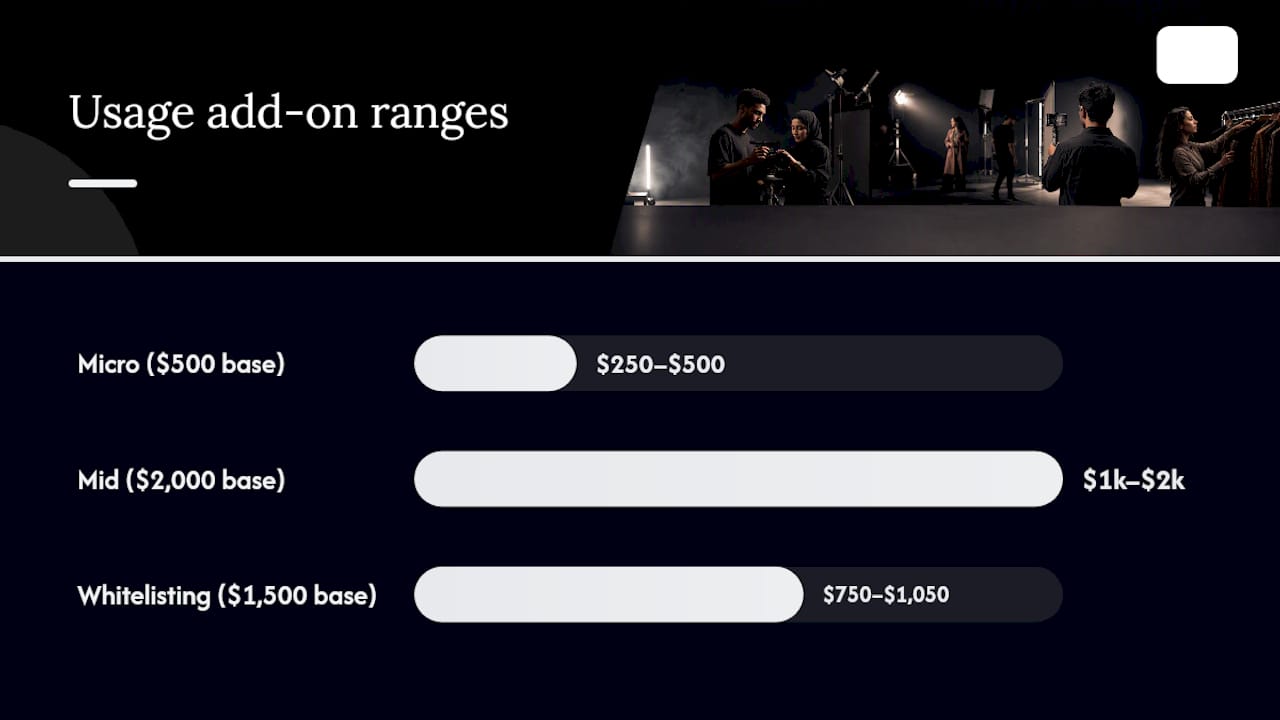
A creator charging $500 for a single organic post might reasonably ask for $250 to $500 more to license that same asset for paid ads over a six-month window on one platform. A mid-tier creator with a $2,000 base fee could see usage add $1,000 to $2,000 for the same terms, and a high-reach creator with documented ad performance, meaning tracked click-through and conversion data showing their content lowers acquisition costs, can justify a multiplier well above that range because the brand is effectively buying proven performance, not just an image.
The pricing workflow that keeps this consistent runs in six steps:
- Set the base creation fee first, independent of any usage discussion.
- Define the exact scope: channels, platforms, and formats.
- Decide exclusivity: exclusive, sole, or non-exclusive.
- Apply the usage multiplier or a flat add-on fee based on that scope.
- Factor in planned ad spend and, for the creator, any documented performance history.
- Separate the final numbers into distinct invoice lines: creative fee, usage license fee, and any exclusivity premium.
A quick example: a brand needs whitelisting rights on TikTok for four months, non-exclusive, single country. On a $1,500 base fee, a fair usage add sits around $750 to $1,050, plus a monthly whitelisting premium if the brand plans to run paid spend behind the creator’s own handle rather than reposting it from the brand account.
What Belongs in a Usage Rights Contract?
A usage-rights clause is only as good as its weakest word. Vague phrasing like “reasonable time” or “any platform” is where disputes are born, because neither side can point to a fixed answer when a disagreement surfaces six months later. Every agreement should nail down the following, in writing, before either side signs:
- Grant of license: exactly which pieces of content, and whether it covers organic use, paid use, or both.
- Permitted platforms and formats: name the specific platforms (Instagram, TikTok, YouTube) and formats (Stories, Reels, static ads).
- Editing rights: state whether the brand can crop, caption, translate, or add branding, and whether the creator must approve edits first.
- Territory: a named country, region, or “worldwide,” never left implied.
- Term: a specific start date and end date, not “for the duration of the campaign.”
- Exclusivity level: exclusive, sole, or non-exclusive, tied to a defined competitor category.
- Renewal terms: whether the license auto-renews, at what rate, and how much notice either side must give to opt out.
- Payment and royalty mechanics: flat fee, percentage-based, or tiered by performance.
- Attribution requirements: whether the brand must tag or credit the creator in any reuse.
- Indemnity: who is liable if the content infringes on a third party’s rights or likeness.
- Moral rights: whether the creator retains the right to object to uses that damage their reputation.
- Consent releases: written confirmation that anyone identifiable in the content, other than the creator, has agreed to appear and be used commercially.
Start and end triggers deserve their own line rather than a vague reference to “the campaign period.” Specify whether the license clock starts on the date the brand approves the final content or the date it first goes live, because those two dates can sit weeks apart and change the effective license length considerably.
Pro Tip: Keep the creative fee and the usage license fee on two separate invoice lines, even when they are paid at the same time. It gives both sides a paper trail if the brand later wants to extend, renew, or expand the license, and it prevents anyone from arguing later that the original payment quietly covered more than it did.
How Should Brands and Creators Negotiate Usage Rights?
Usage rights negotiations have real levers on both sides, and treating every request as a fixed price rather than a set of tradeoffs usually gets a better outcome for both parties.
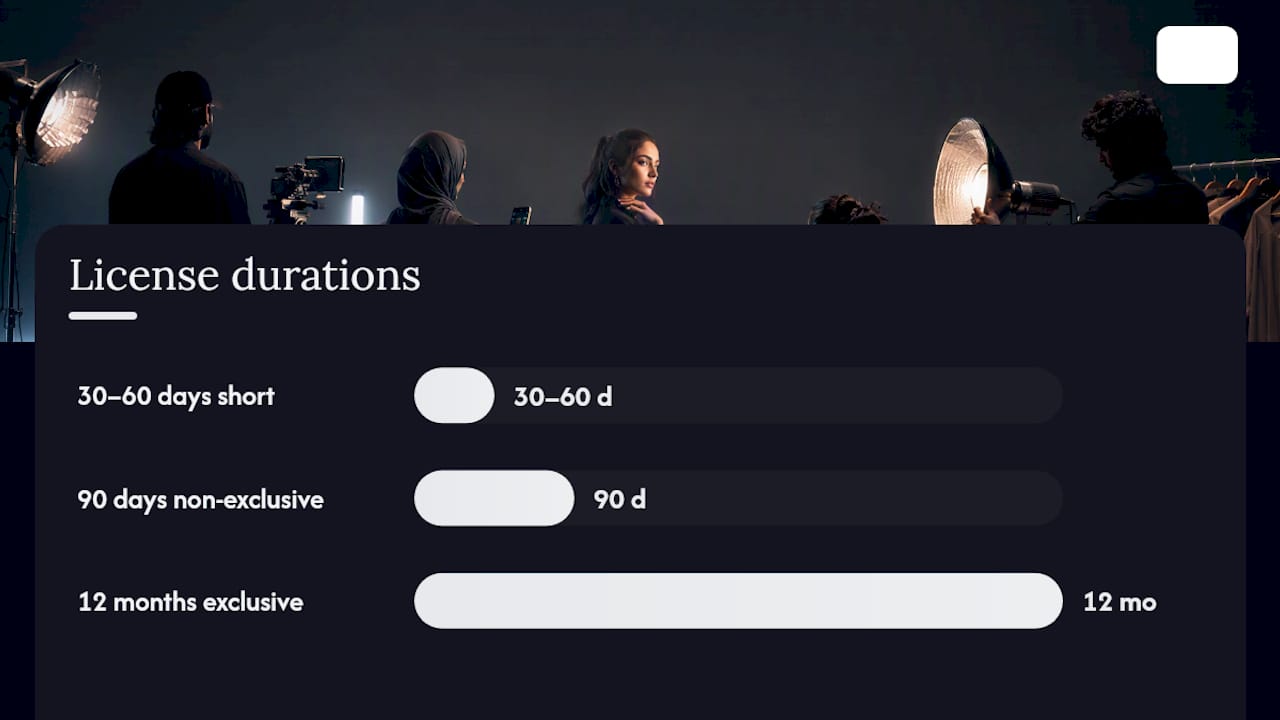
Time, territory, exclusivity, platform count, and attribution requirements are the five dials that actually move price. A brand that agrees to a 90-day non-exclusive license on one platform will pay far less than one asking for 12 months exclusive across every channel worldwide, and creators should price each dial separately rather than quoting one lump number for “usage rights” as a vague category.
Watch for these red flags before signing anything:
- “All media, worldwide, in perpetuity” language with no expiry date and no separate usage fee attached.
- No consent documentation for other identifiable people appearing in the content, such as friends, family, or bystanders.
- Auto-renewal clauses with no cap on how many times they can renew or at what rate.
- Missing exclusivity boundaries, where “exclusive” is never tied to a specific competitor category or time window.
Fair compromises exist for almost every sticking point. A brand that wants long-term flexibility can offer a short exclusivity window (30 to 60 days) with a renewal option at a pre-agreed rate, rather than locking in a full year up front. A creator worried about broad category exclusivity can propose narrowing it to direct competitors only, leaving room to work with adjacent brands.
How Do You Manage Usage Rights After the Campaign Ends?
A signed contract is only half the job. The bigger risk shows up months later, when a license quietly expires and nobody notices until an ad is still running.
Build a simple tracking system: one shared spreadsheet or a dedicated rights-management tool with columns for asset name, licensee, platforms, start date, expiry date, territory, exclusivity level, and a link to proof of use. Automated reminders at 30, 14, and 3 days before expiry catch the renewals brands would otherwise miss entirely.
Detecting unauthorized use takes a bit of legwork but not much. Meta’s Ad Library and TikTok’s Commercial Content Library let anyone search for a creator’s content running as a paid ad, which is the fastest way to catch whitelisting that was never approved. Creators should also periodically ask brands for invoices or campaign reports tied to their content.
When a breach turns up, the response should scale with severity: start with an additional invoice covering the unauthorized period, escalate to a formal takedown request if the brand doesn’t respond, and bring in legal counsel only when both of those are ignored.
What Contract Language and Invoice Templates Can You Use?
A few adaptable lines cover most standard deals.
Sample invoice wording:
- “Creative Fee: [content description], flat rate, $______”
- “Usage License: [platform/channel], [territory], [start date] to [end date], non-exclusive, $______”
Sample clause snippets:
- Paid ads grant: “Licensee may use the Content in paid advertising on [platform(s)] within [territory] for a period of [X months] from [trigger date].”
- Territory and duration: “This license is limited to [country/region] and expires [X] months from first publication unless renewed in writing.”
- Renewal: “This license may be renewed for an additional [X]-month term at a fee of [$______ or percentage of original fee], subject to written agreement from both parties.”
Before signing, run through a short pre-execution checklist: confirm license type, territory, term, exclusivity, edit permissions, and third-party consent are all named explicitly, and confirm the creative fee and usage fee appear as separate figures.
How ANT Management Approaches Usage Rights for Brand Campaigns
Scoping usage rights across international campaigns means balancing exclusivity against reach from the start, not patching it in after a creator is already booked. Licensing is structured around the channels a campaign will actually use, with renewal terms built into the original agreement so brands are not renegotiating from scratch when a campaign extends. This keeps paid-ads and whitelisting terms aligned with real usage instead of guesswork, regardless of the talent’s location.
— ANT
Book Talent With Usage Rights Built In From the Start
Sourcing the right creator is only half the equation. The harder part is getting the licensing terms scoped correctly before a campaign launches, and that is where a lot of in-house teams lose weeks going back and forth on contract language after the shoot is already done.
Talent booking and usage-rights negotiation are handled as one process, not two separate conversations. Whether a brand needs a single organic influencer post or a full whitelisting arrangement across multiple markets, the licensing terms get built into the booking from day one, drawing on a broad international network alongside regional coverage across the Gulf. This results in fewer surprise renegotiations mid campaign and clearer invoice lines separating creative fees from usage fees. Brands running campaigns tied to specific markets can start with the regional pages for talent in Qatar, Kuwait, or Saudi Arabia, or explore the full Dubai-based talent roster to request a consultation before your next rights-heavy campaign goes into contract.
Sources
- What Are Usage Rights? Guide For Influencers & Content Creators - Kate Cooper Law
- What Is a Content Licensing Agreement? | Ironclad
- UGC usage rights: the complete creator guide | Flare