
Brand Activation Staffing: Hire Faster, Hire Right
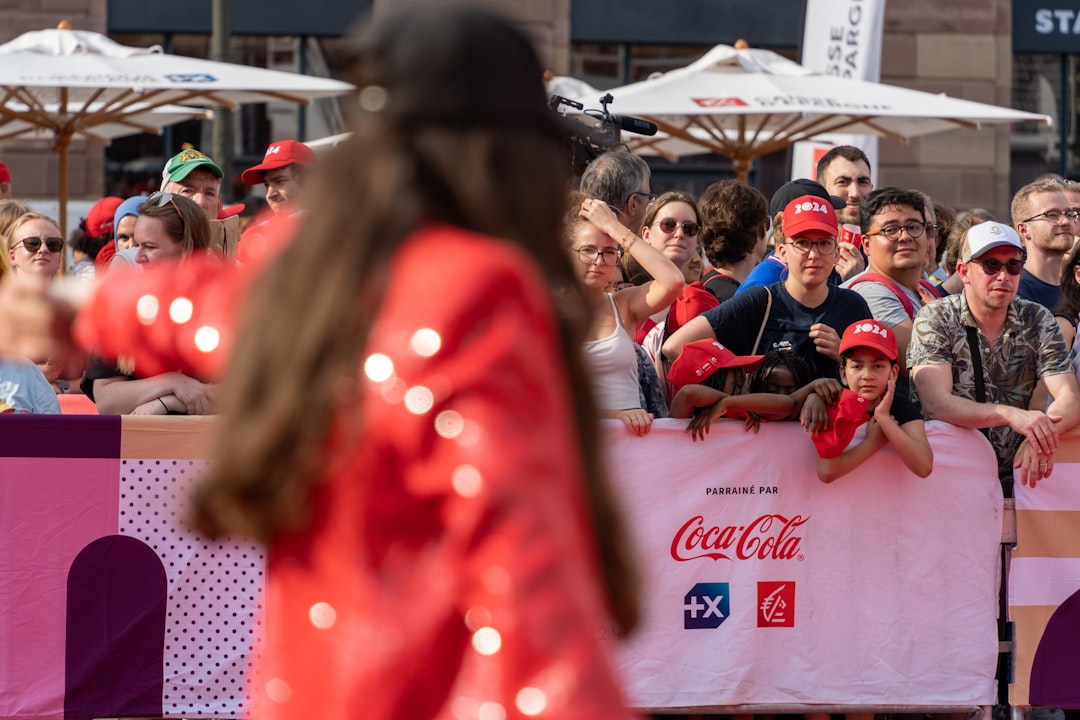
For most U.S. brand activations, the core staffing mix that consistently delivers is this: two to four trained brand ambassadors, one onsite activation manager, and product specialists added based on demo complexity. Send your event date, location, activation brief, and expected shift hours to your agency now. Reputable partners with W-2 employment models and comprehensive vetting return quotes in as little as 1–3 hours, with most standard campaigns live within 5–7 business days.
Before you brief any agency, confirm three things:
-
Vetting and background checks: Every staff member should pass a background check before deployment. No exceptions.
-
W-2 employment model: W-2 staff carry the agency’s liability insurance, which protects your brand on-site. 1099 contractors shift that risk back to you.
-
Quote turnaround: Reliable agencies return quotes within 48–72 hours; some deliver in 1–3 hours for standard market requests.
Key Takeaways
Effective brand activation staffing is thought to combine curated talent, appropriate employment models, brand-specific training, and a precise brief to turn consumer touchpoints into measurable results.
| Point | Details |
|---|---|
| Core staffing mix | Deploy brand ambassadors plus one onsite manager; add product specialists for demo-heavy activations. |
| Booking lead time | Typical window for single-market activations is 5–7 business days; multi-market rollouts generally require 3–6 weeks or more. For urgent launches, professional operators can compress timelines through prioritized crew booking, but building a two-week buffer beyond the minimum is recommended. |
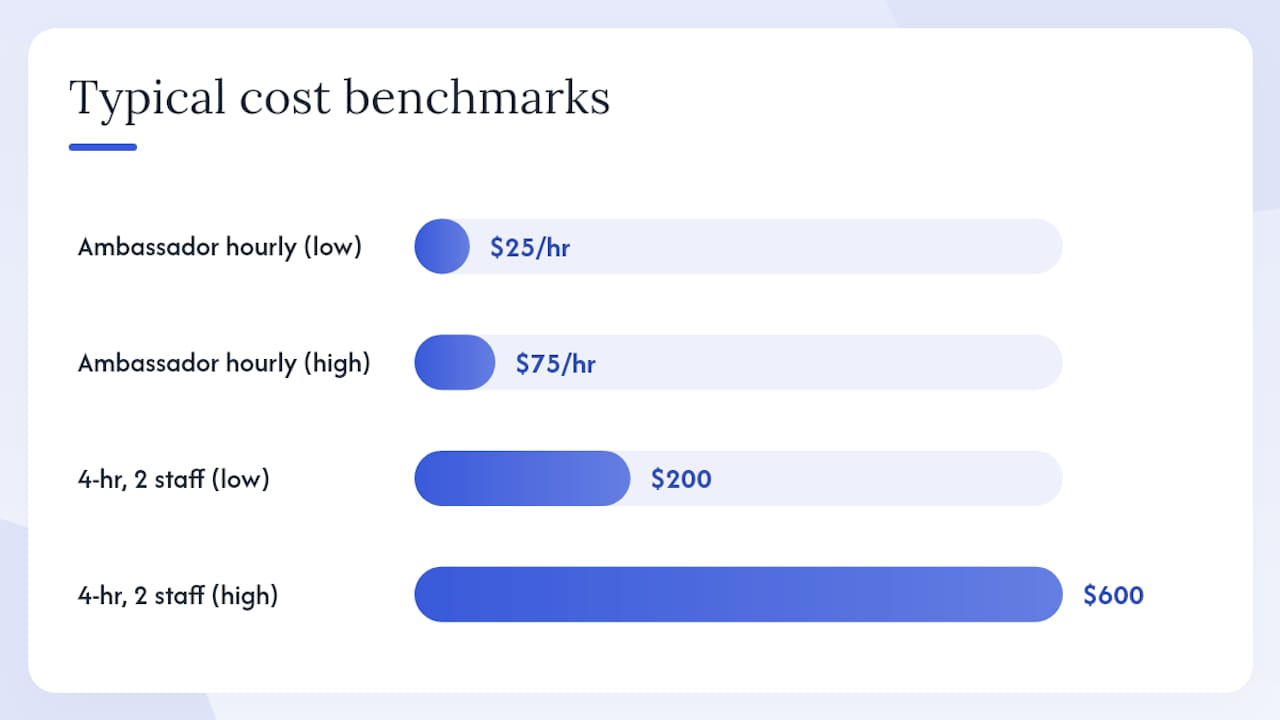
| Rate benchmarks | Street team and ambassador rates typically run $25–$75 per hour depending on market and experience; a 4-hour activation with two staff commonly costs $200–$600 at that range. |
| Must-ask questions | Confirm W-2 model, background checks, brand-specific training, insurance coverage, and post-event reporting format. |
| Antmgmt advantage | Curated talent selected for brand fit, trained through ANT Camp, and managed through a single point of contact for U.S. activations. |
Table of Contents
-
Where are activation staff deployed, and what changes by market?
-
How Antmgmt approaches talent curation and activation staffing
What types of brand activation staff do you actually need?
Brand activation staffing draws from a layered roster of roles, each with a distinct on-site function. Matching the role to the job-to-be-done is where most briefs either sharpen or collapse.
| Role | Primary on-site task | Typical deployment |
|---|---|---|
| Brand ambassador | Guest engagement, sampling, brand narrative | Pop-ups, street activations, retail |
| Street team member | Flyer distribution, foot-traffic intercept | Multi-market tours, outdoor festivals |
| Trade show / booth staff | Lead qualification, product walk-throughs | Conventions, B2B expos |
| Product specialist / demo staff | Technical demos, Q&A | Product launches, tech activations |
| Host / hostess | Registration, VIP concierge, crowd flow | Experiential events, brand lounges |
| Promo model / photography talent | Visual brand presence, content creation | Launches, editorial activations |
| Merchandiser | Display setup, inventory management | Retail and CPG activations |
| Activation manager / supervisor | Onsite direction, compliance, reporting | All event types |
| AV / technical staff | Equipment operation, staging | Experiential tours, stadium events |
| Data-capture staff | Digital signups, CRM lead input | Pop-ups, sampling routes |
Street activations with professional brand ambassadors now reach 1,000+ U.S. cities, and field-based engagement tends to outperform digital-only campaigns by a measurable margin. Data-capture staff go further, running digital signups and surveys that feed clean leads directly into client CRMs, turning impressions into a measurable pipeline.
What does activation staff actually handle on site?
The scope of on-site work is wider than most briefs acknowledge. A well-staffed activation runs on interlocking responsibilities, not isolated tasks.
Core duties span the full event arc:
-
Guest engagement and brand storytelling: Ambassadors open conversations, deliver scripted brand narratives, and adapt messaging to individual consumer responses.
-
Demos and product sampling: Specialists guide hands-on experiences, answer technical questions, and manage sample inventory counts.
-
Lead capture and CRM input: Data-capture staff collect digital signups, run on-site contests, and push clean data into the client’s CRM in real time.
-
Sales support: Staff facilitate on-site purchases, coupon distribution, or retailer referrals depending on the activation model.
-
Registration and hospitality: Hosts manage guest flow, check-in queues, and VIP experiences.
-
Setup and tear-down: Most contracts include pre-event build and post-event strike windows; scope these hours explicitly.
-
Inventory and compliance checks: Merchandisers and managers track sample counts, display integrity, and brand standards throughout the shift.
A well-documented brief that defines behavioral objectives, geography, and success metrics is what separates a measurable activation from a day of impressions. Tie every role to a KPI: conversions per hour, leads captured, samples distributed, or dwell time.
Where are activation staff deployed, and what changes by market?
The event type shapes the staffing model as much as the headcount does.
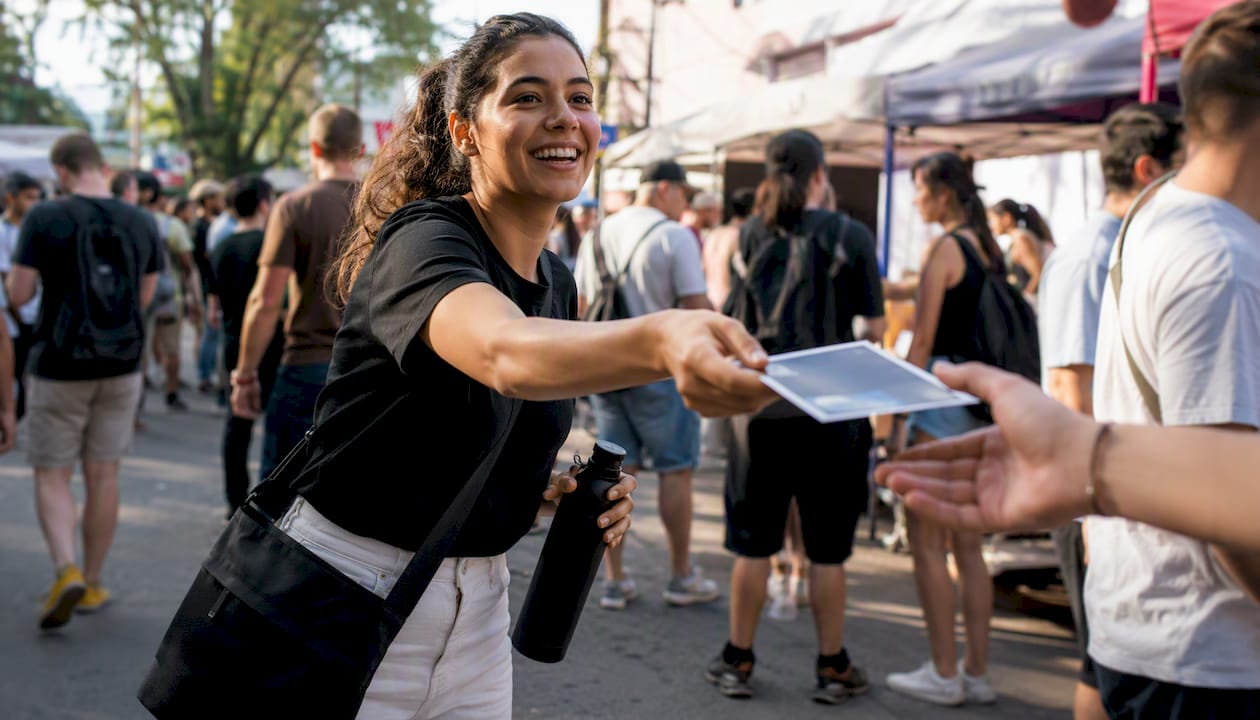
Trade shows and conventions demand booth staff who can qualify leads quickly and sustain energy across multi-day schedules. Retail pop-ups need ambassadors who can hold a brand narrative in a high-distraction environment. Festivals and outdoor activations require street teams built for footfall and weather variability. Stadium and sports events add crowd-control and hospitality layers. Sampling routes and door-to-door programs call for mobile teams with tight geographic routing. Experiential tours and product launches often combine promo talent, AV staff, and an activation manager under a single command structure.
Market-level variables matter just as much. Urban markets carry higher labor rates and permit requirements. Multi-day programs need staff with consistent availability. National rollouts across 10 or more cities require a staffing partner with genuine multi-market infrastructure, not just a single-city roster.
How do you hire and book brand activation staff?
What to include in your brief
A precise brief is the single lever that compresses timelines and sharpens quotes. Include: event objectives, exact venue and address, setup and tear-down windows, target audience profile, expected KPIs, equipment needs, sample or product counts, hours per shift, and your onsite contact.
Selection criteria and questions to ask
Ask every agency these directly:
-
What is your employment model — W-2 or 1099?
-
What does your background-check process cover?
-
What training do staff receive before deployment, and is it brand-specific?
-
What is your manager-to-staff ratio on-site?
-
What liability insurance do you carry, and does it cover the venue?
-
Can you provide a reference activation or case study in a comparable market?
-
How is post-event data reported, and what is the reporting turnaround?
Red flags to watch for
Vague replacement policies, no supervisory presence, no evidence of brand-specific training, unclear insurance terms, and hidden travel or loss-of-day costs are the four patterns that most often derail activations mid-program.
Booking timeline
| Milestone | Typical window |
|---|---|
| Quote delivery | 1–72 hours after brief submission |
| Standard single-market activation live | 5–7 business days |
| Multi-market rollout booking | 3–6 weeks minimum |
| Post-event reporting | 48–72 hours after event close |
Pro Tip: For national rollouts, build a two-week buffer beyond the agency’s stated minimum lead time. Crew availability, permit processing, and brand-specific training all compress under urgency, and professional operators can prioritize crew booking when timelines are tight, but the buffer protects quality.
Contract sign-off checklist: confirm payment terms, cancellation policy, overtime and travel fees, PO requirements, and run-of-show approval before any deposit clears.
How Antmgmt approaches talent curation and activation staffing
Antmgmt operates as a premier talent agency with a curation network spanning Europe, the U.S., and Asia, selecting talent through a rigorous casting process that prioritizes on-brand fit, professional conduct, and activation-ready presentation. Every talent placed through Antmgmt passes through the ANT Camp training program, which builds the behavioral and brand-communication skills that generic staffing rosters rarely develop.
Client strengths that distinguish the Antmgmt model:
-
Curated casting: talent selected for brand alignment, not just availability
-
ANT Camp training: structured preparation covering brand narrative, consumer engagement, and on-site conduct
-
Single point of contact: one account lead manages casting, logistics, and post-event reporting
-
White-label support: available for agency partners running activations under their own brand
What determines brand activation staffing rates?
Pricing for experiential marketing staff is almost always custom-quoted, shaped by role complexity, market, hours, and program scale. Agencies prefer scoped quotes over public rate cards because the variables are too interdependent for a flat price to be accurate.
That said, published benchmarks offer a useful floor. Brand ambassador and street team rates typically run $25–$75 per hour depending on city, campaign type, and experience level. A standard 4-hour street activation with two team members commonly costs $200–$600 all-in at that range. Trade show staff, product specialists, and activation managers carry higher day rates reflecting their technical or supervisory scope. Rush bookings — anything inside a 5-business-day window — often carry a surcharge of 15–25% above standard rates.
Day-rate structures suit multi-day trade shows. Hourly pricing fits pop-ups and sampling routes with variable shift lengths. Package pricing, where the agency bundles talent, management, and reporting into a fixed fee, works best for national tours where predictability matters more than per-unit optimization.
What additional costs appear beyond base staffing rates?
The base rate covers labor. Everything else is a line item. Travel reimbursement, hotel accommodations, and per diems apply whenever staff work outside their home market, and these costs vary depending on city and booking lead time. Mileage reimbursement for local driving, parking, and tolls is standard in most contracts.
Equipment and materials handling, where staff manage branded assets, tents, or sampling kits, may carry a separate handling fee. Overtime kicks in beyond the contracted shift length, typically at 1.5x the hourly rate. Some agencies charge a production or project management fee on top of labor, particularly for activations requiring pre-event scouting or multi-city coordination. Permit costs, when the agency handles them, are passed through at cost.
The tradeoff every hiring manager faces
The tension in activation staffing is not cost versus quality. It is control versus speed. Agencies with large pre-vetted rosters can deploy faster, but the talent pool is broader and brand-fit is less precise. Boutique or curated agencies take longer to cast but deliver staff who feel like an extension of the brand, not a hired hand.
Tactical guidance worth keeping:
-
Prioritize W-2 talent for any activation where brand representation and liability exposure are high.
-
Run a single-market pilot before committing to a national rollout; use it to stress-test scripts, KPIs, and the agency’s reporting cadence.
-
Negotiate travel and per diem terms in the initial contract, not after the first invoice.
-
Collect lead counts, sample distribution totals, and consumer dwell time on-site; these three metrics give you the data to refine the next activation’s staffing brief.
Antmgmt staffs your next U.S. brand activation
Antmgmt brings curated, trained talent to U.S. activations across trade shows, retail pop-ups, experiential tours, and product launches. The roster spans brand ambassadors, hosts, photographers, content creators, and activation managers, all cast for brand alignment and prepared through ANT Camp before deployment.
Every engagement runs through a single point of contact who handles casting, briefing, logistics, and post-event reporting. For agency partners, white-label support keeps the client relationship clean. To request a quote, send your event date, location, activation brief, and shift hours to Antmgmt and receive a scoped response within 48–72 hours.
Sources
-
Street Team Marketing Agency | 1,000+ Cities Nationwide | Street Teams Co
-
How to Manage a Street Team: Recruiting, Briefing, Deploying, and Measuring Field Staff
-
Encore Nationwide | Premier Event Staffing & Brand Ambassadors Nationwide
-
Brand Activation Staffing Agency - Ambassadors & Activation Staff | Air Fresh Marketing