
How to Write a Casting Brief: Template and Sample Included

A casting brief tells your team who to find, why that character exists, where the work will run, and how the talent gets paid, all in one document. It must contain, at minimum, a project snapshot, role description, usage and rights terms, dates and logistics, compensation, and submission instructions, a structure endorsed by the IPA’s Artist’s Casting Brief and echoed in the Backstage casting notice framework. ANT Management builds every casting brief around these six fields before a single submission comes in.
-
Project snapshot (title, format, concept)
-
Role or character description
-
Usage and rights terms
-
Dates and logistics
-
Compensation structure
-
Submission instructions
Key Takeaways
A casting brief succeeds when it pairs a clear character objective with precise usage, compensation, and logistics terms rather than vague physical criteria.
| Point | Details |
|---|---|
| Six mandatory fields | Every brief needs a project snapshot, role description, usage/rights, logistics, compensation, and submission instructions. |
| Behavior over looks | Lead role descriptions with objective and tone; reserve physical detail for story-essential cases only. |
| Usage sets your pool | Spell out channels, territory, and duration in months or years to avoid renegotiation later. |
| Use a structured template | Standardized fields cut briefing time and reduce mismatched submissions. |
| Partner for execution | ANT Management reviews casting briefs and manages talent sourcing from brief to final deliverable. |
Table of Contents
What Belongs in a Complete Casting Brief Checklist
A casting brief checklist works like a pre-flight sequence: skip a field and something breaks downstream, usually a mismatched submission or a renegotiation nobody budgeted for.
Project snapshot. Title, format (print, digital film, social series), a one-line concept or goal, and launch dates if you have them.
Role and character description. State the character’s objective, an age range, behavioral tone, and essential skills, then add inclusive language guidance rather than a narrow physical checklist.

Usage and rights. Name the media channels, territories, and duration in months or years, plus whether the fee is a flat buyout or tiered by platform.
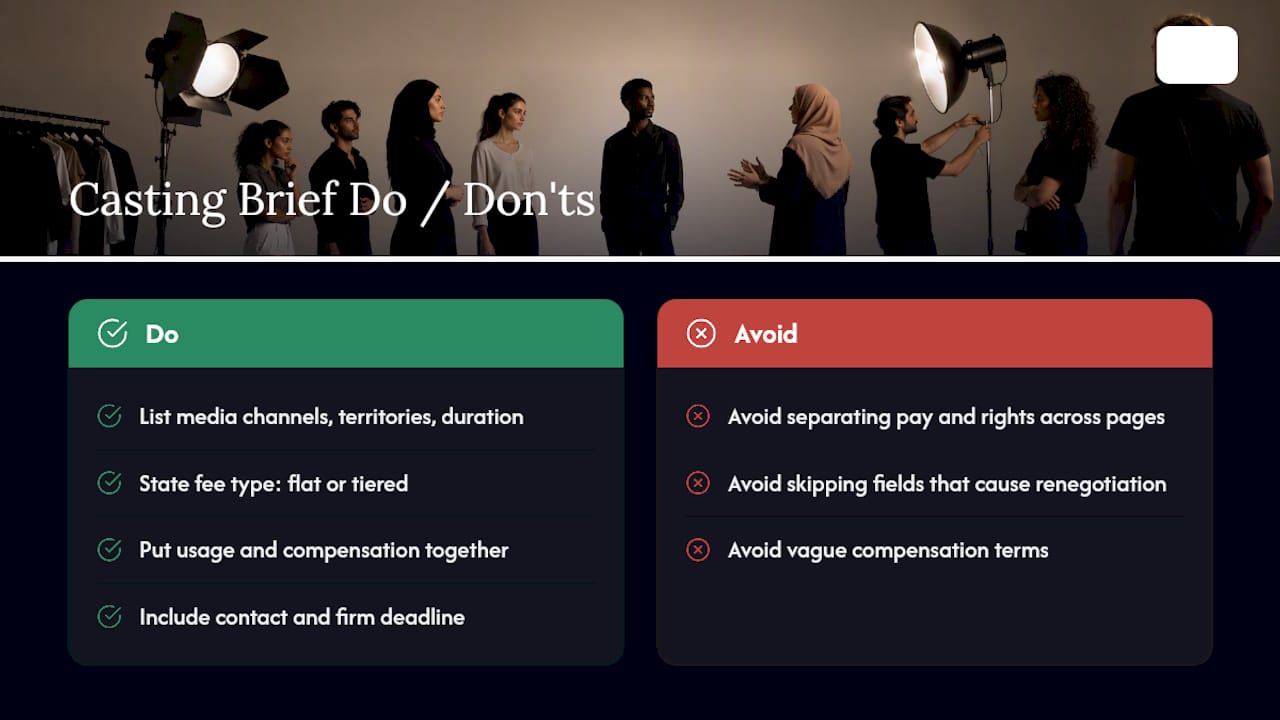
Logistics. Shoot dates, fitting windows, callback slots, travel and accommodation policy, and any rehearsal time.

Compensation. Day rate, buyout, overtime terms, deposit or payment schedule, and union or non-union status, a detail Backstage flags as a frequent source of later confusion.
Submission instructions. List required materials (digitals, walk videos, self-tape sides), a firm deadline, and a named contact.
Attach visual references, a mood board or sample reel, along with any performance notes that clarify tone beyond what a photo can show.
Pro Tip: Put usage and compensation on the same line of the brief. Agents scan for pay and rights together, and separating them across pages is a common reason briefs get skipped over.
How Do You Write a Casting Brief Step by Step?
Producers who treat this as a five-step sequence usually finish a workable brief in a single working session.
-
Draft the project snapshot. Keep it to roughly 50 words, then attach a visual reference, a mood board image or reference reel, so tone reads instantly.
-
Translate creative direction into character objectives. Write what the character wants and how they carry themselves, not just what they look like. This is where Backstage’s guidance on avoiding looks-only criteria matters most.
-
Define usage and rights. Spell out channels, territories, and duration, then attach a pay structure tied to usage tiers rather than a flat number.
-
Lock logistics. Confirm shoot dates, availability windows, fitting and callback schedules, travel rules, and a contingency buffer for reshoots.
-
Finalize submission instructions. Set required materials, a deadline, and a decision timeline, then circulate the brief to agents and casting partners.
Pro Tip: Run a 15 to 30 minute creative call with your director or brand lead before the brief goes out. Ambiguous notes caught in that call save far more time than fixing them after submissions start arriving.
How Do Usage Rights and Rates Shape Who Submits?
Usage terms decide who bothers to submit. A web-only campaign with a six-month window draws a different talent pool than a global out-of-home buyout, and vague terms like “web and social, duration TBD” quietly filter out experienced talent who need to price the job accurately.
Present fees as a structure, not a single number: day rate, buyout tiers by platform, renewal terms if the campaign extends, and overtime rules for sessions that run long. Add a line on the payment schedule, deposit on booking, balance on delivery, since that detail affects who accepts the job as much as the rate itself.
Flag union or non-union status plainly, and note in one sentence whether a contract template or legal review applies. This is guidance, not legal advice.
A compact usage entry might read: “Digital: global, 24 months; OOH: regional, 12 months; social: global, evergreen with 12-month review.” That single line, built on the usage matrix approach recommended by casting template guides, replaces paragraphs of back-and-forth negotiation.
Writing Character Descriptions That Invite Authentic Casting
Lead with behavior, objective, and emotional tone. Save specific physical descriptors for cases where the story genuinely requires them, not as a default filter.
-
Offer inclusive ranges for age, body type, and pronouns, and invite self-identification from underrepresented groups.
-
Address cultural or contextual authenticity directly rather than prescribing ethnicity as a checkbox.
-
Frame the character’s “why” before the “what,” a distinction the IPA’s guidance treats as central to more diverse, less formulaic casting.
Pro Tip: Frame diversity as a campaign objective, something the brand is trying to achieve, rather than a quota to fill. That framing produces better casting and avoids the tokenism that checklist-style diversity notes tend to invite.
Casting Brief Template and Sample Breakdown
A modular template mirrors the checklist above, and structured formats like this have been shown to cut briefing time from roughly 42 minutes to 18 in documented template comparisons.
Template fields:
-
Project snapshot (title, format, concept, air/launch date)
-
Visual references (mood board link, reel link)
-
Role block (objective, age range, tone, must-haves, submission notes)
-
Usage matrix (channel × territory × duration)
-
Logistics (shoot dates, fitting, callbacks, travel policy)
-
Compensation (rate, buyout, overtime, payment schedule)
-
Submission checklist (materials, deadline, contact)
Sample role block: “Role: Supportive best friend, commercial spot. Objective: grounds the lead character with warmth and dry humor. Age range: 28 to 38. Tone: confident, understated, never performative. Must-haves: comfortable with improvised dialogue. Submit: one self-tape reading attached sides, current digitals, by Friday 6 PM.”
Send the completed template to agents as a single PDF or shared document, and attach contract or usage appendices separately so the core brief stays scannable.
Common Mistakes That Slow Down Casting
Vague usage terms like “web and social” with no stated duration cause more renegotiation than any other gap. Missing payment schedules and unclear fitting or travel rules run a close second.
-
Over-specifying appearance while skipping performance direction narrows submissions without improving fit.
-
Skipping visual references forces agents to guess at tone.
-
Setting submission windows too tight shrinks your pool before casting even starts.
How ANT Management Approaches the Casting Brief
ANT Management treats the casting brief as a working document built with clients and agents together, not a one-way memo, which cuts down on re-casting and wasted callbacks. Standards from ANT Camp, the agency’s talent development program, feed directly into how role objectives and performance notes get written. Author credentials and agency case details are available on request.
Get a Managed Casting Partner for Your Next Production
Writing a strong brief is half the job. Finding talent who actually fits it, across fashion, commercial, and event work, is the other half, and that is where a managed partner earns its keep. ANT Management runs casting from brief to final deliverable across its network in Europe, the US, and Asia, so production teams skip the sourcing grind and go straight to a curated shortlist.
If your brief is ready but your talent pool is not, ANT Management can review your casting brief and connect you with vetted models, influencers, and creatives suited to the role. Reach out through the agency’s production page to request a brief review or start a booking conversation this week.
Frequently Asked Questions
What is the difference between a casting brief and a casting call? A casting brief is the internal document defining role, usage, rates, and logistics; a casting call is the public-facing notice built from that brief.
Who should write the casting brief? Producers or casting directors typically draft it, often with input from creative directors and agents on role objectives and usage terms.
Does a casting brief need a lawyer’s review? Usage and buyout terms often benefit from legal review, particularly for union productions, though the brief itself is not a legal document.
How long should submission windows be? Give agents at least three to five business days for standard bookings; tighter windows shrink your talent pool without improving quality.
Sources
-
How to Write a Casting Notice That Attracts Talent | Backstage
-
Casting brief templates that save time and attract the right model profiles