
How to Hire Influencers for Brands and Marketers

Six steps separate a wasted budget from a campaign that converts: define your goal and KPI, build an ideal influencer profile, search the right channels, vet for authenticity, lock terms into a signed contract, then track and optimize. Skip vetting and you risk paying for an audience full of bots. Skip the contract and you risk losing the right to reuse content you paid for.
Before you contact a single creator, look for three signals. First, authentic engagement, typically within a healthy range for accounts depending on platform and follower size. Second, alignment with the industry’s dominant selection filter: roughly 73% of brands now rank authenticity as their top creator-selection priority, above reach or follower count. Third, whether the scale of your campaign calls for a managed booking through an agency like ANT Management rather than solo outreach.
Here is what to do in the next hour, before you read another word:
-
Pick one primary conversion KPI (sales, sign-ups, or app installs) and one or two supporting metrics.
-
Set a budget range you can defend to a finance team, not a wish-list number.
-
Draft a two-sentence outreach pitch that states what you’re offering and what you want back.
Key Takeaways
Hiring influencers successfully requires a defined KPI, a rigorous authenticity check, and a signed contract with explicit usage rights before any content goes live.
| Point | Details |
|---|---|
| Start with one KPI | Define a primary conversion or awareness metric before searching for any creator. |
| Match tier to objective | Use micro-influencers for conversion-focused campaigns and macro or mega tiers for broad awareness. |
| Vet engagement rate | Confirm a 3% to 8% engagement rate and check comment quality before shortlisting a creator. |
| Contract usage rights explicitly | Specify paid-ad usage, exclusivity terms, and payment schedule before content is created. |
| Consider a managed booking | ANT Management offers curated talent and contract handling for brands scaling beyond solo outreach. |
Table of Contents
How to Hire Influencers: Setting Goals, Audience, and Budget First
Searching for creators before you’ve defined success is how brands end up with a beautiful Instagram post and zero sales lift. The influencer selection guide that actually works starts with a single question: what number needs to move?
Pick one primary objective, awareness, consideration, or conversion, and resist the urge to chase all three at once. A conversion campaign wants a strong primary KPI like cost-per-acquisition, backed by supporting metrics such as click-through rate and add-to-cart rate. An awareness campaign leans on reach and video completion rate instead. Trying to optimize for both simultaneously usually means the creator’s content compromises on both.
Your audience map matters just as much as your KPI. Write down the age range, location, income bracket, and buying behavior your product actually serves, then hold every candidate creator’s audience data against that list. A fitness influencer with 200,000 followers in the wrong country is not a match, no matter how polished the content looks.
Budget comes next, and it should be a range, not a single figure. Decide your pricing model preference before you negotiate: flat fee for predictability, performance-based for lower risk, product-for-post for smaller budgets, or a hybrid that blends a base fee with bonus payment tied to results.
-
Is this a one-time campaign or an ongoing ambassador relationship?
-
Have you reserved a separate line item for paid boosting of the creator’s content?
-
Does your budget include a fee for extended usage rights, not just the initial post?
-
Do you have a contingency amount for a second creator if the first underperforms?
Pro Tip: *Set your budget range before you see any creator’s rate card.
Which Influencer Tier and Platform Fit Your Goal?
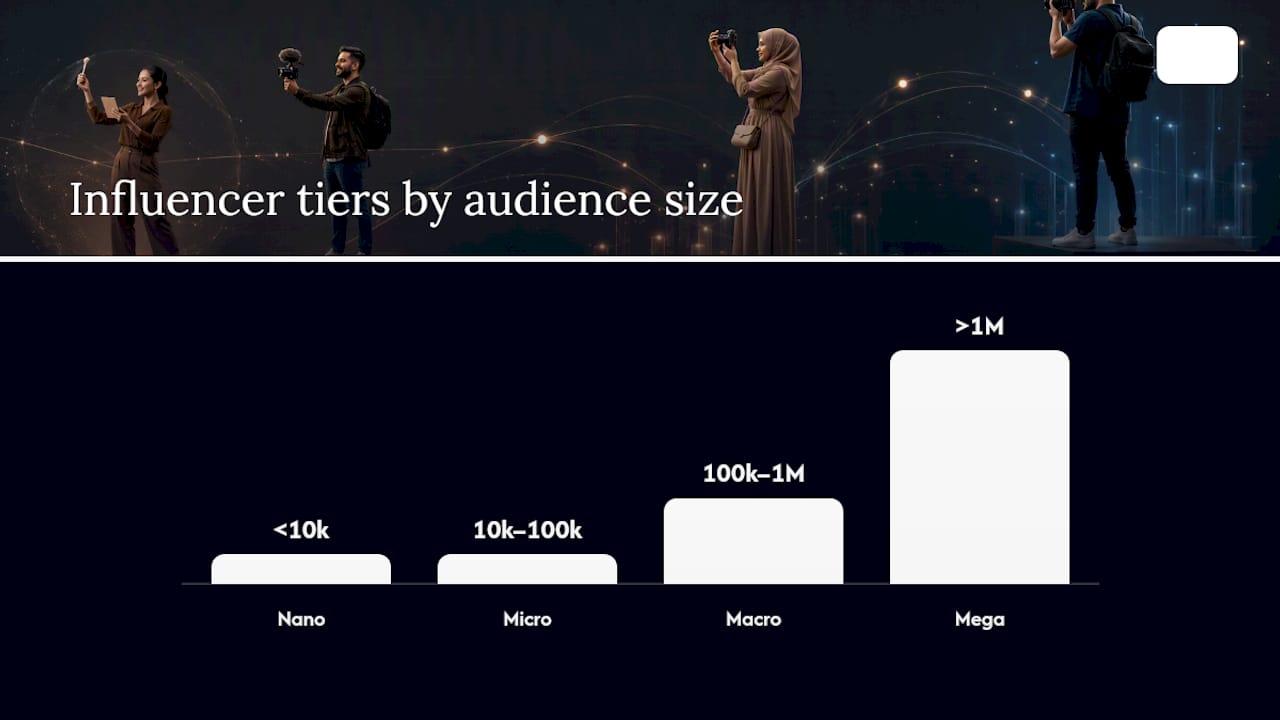
The tier you choose should follow your KPI, not your budget alone. Mega influencers (over one million followers) deliver reach at scale but usually the weakest engagement rate per follower. Micro-influencers (10,000 to 100,000 followers) tend to deliver the opposite: smaller audiences with tighter trust and higher conversion intent. Nano-influencers (under 10,000) sit even further toward authenticity, often at the cost of production polish.

| Tier | Typical audience size | Reach vs. authenticity trade-off | Best-fit objective |
|---|---|---|---|
| Nano | Under 10,000 | Lowest reach, highest trust | Local or niche conversion, community trust-building |
| Micro | 10,000 to 100,000 | Moderate reach, strong engagement | Conversion, product launches, commerce-driven campaigns |
| Macro | 100,000 to 1 million | High reach, moderate authenticity | Consideration, category awareness |
| Mega | Over 1 million | Highest reach, lowest per-follower trust | Brand awareness, mass launches |
Platform choice should follow the same logic. TikTok and Instagram Reels reward discovery and impulse conversion. YouTube suits considered purchases that need explanation, think skincare routines or software walkthroughs. Instagram’s shopping tags and TikTok Shop integrations give conversion-focused campaigns a direct commerce path that a general awareness platform doesn’t offer.
A brand chasing a hard sales number is usually better served by five or six well-matched micro-influencers than one mega placement. Splitting the budget across multiple micro-creators diversifies audience overlap risk and gives you multiple content styles to test against each other, something a single big-name placement can’t replicate.
Where to Find Influencers Worth Hiring
Discovery is where most brands either waste weeks or find their shortlist in an afternoon. Each channel trades speed against verification depth, and knowing which trade-off you’re making up front saves you from starting over.
-
Creator marketplaces (platforms like Collabstr) let you browse creator profiles, rates, and past work in one place, which speeds up initial screening but leaves the deeper vetting to you.
-
Talent and modeling agencies curate rosters in advance, verify authenticity before you ever see a profile, and handle contracts and content rights as part of the booking.
-
Organic platform search using hashtags, niche keywords, and geotags costs nothing but time, and it often surfaces nano-creators marketplaces haven’t onboarded yet.
-
Creator referrals from influencers you’ve already worked with tend to produce strong-fit candidates because creators refer people with similar values and audiences.
-
Industry events and trade shows put you face-to-face with creators and their managers, useful for negotiating exclusivity terms in person.
-
Shoutout and sponsorship marketplaces (platforms like Shoutcart) offer a faster, lower-touch route for smaller budgets, though verification depth varies by listing.
Use marketplaces when speed matters more than deep vetting and your budget is modest. Use an agency when you need verified talent, contract handling, and accountability built into the booking. Reserve organic search for niche categories where the right creator hasn’t been “discovered” by a platform yet, and scale up with a discovery tool once you’ve validated the approach with two or three creators manually.
Pro Tip: Search the comments section on a creator’s last five posts before you search their bio. Genuine fans ask questions and reference specific details; bot-driven comments repeat generic praise like “Great post!” with no reference to the content itself.
How Do You Vet an Influencer Before Hiring Them?
Vetting is the step brands skip when they’re excited about a creator’s aesthetic, and it’s the step that determines whether your campaign budget goes to real customers or fake accounts. Selection frameworks built around audience match, engagement authenticity, and brand safety now outperform reach-only filtering, and treating this like a hiring process, not a casual browse, changes outcomes.
-
Review the last 50 to 100 posts for consistency in tone, content quality, and posting frequency. Gaps of several weeks followed by sudden bursts often signal a creator juggling too many brand deals or losing audience interest.
-
Read a sample of comments, not just the count. Look for specific, on-topic replies rather than repeated generic phrases, which is the clearest fingerprint of purchased engagement.
-
Check the follower growth curve using a platform analytics tool. A sudden vertical spike followed by a flat line usually means a follower-buying event, not organic growth.
-
Confirm audience demographics and timezones match your target market. A creator based in one country can still have most of their audience in another, which either helps or hurts you depending on your campaign.
-
Search the creator’s name alongside terms like “controversy” or “scandal” to screen for reputational risk before you sign anything.
Engagement rate is the single number that tells you the most, and it’s simple to calculate: (likes + comments) divided by follower count, multiplied by 100. A creator with 50,000 followers who averages 2,000 likes and 150 comments per post has an engagement rate of about 4.3%, solidly within the healthy 3% to 8% range most brands treat as a baseline.
A rate under 1% on an account with six-figure followers is a warning sign worth investigating, especially if it’s paired with comments that read like they were written by a template. InfluenceFlow’s creator selection framework recommends combining that quantitative check with a qualitative read of content voice and past brand fit, since a fraud-checking tool alone can’t tell you whether a creator’s values match your brand.
-
Cross-check follower counts and engagement against a third-party audience verification tool rather than trusting platform-native analytics alone.
-
Ask the creator directly for a screenshot of their own audience insights dashboard; hesitation to share it is itself a signal.
-
Confirm they haven’t promoted a direct competitor in the past 90 days unless your contract explicitly allows shared placements.
Pricing Models and How to Negotiate a Fair Rate
Influencer pricing has no fixed rate card, which is exactly why brands who walk in with a formula outnegotiate those who don’t. The cost of hiring influencers varies by tier, platform, deliverable count, and usage rights, sometimes by a factor of ten for creators with similar follower counts.
The five common pricing structures are flat fee (a fixed payment regardless of performance), CPM-equivalent (pricing tied to estimated impressions), affiliate or commission-based (payment as a percentage of sales driven), product-for-post (compensation in free product instead of cash, common with nano-creators), and hybrid models that combine a base fee with a performance bonus.
A workable starting formula: estimate reach (average views or impressions per post), multiply by your industry’s typical engagement rate, then apply a baseline rate adjustment for platform and deliverable type. A creator averaging 20,000 views per Reel with a 5% engagement rate might reasonably command $200 to $400 per post at nano-to-micro tier, scaling upward significantly for video-heavy formats like YouTube integrations, which typically command a premium over static posts.
-
Open with your budget range, not your maximum, and ask the creator to propose deliverables within it.
-
Ask specifically about usage rights before discussing final price: “Does this rate include paid ad usage, or is that a separate fee?”
-
Clarify reporting expectations up front: what analytics will they share, and by when after posting?
-
Discuss exclusivity separately from the base fee. A 30-day category exclusivity window typically adds 15% to 25% to a base rate.
-
Confirm payment schedule and stick to it. Creators talk to each other, and a reputation for late payment closes doors to future talent.
-
Never lead a negotiation with “what’s your rate?” alone. Ask what’s included first.
-
Build in a 10% contingency for revision requests before you finalize a number.
-
Treat product-for-post as a legitimate tier for nano-creators, not a way to avoid paying anyone.
What Goes Into a Solid Influencer Brief and Contract
A brief without a contract is a wish list. A contract without a clear brief is a legal document protecting nothing specific. You need both, and they need to agree with each other line for line.

The brief should state the campaign goal, one or two mandatory messages the creator must include, the creative freedoms they retain otherwise, technical specs (aspect ratio, minimum video length, required hashtags), the posting window, and the KPIs you’ll be tracking. Overly rigid briefs produce content that reads like an ad; briefs that trust the creator’s voice within clear guardrails tend to convert better.
Jotform’s influencer contract template outlines the core legal elements every agreement needs, and the checklist holds regardless of which template you start from:
-
Exact deliverables (number of posts, platform, format)
-
Content usage rights, specifying whether the brand can repurpose the content in paid ads or owned channels beyond the organic post
-
Exclusivity term and which competing categories it covers
-
Payment schedule tied to specific milestones, not a single lump sum
-
Number of revision rounds included before additional fees apply
-
Cancellation terms and what happens to partial payments if either side pulls out
A contract is content-usage insurance, not a formality you file away after signing. The moment you want to repurpose a creator’s Reel into a paid ad, the only thing standing between you and a usage-rights dispute is the specific language you negotiated up front, not goodwill.
WiseMonk’s guidance on hiring influencers makes the same point from a legal-protection angle: exclusivity clauses and explicit usage rights are the terms brands most often skip, and the ones most likely to cause a dispute later.
Pro Tip: Always confirm FTC or local advertising disclosure requirements are written into the contract as a creator obligation, not an assumption. A creator who forgets to add #ad isn’t just a compliance risk, it can undermine your entire campaign’s credibility if flagged publicly. For a broader compliance angle, this independent advisor compliance marketing checklist walks through disclosure and brand-safety screening in more regulated categories.
How to Track Performance and Measure Influencer ROI
A campaign without tracking infrastructure is a campaign you can’t defend at budget review. Set up UTM parameters and unique promo codes for every creator before the first post goes live, not after someone asks for results.
Active management means approving content before it posts, confirming the agreed posting window, monitoring engagement in the first 24 hours, and deciding quickly whether a paid boost makes sense once organic performance shows. A post underperforming in its first two hours rarely recovers without a boost; one performing well can often be scaled with a modest ad spend behind it.
| Metric | Formula | Representative target |
|---|---|---|
| Engagement rate | (Likes + comments) ÷ followers × 100 | 3% to 8% |
| Click-through rate | Clicks ÷ impressions × 100 | 1% to 3% for consideration campaigns |
| Cost per acquisition | Total spend ÷ conversions | Varies by industry, benchmark against your paid-social CPA |
| Return on investment | (Revenue attributed to influencer) ÷ spend | Above 100% signals a repeatable partnership |
Medianug’s KPI framework recommends attributing conversions specifically through UTMs and unique promo codes rather than relying on platform-reported reach alone, since reach tells you how many people saw a post, not how many acted on it.
-
Build a simple reporting template that tracks reach, engagement, CTR, conversions, CPA, and a short qualitative note on comment sentiment.
-
Compare each creator’s CPA against your existing paid-acquisition channels to judge whether influencer spend is actually competitive.
-
Revisit the KPI you set at the outset. A campaign that hit strong engagement but missed its conversion target needs a different creator profile next round, not just more budget.
A campaign missing its CPA target by more than 30% after the first two weeks rarely course-corrects on its own and usually needs either a new creative angle or a different creator tier entirely.
Common Mistakes and Red Flags When Hiring Influencers
Most influencer campaigns that underdeliver fail for the same handful of reasons, and nearly all of them are avoidable with the workflow above.
-
Sudden follower spikes with no corresponding viral moment or press mention usually mean purchased followers.
-
Generic, repetitive comments (“Love this!” “So cute!”) across multiple posts are the clearest fingerprint of engagement pods or bots.
-
Inconsistent posting history with long gaps suggests either declining interest or overcommitment to too many brand deals at once.
-
Undisclosed past controversies surface after launch far more often than before, so a basic search before signing is cheap insurance.
-
Repeated brand mismatches, a creator promoting products with no logical connection to their content, signals they’ll take any deal, which erodes audience trust in sponsored posts generally.
On the brand side, the most expensive mistakes are skipping a trial post before a larger commitment, failing to define a KPI before searching for creators, ignoring usage rights until you want to repurpose content, and not verifying audience geography against your actual market.
If a partnership shows early warning signs, don’t wait for the full campaign to play out. Pause additional payments tied to future deliverables, request updated analytics directly from the creator, and if the mismatch is severe, invoke the cancellation terms you built into the contract rather than absorbing a loss silently.
When an Agency-Managed Approach Makes More Sense
Solo outreach works well for a single campaign with one or two creators. It starts to break down once you’re running multi-market campaigns, need fast turnaround, or require content repurposing rights across several paid channels simultaneously.
An agency-managed booking through a firm like ANT Management shifts the verification, contract negotiation, and content rights conversation onto a team that already has relationships with curated talent across fashion, commercial, and influencer categories. That matters most when you need speed without sacrificing the vetting rigor described above, or when a campaign spans multiple countries and each market has different disclosure and usage norms to navigate.
-
Choose a platform or marketplace when your budget is limited, your timeline is flexible, and you’re comfortable handling vetting and contracts yourself.
-
Choose an agency when you need talent curated in advance, contract terms handled by people who negotiate them daily, or content repurposing rights across paid and owned channels built into the booking from day one.
-
Choose organic outreach only for small-scale, single-market tests where the learning curve itself is part of the value.
Pro Tip: When evaluating an agency, ask specifically how they screen talent for authenticity and brand fit, not just reach. A managed booking should come with the same vetting rigor described in this guide, applied by a team that does it daily instead of once a quarter.
Outreach Templates and a 6-Step Hiring Workflow
A good outreach message respects the creator’s time while making the offer unmistakable. Keep it short: acknowledge specific content you liked, state the campaign in one sentence, name a rough compensation range, and ask if they’re open to a call.
A workable outreach opener: “Hi [name], I’ve followed your content on [specific topic] for a while, especially [specific post]. We’re running a campaign for [brand] targeting [audience] and think your audience is a strong fit. Compensation is in the [range] area depending on deliverables. Are you open to a quick call this week?”
Your one-page brief should answer five questions before a creator ever asks them: What’s the goal? What are the exact deliverables? What’s the timeline? What’s the compensation and payment schedule? Who approves content before it posts?
-
Initial outreach with a personalized message and rough scope.
-
Discovery call to confirm fit, availability, and rate expectations.
-
Brief and contract sent together, so deliverables and legal terms match exactly.
-
Content draft submitted for approval within the agreed revision limit.
-
Post goes live during the confirmed window, tracked with UTMs and promo codes from the start.
-
Reporting and relationship review, deciding whether this creator earns a second, larger campaign.
-
Build a simple spreadsheet tracking every creator’s outreach date, response, rate, and contract status so nothing falls through during a multi-creator campaign.
-
Follow up once, politely, after five business days of silence before moving on to the next candidate.
-
Keep a short list of backup creators ready in case your first choice declines or fails vetting late in the process.
Agency Lessons From Managing Talent Bookings
Brands often come to a managed booking after a first solo campaign went sideways, usually because a creator with an impressive follower count delivered an audience that didn’t match the product at all. The fix isn’t always a bigger budget. It’s usually a tighter vetting process applied before the contract, not after the invoice.
The recurring pattern worth naming: brands that treat creator selection as a quick browse based on aesthetic fit lose more budget to mismatched audiences than brands that spend an extra week vetting properly. Speed feels like an advantage right up until the campaign report shows a conversion rate that doesn’t justify the spend.
What consistently prevents that outcome is process discipline: a documented set of non-negotiables before searching, a vetting checklist applied to every candidate regardless of how good their feed looks, and a contract that spells out usage rights before content gets created rather than after a brand wants to reuse it. None of that is glamorous. All of it is what separates a campaign that scales into an ongoing partnership from one that gets quietly written off after a single disappointing report.
If you’re weighing whether to run your next campaign solo or bring in curated talent through a managed process, start small. Test one creator, one clear KPI, and one contract built the right way, then decide whether the results justify scaling with agency support.
Book Curated Talent Through ANT Management
ANT Management gives brands a faster route to vetted talent than building a shortlist from scratch, curated creators, models, and content producers already screened for authenticity, brand fit, and reliability before you ever see a profile.
Where a marketplace hands you a list of profiles to vet yourself, ANT Management handles that screening as part of the booking, alongside contract terms that protect your usage rights from the start. The agency’s roster spans fashion, commercial, and influencer talent across Europe, the US, and Asia, plus training programs like ANT Camp that develop talent for long-term brand partnerships rather than one-off posts. If your next campaign needs curated talent, contract handling, and content rights sorted out before launch, get in touch with ANT Management to discuss a managed booking for your next campaign.
Sources
For deeper dives into specific steps of this process, these resources cover discovery, vetting, contracting, and measurement in more detail.