
Every Production Crew Role You Need to Know
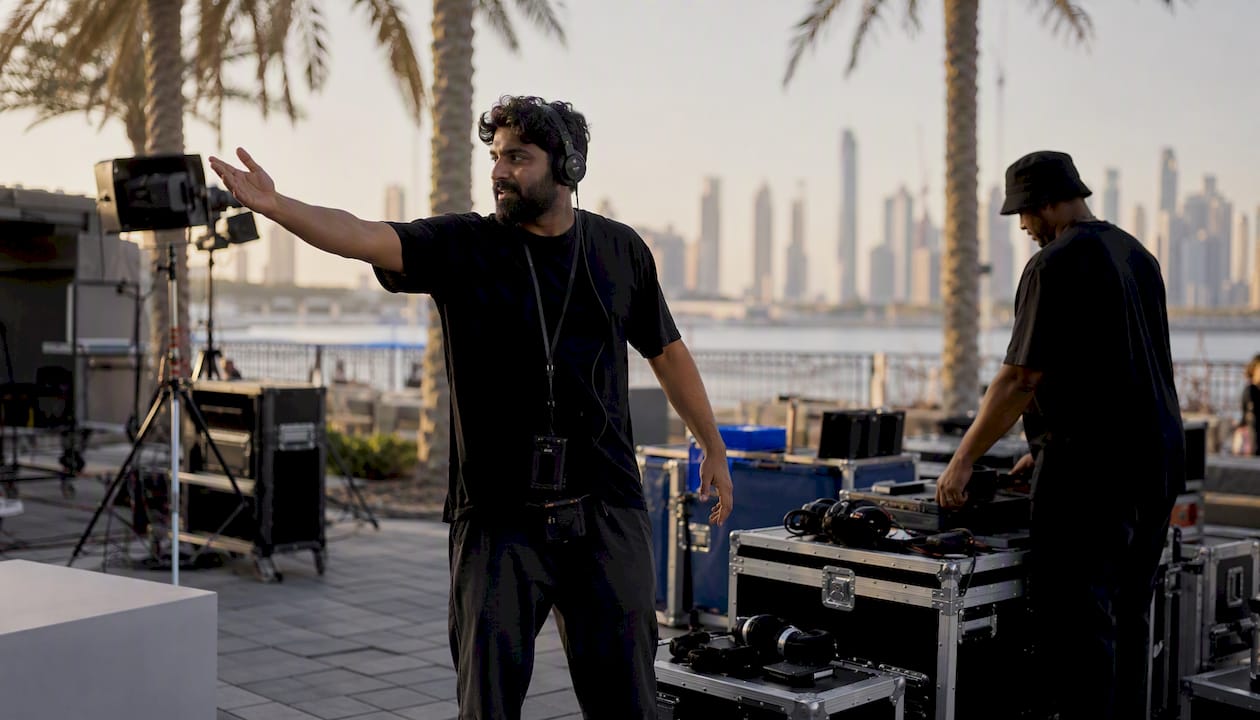
A production crew is the collective of professionals hired by a production company to execute the technical, creative, and logistical demands of a film or television project — distinct from the cast, who perform on camera, and from executive producers, who operate above the creative fray. The crew divides into six core departments, each with its own hierarchy, vocabulary, and rhythm:
- Production office (producers, UPM, coordinators, accountants)
- Camera, grip, and electric (DP, operators, gaffers, key grips)
- Art, sets, and props (production designer, set decorator, prop master)
- Sound (production sound mixer, boom operator, utility)
- Wardrobe, hair, and makeup (costume designer, stylists, artists)
- Post-production (editor, colorist, sound post, VFX, composer)
The most common entry point into any of these departments is the Production Assistant (PA) role, a position that places you inside the machine before you specialize.
Key Takeaways
Every production crew role exists within a layered hierarchy of creative and operational authority, and understanding that structure is the first step toward navigating it with confidence.
| Point | Details |
|---|---|
| ATL vs. BTL distinction | Above-the-line costs are fixed packages; below-the-line day rates scale with shoot length. |
| UPM vs. coordinator clarity | The UPM manages budget and hiring; the Production Coordinator moves paperwork and daily logistics. |
| PA as the entry point | Production Assistants support all departments and are the most common first credit on U.S. sets. |
| Call sheet literacy | Read the full call sheet before arriving; locate your department head and 2nd AD on arrival. |
| Build your crew list early | A living, updated crew list is a career asset — start it on your first production and never stop. |
Table of Contents
- How are production crew roles organized on a real set?
- What does the production department actually do?
- What do directors and assistant directors do differently?
- Who runs the camera department and what does each role do?
- How do grip and electric departments light a set?
- What does the sound department do during principal photography?
- How does the art department build the world of a production?
- What do wardrobe, hair, and makeup departments manage on set?
- What do script supervisors, location managers, casting directors, and stunt coordinators do?
- What happens in post-production and who handles it?
- How do you read a crew list and call sheet?
- How do you start a career in production in the U.S.?
- What on-set etiquette actually shapes a career?
- Assembling the right talent for your production
- Sources
How are production crew roles organized on a real set?
Every production crew operates along two axes: creative authority and operational authority. Understanding both is what separates someone who can read a call sheet from someone who merely holds one.
Above-the-line vs. below-the-line
The industry divides its full production team roles into above-the-line (ATL) and below-the-line (BTL) categories, a distinction that is primarily financial. ATL costs — producers, director, key cast, and writers — are negotiated as upfront package deals before principal photography begins. BTL costs, covering the technical crew, scale with the number of shoot days. The longer the production runs, the more BTL labor costs compound.
| Dimension | Above-the-line | Below-the-line |
|---|---|---|
| Who | Producers, director, key cast, writers | Department heads, technicians, PAs |
| Compensation model | Negotiated package, often flat fee | Day rates or hourly, scales with shoot days |
| Hiring timing | Before pre-production begins | Pre-production through wrap |
| Examples | Executive Producer, Director, Lead Actor | Gaffer, 1st AC, Set Decorator, PA |
How reporting lines actually work
The production office sits at the center of the operational web. The Unit Production Manager (UPM) manages budget and high-level logistics; the Production Coordinator is the information hub that moves paperwork, equipment rentals, and daily communication between departments. Confusing these two roles causes bottlenecks on fast-moving sets — the UPM decides, the Coordinator executes.
On set, the 1st Assistant Director (1st AD) is the operational authority. Every department head reports to the 1st AD for scheduling and safety. Department heads then manage their own chains downward: the gaffer manages electricians, the prop master manages set dressers, the 1st AC manages the 2nd AC and camera trainees.
- Production office → UPM → Production Coordinator → PAs
- Set → 1st AD → Department Heads → Assistants → Trainees
- Creative → Director → DP → Camera Operator → ACs
Pro Tip: When you first join a set, locate the 1st AD and your department head before anyone else. Those two relationships define your entire day.
A crew list is a dynamic, cloud-based project-management asset used to track day rates, location releases, crew contact information, and to generate daily call sheets. Treat it as a living document, not a static roster.
What does the production department actually do?
The production department is the administrative and logistical spine of any shoot. Without it, no department gets paid, no location gets permitted, and no call sheet reaches anyone’s inbox.
Producer — The creative and financial architect. The producer develops the project, secures financing, hires key department heads, and holds final authority over the budget. On larger productions, multiple producers divide these responsibilities across executive, co-producer, and associate tiers.
Line Producer — Translates the producer’s vision into a working budget and schedule. The line producer is the financial conscience of the production, tracking every dollar from pre-production through wrap. They report to the producer and work in close collaboration with the UPM.
Unit Production Manager (UPM) — The operational engine. The UPM manages hiring, negotiates vendor deals, oversees payroll, and coordinates department heads on budget compliance. In the U.S., the UPM is typically covered under the Directors Guild of America (DGA), which sets minimum rates and working conditions. The UPM reports to the line producer.
Production Coordinator — The information hub. The coordinator distributes call sheets, manages equipment rentals, tracks crew paperwork, and fields the constant flow of communication between departments. This role is often the first step up from PA for organized, detail-oriented crew members.
Production Accountant — Manages the financial ledger: purchase orders, check requests, petty cash, and weekly cost reports. On union productions, the accountant must navigate IATSE payroll rules, including overtime thresholds and fringe calculations. Payroll services like Cast & Crew or Media Services are commonly used on U.S. productions to handle these complexities.
Office PA — Supports the production office with filing, phone coverage, supply runs, and document distribution. The Office PA is the coordinator’s right hand and often the first to know when something goes wrong.
Set PA — Works directly on set under the 2nd AD, managing walkie-talkies, locking up locations during takes, running sides (script pages) to cast, and handling any on-set errand the AD team needs. PAs are the entry-level foundation of U.S. productions, supporting all departments with setup, breakdown, and logistics.
The production office manages three critical documents: the crew list, the daily call sheet, and the production report. The call sheet tells everyone where to be and when; the production report records what was actually shot. Both feed directly into payroll and post-production scheduling.
Pro Tip: Learn to read a production report before your first week ends. It tells you whether the production is on schedule and which departments are running over — intelligence that shapes every conversation you’ll have.
What do directors and assistant directors do differently?
The director and the AD team occupy the same physical space on set but operate in entirely different registers. One is concerned with performance and image; the other is concerned with time and order.
Director — The creative authority on set. The director works with the DP to frame shots, guides actors through performance, and makes final decisions on what is captured. The director does not manage the schedule, call lunch, or coordinate departments — that is the AD’s domain.
1st Assistant Director (1st AD) — The operational commander of the set. The 1st AD builds the shooting schedule during pre-production, creates the daily call sheet in collaboration with the production coordinator, and manages on-set safety. A typical 1st AD day begins before call time: reviewing the day’s scenes, confirming department readiness, and calling the set to order. During shooting, the 1st AD calls “rolling,” “cut” (relayed from the director), and manages transitions between setups. The 1st AD focuses on scheduling, on-set management, and safety; the 2nd AD handles call sheets and talent movement.
2nd Assistant Director (2nd AD) — The 1st AD’s logistical partner. The 2nd AD produces call sheets, manages talent movement from holding to set, coordinates background performers, and handles paperwork including exhibit G forms and SAG-AFTRA daily contracts on union productions.
- 2nd 2nd AD / 3rd AD — On larger productions, additional ADs manage background extras, crowd control, and secondary unit logistics. On a low-budget shoot, the 2nd AD absorbs all of these duties alone.
The AD team coordinates with every department head. When the gaffer needs ten minutes to adjust lighting, the 1st AD decides whether the schedule can absorb it. When an actor is late from makeup, the 2nd AD communicates the delay and adjusts the sequence of scenes.
Pro Tip: Never walk onto a set mid-take. Wait for the 1st AD to call “cut” and “moving on” before crossing into the shooting area. This single habit marks you as someone who understands set protocol.
Who runs the camera department and what does each role do?
The camera department translates the director’s vision into light and image. Its hierarchy is precise, its equipment is expensive, and its coordination with grip and electric is constant.
Director of Photography (DP) / Cinematographer — The creative and technical lead of the camera department. The DP designs the visual language of the production: lighting style, camera movement, lens choices, and color palette. The DP coordinates directly with the gaffer for lighting and with the key grip for camera support and rigging. The DP oversees both the camera team and lighting coordination with the gaffer and key grip.
Camera Operator — Executes the DP’s framing in real time. On narrative productions, the DP often operates the camera personally; on larger shoots, a dedicated operator handles the physical camera while the DP focuses on overall image quality.
1st Assistant Camera (1st AC) / Focus Puller — Responsible for maintaining focus throughout every take. The 1st AC builds and preps the camera package, manages lens changes, and pulls focus using a wireless follow-focus system. Precision and calm under pressure define this role.
2nd Assistant Camera (2nd AC) / Clapper Loader — Slates each take with the clapperboard, loads and unloads media cards or film magazines, and maintains the camera report. The 2nd AC is also responsible for keeping the camera package organized and charged.
Digital Imaging Technician (DIT) — Manages the digital pipeline on set. The DIT performs checksum-verified offloads of camera media, monitors the image for technical consistency, and creates dailies for the director and editor. On high-end productions, the DIT also manages on-set color grading to establish the look.
Camera Trainee — Assists the 2nd AC with equipment transport, battery management, and organizational tasks. This is often the first camera-department credit a new crew member earns.
In the U.S., camera department crew on union productions typically belong to IATSE locals — Local 600 (International Cinematographers Guild) covers DPs, camera operators, and ACs in most markets. Understanding which local governs your region affects both your eligibility to work on union productions and your minimum day rate.
How do grip and electric departments light a set?
Grip and electric are two distinct departments that work in such close coordination they are often discussed as one. The distinction matters: electric provides power and light; grip provides the mechanical support that shapes and controls that light.
Gaffer (Chief Lighting Technician) — The head of the electric department. The gaffer translates the DP’s lighting design into a practical plan: which fixtures, how much power, where each unit is positioned. The gaffer manages the entire electric crew and coordinates with the generator operator on power distribution.
Key Grip — The head of the grip department. The key grip manages all camera support equipment (dollies, jibs, cranes, sliders) and the rigging of lighting fixtures. Where the gaffer controls what light does, the key grip controls where it goes and how it is mounted.
Best Boy Electric — The gaffer’s second-in-command. The best boy electric manages the electric crew’s daily scheduling, equipment inventory, and paperwork. On set, the best boy coordinates the movement of lighting equipment between setups.
Best Boy Grip — The key grip’s operational partner, managing grip equipment, truck inventory, and crew scheduling. The best boy grip is often the person who knows exactly where every piece of gear is at any given moment.
Grips — The hands of the grip department. Grips lay dolly track, rig overhead frames, position flags and diffusion, and move camera support equipment between setups. Physical endurance and spatial reasoning are core competencies.
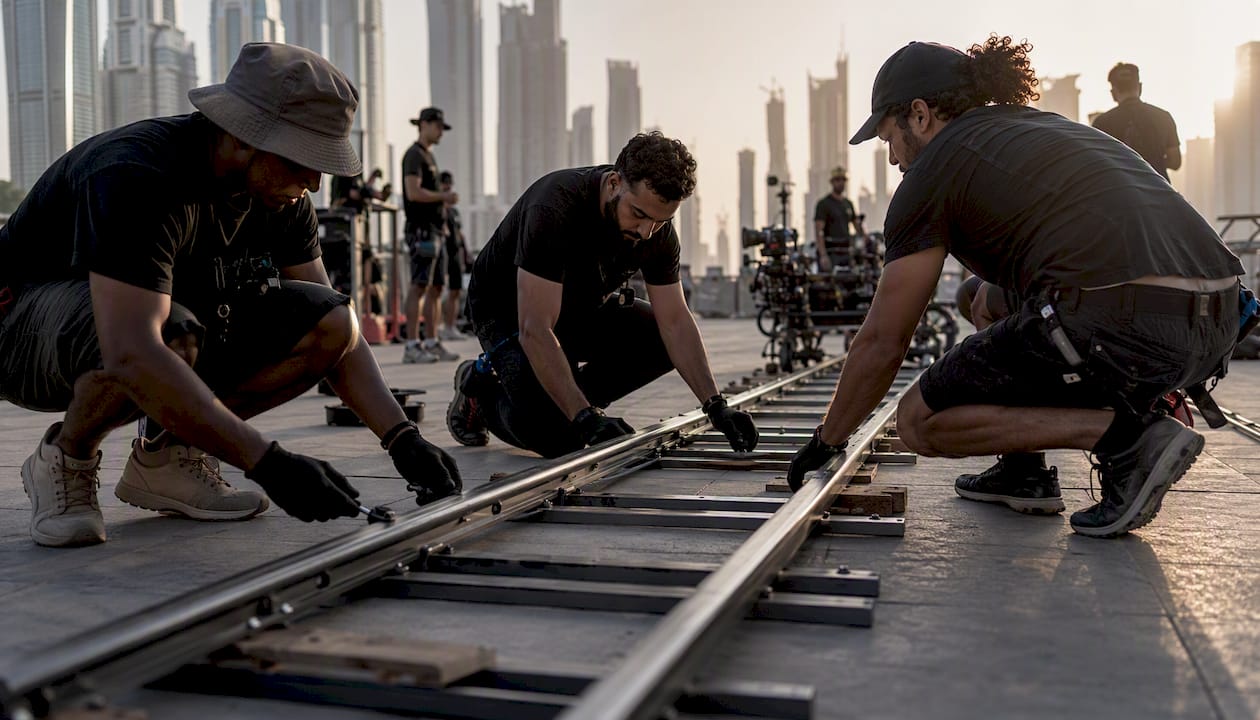
Electricians (Lamp Operators) — Position, cable, and operate lighting fixtures under the gaffer’s direction. On larger productions, electricians specialize in rigging (working at height) or floor operations.
Safety in grip and electric is non-negotiable. Rigging at height requires fall-arrest equipment and a designated rigger with verified competency. Stunt coordinators and safety officers assess risk on set, but the gaffer and key grip are responsible for the safety of their own departments’ rigging operations. Every electrical connection on a set must be made by a qualified electrician — never by a PA or a grip.
Pro Tip: If you are new to the electric department, learn the names of every fixture in the truck before your first day. Gaffers lose patience quickly when a lamp operator asks what a 1.2K HMI is.
What does the sound department do during principal photography?
Sound is captured once. Unlike a poorly lit frame that can sometimes be corrected in color, unusable audio means a reshoot or expensive ADR (automated dialogue replacement) in post. The sound department’s discipline on set protects the entire production.
Production Sound Mixer — The head of the sound department. The mixer selects microphones, designs the recording setup, monitors audio levels in real time, and delivers clean, organized sound files at the end of each day. The mixer works from a cart equipped with a multi-track recorder, a mixer board, and a timecode generator.
Boom Operator — Positions the boom microphone to capture dialogue without entering the frame. The boom operator must know every line of dialogue, every camera angle, and every actor’s movement pattern — often before the director finalizes the blocking. Physical stamina and acute spatial awareness define the role.
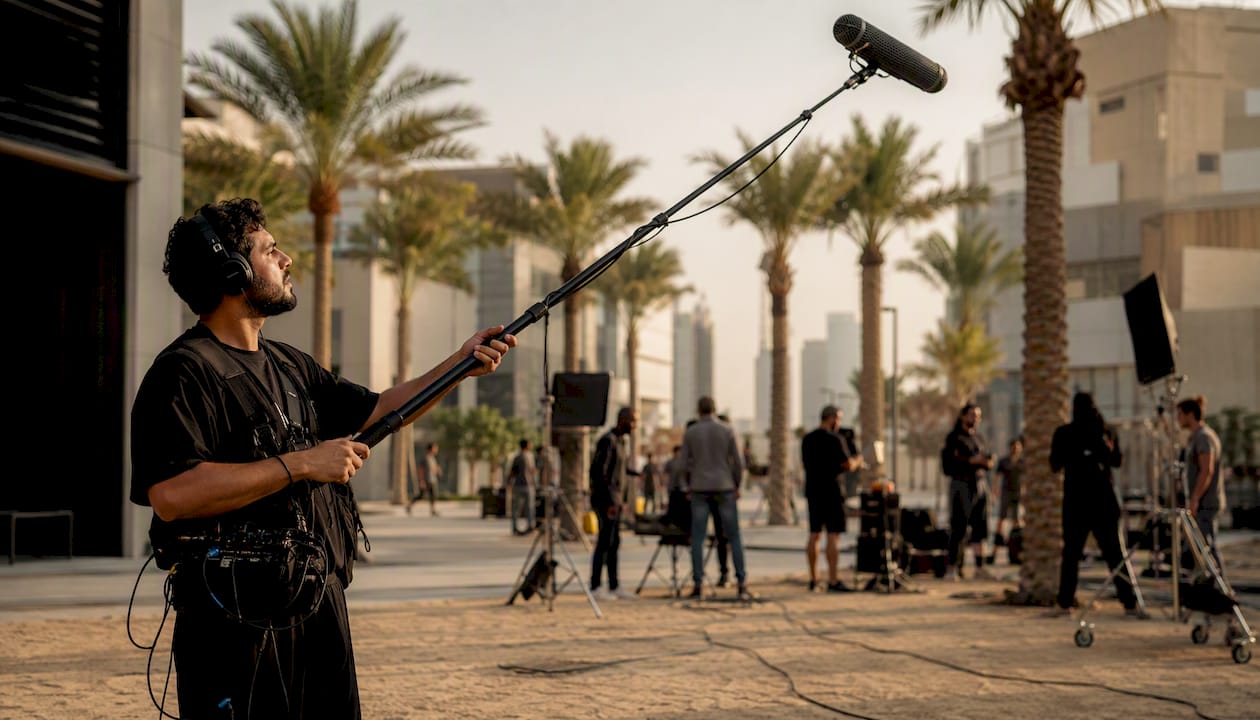
Sound Utility / Cable Person — Places and manages wireless lavalier microphones on talent, runs cables, maintains the sound cart, and supports the mixer and boom operator throughout the day. On smaller productions, the boom operator absorbs these duties.
Common equipment includes Lectrosonics or Zaxcom wireless systems, Schoeps or Sennheiser boom microphones, Sound Devices recorders, and Ambient timecode slates. Timecode synchronization between the camera and sound recorder is the 2nd AC and sound utility’s shared responsibility at the start of each day.
Sound coordinates directly with post: organized sound reports, clearly labeled files, and accurate metadata prevent editorial delays. The mixer delivers a production sound report with every day’s media, noting which takes are circled (selected by the director) and any audio anomalies.
Pro Tip: On set, “quiet please” is a request. “Rolling” is a command. When the 1st AD calls rolling, every conversation stops — including yours, regardless of how urgent it feels.
How does the art department build the world of a production?
The art department creates every visual element the camera sees that is not a performer. From the color of a wall to the brand of a cereal box on a kitchen counter, the art department makes deliberate choices that communicate character, period, and tone.
Production Designer — The creative head of the art department. The production designer establishes the visual concept for the entire production in collaboration with the director and DP. Every set, location modification, and prop category flows from the production designer’s vision.
Art Director — Translates the production designer’s concepts into technical drawings, budgets, and construction schedules. The art director manages the scenic construction crew and ensures that built sets meet both creative and structural requirements.
Set Decorator — Responsible for every object inside a set that is not a structural element: furniture, drapery, artwork, plants, and surface dressing. The set decorator works with a team of buyers who source items from vendors, rental houses, and prop houses.
Prop Master — Manages all props that actors handle or interact with directly. A prop’s lifecycle on a production follows a clear path: the script supervisor or director requests it, the prop master sources and approves it with the production designer, and it is logged in and out of the prop truck each shooting day. Continuity between takes is the prop master’s responsibility.
Leadman — The set decorator’s on-set supervisor, managing the swing gang (set dressers) who physically dress and strike sets between setups.
Set Dresser — Executes the set decorator’s plan, placing and adjusting set dressing elements on the day. Set dressers work quickly and quietly, often dressing a set while the camera department is lighting the previous one.
Scenic Carpenter / Construction Coordinator — Builds and modifies physical sets. The construction coordinator manages the carpentry, paint, and labor crews who construct environments from the art director’s technical drawings.
The art department coordinates closely with the locations department (to understand what modifications a location will permit) and with the camera department (to understand which walls may need to be wild, or removable, for camera access). The line producer and UPM review art department budgets weekly, since set construction and prop acquisition are among the most variable cost centers on any production.
What do wardrobe, hair, and makeup departments manage on set?
These three departments share a common purpose: ensuring that every performer looks exactly right, and that “exactly right” is reproducible across every take, every day, for the entire shoot.
Costume Designer — The creative lead of the wardrobe department. The costume designer develops the clothing concept for every character in collaboration with the director and production designer, then sources, builds, or rents the garments that realize that vision.

Wardrobe Supervisor / Costumer — Manages the day-to-day operations of the wardrobe department: scheduling fittings, maintaining the costume inventory, coordinating with the production office on budget, and supervising set costumers. The wardrobe supervisor is the costume designer’s operational partner.
Set Costumer — Works directly on set, managing costume changes, maintaining continuity between takes, and handling emergency repairs. The set costumer keeps a wardrobe log documenting exactly what each performer is wearing in each scene, including accessories, layering, and any distressing.
Hair Stylist — Designs and maintains hairstyles for all performers. On productions with period or character-specific requirements, the hair department may include wigmakers and additional stylists for background performers.
Makeup Artist — Applies and maintains makeup for all performers, from naturalistic beauty looks to character and special effects makeup. On productions with prosthetics or creature work, a separate SFX makeup team operates under the makeup department’s umbrella.
Wardrobe logs and labeled costumes are the primary tools for preventing continuity errors — errors that are expensive to fix in post when an editor discovers a jacket was buttoned differently between two shots that must cut together. The script supervisor cross-references wardrobe notes with scene continuity records.
Pro Tip: If a costume tears or a button breaks mid-shoot, the set costumer’s emergency kit — needle, thread, safety pins, double-sided tape, and a steamer — is the fastest solution. Never let a costume emergency halt a shooting day without first checking with the set costumer.
What do script supervisors, location managers, casting directors, and stunt coordinators do?
These roles are sometimes grouped under “specialized crew,” but each is a department unto itself with distinct responsibilities, reporting lines, and professional standards.
Script Supervisor — The continuity authority on set. The script supervisor tracks every detail of every take: which lines were delivered, which props were used, camera angles, actor positions, and timing. The script supervisor’s notes are the editor’s primary reference for assembling a coherent cut.
Location Manager / Location Scout — Identifies, negotiates, and manages all filming locations. The location manager secures permits from local film offices (in Los Angeles, this means the FilmLA permit office; in New York, the Mayor’s Office of Media and Entertainment), coordinates neighbor notifications, arranges parking and holding areas, and manages location fees. The location scout researches and photographs potential locations before the location manager finalizes agreements.
Casting Director — Leads the process of identifying and selecting performers for all roles. The casting director works with the director and producer to define character requirements, organizes auditions and callbacks, negotiates with talent agents, and manages SAG-AFTRA contract compliance for union productions. Background casting is often handled by a separate background casting agency under the casting director’s oversight.
Stunt Coordinator — Designs, rehearses, and supervises all stunt sequences. The stunt coordinator assesses risk for every stunt, creates a written risk assessment, and coordinates with the 1st AD and production to schedule adequate rehearsal time. Safety and medical coverage are core production responsibilities: stunt coordinators assess and manage risk, and productions typically require a designated medic or safety officer when stunts or hazardous conditions are present.
Special Effects (SFX) Supervisor — Manages practical on-set effects: rain rigs, wind machines, fire, breakaway props, and mechanical effects. The SFX supervisor coordinates with the stunt coordinator when effects and stunts intersect, and with the VFX supervisor to determine which elements are captured practically versus added in post.
Set Medic / Safety Officer — Required on any production involving stunts, hazardous materials, or extreme conditions. The set medic maintains a medical kit, monitors crew health during long shooting days, and is the first responder in any on-set emergency.
What happens in post-production and who handles it?
Post-production is where the raw material of principal photography becomes a finished work. The handoff from production to post is a critical operational moment: organized media, metadata, sound files, and continuity notes prevent costly rework and keep the editorial schedule on track.
Editor — The primary creative collaborator in post. The editor assembles the footage into a coherent narrative, working first in an offline edit (lower-resolution proxies) and then in an online edit (full-resolution, color-graded master). The editor works closely with the director through multiple cut stages: assembly, rough cut, director’s cut, and picture lock.
Assistant Editor — Manages the technical infrastructure of the editorial suite: ingesting media, syncing audio, organizing bins, and maintaining the project file. The assistant editor also coordinates with the DIT on media verification and with the sound department on audio deliverables.
Post-Production Supervisor — Coordinates the entire post pipeline: editorial, color, sound, VFX, music, and delivery. The post supervisor manages schedules, vendor relationships, and the final delivery specifications for distributors or broadcasters.
Colorist — Applies the final color grade to the picture-locked edit, working from the DP’s creative intent and the delivery specifications of the platform or distributor. The colorist uses tools like DaVinci Resolve to shape the image’s tone, contrast, and palette.
Sound Editor / Re-recording Mixer — Designs and mixes the final audio: dialogue editing, ADR, sound effects, Foley, and music. The re-recording mixer balances all audio elements into the final mix, delivered in formats specified by the distributor (stereo, 5.1, Dolby Atmos).
VFX Supervisor — Oversees all visual effects work, from on-set supervision (ensuring that practical elements are captured correctly for compositing) through the delivery of finished VFX shots. The VFX supervisor coordinates with the editor on shot lists and with the colorist on matching VFX shots to the grade.
Composer — Creates the original score. The composer typically begins work after picture lock, though on larger productions temp music guides the editorial process from early cuts onward.
Pro Tip: A well-managed media workflow — clear naming conventions, checksum-verified backups, and verified offloads at wrap — is the single most reliable way to avoid reshoots and editorial delays. The DIT and assistant editor should confirm every card’s offload before any media is reformatted.
How do you read a crew list and call sheet?
A call sheet is not a document you skim. It is the operational blueprint for a shooting day, and every crew member is expected to arrive having read it in full.
A standard U.S. call sheet contains the following sections:
- Production header — Project title, production company, date, shooting day number, and general crew call time
- Shooting schedule — Scene numbers, locations, cast members required, and estimated page count for each scene
- Cast call times — Individual call times for each principal performer, including makeup/hair call and set call
- Department call blocks — Call times for each department (camera, grip, electric, sound, art, wardrobe, hair/makeup), listed separately from cast
- Location details — Address, parking instructions, holding area, and nearest hospital (required on all U.S. union call sheets)
- Advanced schedule — The next day’s planned scenes, giving departments time to prep
- Safety notes — Any hazards, stunt sequences, or special conditions requiring crew awareness
A crew list functions as a dynamic project-management asset that tracks day rates, location releases, and contact information, and generates the call sheet’s department blocks. Cloud-based templates allow producers and department leads to access tailored views of the same underlying data.
When you arrive on set, check in with your department head or the 2nd AD, confirm your position on the call sheet, and locate your department’s staging area. Do not assume your call time is the same as the general crew call — department calls vary, and arriving at the wrong time is a professional misstep.
Pro Tip: Save every call sheet you receive. They are a record of your credits, your contacts, and the productions you have worked on — the raw material of your professional history.
How do you start a career in production in the U.S.?
The path into the industry is less mysterious than it appears, and more dependent on consistency than on any single credential. Here is a practical first-six-months roadmap:
- Apply for PA positions on local productions, student films, and commercial shoots. Platforms like ProductionHUB, Mandy, and local film commission crew registries list open calls regularly.
- Volunteer on student film sets at nearby film schools. These sets offer real experience, real credits, and real relationships without the pressure of a paid production.
- Take a short technical course in your target department — camera operation, sound recording, or production coordination. Organizations like the American Film Institute (AFI) and local IATSE training programs offer accessible entry points.
- Build your crew list from day one. Every person you work with — their name, role, contact, and the production — goes into a spreadsheet or a tool like Airtable. A practical career path for many U.S.-based crew begins by working as a PA, building references on local shoots and student films, and joining local crew lists or unions when eligible.
- Ask for references after every production. A written reference from a production coordinator or department head carries more weight than a resume line.
- Research union requirements for your target department before you need them. IATSE membership requires accumulating qualifying hours in your local; DGA membership requires meeting specific employment thresholds; SAG-AFTRA governs performers and some broadcast roles.
Union vs. non-union: what it means for your career
In the U.S., union status affects your minimum day rate, your access to benefits (health insurance, pension), and which productions you can legally work on. IATSE covers most below-the-line technical crew across its various locals (Local 600 for camera, Local 728 for lighting, Local 44 for art department, among others). The DGA covers directors, UPMs, and ADs. SAG-AFTRA covers performers and some broadcast technicians.
Non-union productions offer more flexibility in hiring and scheduling but typically pay lower rates and provide no benefits. Many crew members begin on non-union productions, accumulate experience and references, and then pursue union membership when their hours qualify.
Freelance vs. staff positions
The vast majority of film and television crew work on a freelance basis, hired per production. Staff positions exist primarily at studios, networks, and post-production facilities. Freelancing offers variety and the ability to build a diverse credit list; it also means managing your own taxes, health insurance, and retirement savings between jobs. Building a reputation for reliability and craft within a specific department is the most direct path to consistent freelance work.
Pro Tip: Build your crew list as a living document, not a static contact sheet. Note the productions each person worked on, their specific role, and any personal detail that helps you remember the relationship. The crew members who rehire you are the ones who remember working with you — make it easy for them to find you.
What on-set etiquette actually shapes a career?
The technical knowledge required for any production crew role can be learned. What separates crew members who get rehired from those who do not is almost always behavioral — how they move through a set, how they communicate, and how they respond to pressure.
Arriving early is not a courtesy; it is a professional baseline. A crew member who arrives at call time is already behind the department head who arrived thirty minutes earlier to prep. The first week on any new production is an audition for the next one, and punctuality is the first signal you send.
Respecting the quiet set is the second. When the 1st AD calls for quiet, conversation stops immediately — not after a sentence is finished, not after a point is made. The discipline of a quiet set protects the sound department’s work and signals to every department head that you understand the hierarchy of the shooting day.
Following AD instructions without negotiation is the third. The 1st AD’s decisions about schedule and safety are not suggestions. When an AD redirects you, the correct response is acknowledgment and action. Questions about why come later, privately, and only when they are genuinely necessary.
These three habits — punctuality, silence discipline, and AD deference — are not abstract etiquette. They are the visible markers that department heads use to decide who gets the call for the next production. A crew member who embodies all three, even at the PA level, moves through the industry with a momentum that technical skill alone cannot generate.
Assembling the right talent for your production
A production is only as strong as the people behind it. Whether you are casting a commercial campaign, staffing a branded content shoot, or building a full creative team for an editorial project, the quality of your crew list determines the quality of your final image. ANT Management connects brands and production teams with rigorously curated talent — from models and influencers to photographers, videographers, stylists, and stunt coordinators — across international markets with a network spanning Europe, the U.S., and Asia.
Explore ANT Management’s talent roster and discover how a structured, professionally managed approach to talent and crew sourcing transforms the production process from the first call sheet to the final frame.
Sources
The following resources cover unions, templates, and authoritative references for anyone building a career in U.S. film and television production:
- Film crew
- Essential Guide: Film Crew Positions | Wrapbook
- Free Film Crew List Template - Airtable
- Film crew positions | OnAssemble