UGC Platforms for Brands: Hire Vetted Creators at Scale

The clearest path to ad-ready, user-generated-style content is a full-service UGC talent agency — one that handles casting, brief-driven production, and paid-media usage rights from a single engagement. For brands running active paid social on Meta or TikTok, that means choosing a partner like ANT Management, which brings vetted creators, editorial-grade production supervision, and licensing clarity to every campaign. Before you reach out to any agency, prepare a brief that specifies your KPIs, target platforms, and expected monthly asset volume. That document will compress your scoping timeline and sharpen every conversation that follows.
Key Takeaways
Hiring a full-service UGC talent agency is the most reliable path to ad-ready creator content at scale — combining vetted talent, production management, and clear licensing into a single, repeatable engagement.
| Point | Details |
|---|---|
| Choose agency over freelance | End-to-end agencies eliminate the coordination overhead of managing multiple creators individually. |
| Insist on rights clarity | Confirm platforms, duration, geographic scope, and exclusivity in writing before production begins. |
| Require modular asset delivery | Each shoot should yield multiple hooks, variants, and platform crops for A/B testing. |
| Confirm FTC compliance knowledge | Agencies must understand U.S. disclosure requirements for paid placements on Meta and TikTok. |
| ANT Management as your partner | ANT Management offers casting, production, licensing, and talent development (ANT Camp) for U.S. brand campaigns. |
Table of Contents
- What do UGC talent agencies actually do for brands?
- Why premier agencies deliver more than freelance creator networks
- How do you evaluate and select a UGC talent agency?
- What pricing, timelines, and deliverables should you expect?
- What does the agency workflow look like from brief to published assets?
- ANT Management and how the agency supports U.S. brands
- Why the agency-led model is the right call for paid social at scale
- What ANT Management offers brands ready to move forward
- Sources
What do UGC talent agencies actually do for brands?
The phrase “ugc platforms for brands” covers a wide range of services, but the most productive interpretation is a talent agency that casts, directs, and delivers creator-led content built for paid placement. This is distinct from software platforms that aggregate organic posts. A talent agency owns the production chain.
Core services include:
- Casting creators, models, and influencers matched to your category and brief
- Scriptwriting and on-brand creative direction
- Production supervision, whether on-location or remote capture
- Editing and formatting to platform specs (vertical 9:16, square, horizontal)
- Rights management and paid-media usage licensing
- Final delivery in ad-ready file formats
The process follows a clear sequence. First, the agency aligns on brief and KPIs. Second, it selects and confirms talent. Third, production proceeds under supervised direction. Fourth, edited assets pass through creative and legal approval gates before final delivery. As Digiday reports, creator agencies are consolidating production, talent management, and business operations into end-to-end service models — a structural shift that makes them far more capable partners for brands than a simple creator marketplace.
Why premier agencies deliver more than freelance creator networks
The practical advantages of a full-service agency compound quickly once a brand moves beyond one-off content requests.
Key benefits:
- Vetted, reliable talent recruited for category fit, on-camera quality, and brief adherence rather than follower counts
- Production project management that removes the coordination burden from your internal team
- Rights and compliance handled at the contract level, including FTC disclosure requirements for paid placements
- Scalability for paid social, with structured delivery cadences that match your media buying rhythm
- Modular assets — multiple hooks, angles, and crops from each shoot, ready for A/B rotation
Pro Tip: Prioritize creators who can follow a written brief and deliver at least three distinct variants per concept. A single shoot that yields one polished video is a missed testing opportunity; three variants from the same session give your media team real data.
Brands running active paid social programs should plan for 10–30 new UGC pieces per month to keep creative rotations fresh and support iterative performance testing. That volume is difficult to sustain through freelance management alone.
Performance-focused agencies structure every concept for testing, delivering multiple content variations from a single brief so media buyers can identify winning creative faster. That systems-level thinking is what separates a production-capable agency from a talent directory.
How do you evaluate and select a UGC talent agency?
The evaluation process rewards specificity. Generic capability claims matter far less than documented process and verifiable output.
Decision criteria checklist:
- Talent vetting process — how are creators screened for category fit, reliability, and on-camera quality?
- Production capacity — can the agency handle your monthly volume without quality degradation?
- Rights and licensing clarity — are paid-media usage rights granted on delivery, or negotiated separately?
- Platform delivery specs — does the agency format assets for Meta, TikTok, YouTube Shorts, and CTV natively?
- Performance test design — does the agency structure shoots to yield multiple variants per concept?
- U.S. compliance knowledge — does the team understand FTC guidelines for sponsored content and paid placements?
- Case studies — can the agency show documented outcomes from comparable campaigns?
Questions to ask in the first conversation:
- Walk me through your roster selection process for a new category.
- Can you share an example of a modular asset pack delivered for a paid-social campaign?
- What is your standard turnaround from signed brief to final delivery?
- How are revisions handled, and what is the revision limit per asset?
- What rights does the brand hold on delivery, and what triggers a usage extension fee?
- What is your kill-fee policy if a campaign is paused mid-production?
Red flags to watch for:
- Vague rights language (“usage rights included” with no platform, duration, or geographic scope defined)
- No documented process for platform-specific formatting
- Creators who negotiate briefs rather than execute them
- Average turnarounds longer than three weeks with no expedited option
- Absence of any U.S. FTC compliance knowledge or disclosure protocol
Talent management agencies that negotiate rates, deliverables, exclusivity, and usage rights on behalf of creators bring that same contractual precision to brand engagements — which means the licensing terms you receive are structured, not improvised.
What pricing, timelines, and deliverables should you expect?
Common pricing structures:
- Per-asset pricing suits brands testing a new category or format before committing to volume.
- Campaign bundle pricing covers a defined number of assets, concepts, and creators for a fixed fee — the most common structure for quarterly paid-social programs.
- Monthly retainers work best for brands with consistent volume needs, providing priority access to vetted talent and predictable delivery cadences.
The right model depends on your monthly asset target. Brands producing fewer than ten pieces per month often find per-asset pricing more flexible; those producing twenty or more typically benefit from retainer economics.
Some agencies maintain large verified creator rosters and offer end-to-end production from brief to final delivery within ten days for standard workflows. Expedited timelines are possible but typically carry a premium.
Licensing checklist — confirm every item in your contract:
- Platforms covered (Meta, TikTok, YouTube, programmatic, CTV)
- Duration of usage rights (90 days, 6 months, perpetual)
- Geographic scope (U.S. only, North America, global)
- Exclusivity terms (category exclusivity, platform exclusivity, or none)
- Kill-fee structure if production is halted
- Usage extension fees and renewal process
What does the agency workflow look like from brief to published assets?
A well-run agency follows a structured sequence with defined approval gates at each stage.
- Brief and KPI alignment — the brand submits a creative brief covering product, audience, platform, tone, and performance goals.
- Concepting and scripting — the agency develops hooks, scripts, and shot lists, with brand sign-off before casting begins.
- Casting — talent is selected from the vetted roster based on category fit, aesthetic, and brief requirements.
- Production — shoot or remote capture proceeds under agency direction, with the brand invited to review raw footage before editing.
- Editing and variants — the agency cuts multiple versions per concept, formatted to each platform’s native spec.
- Internal QA and rights sign-off — assets are reviewed for brand compliance, FTC disclosure labeling, and usage rights confirmation.
- Final delivery — assets are packaged in a shared drive or delivery system, labeled by concept, variant, and platform.
- Performance feedback loop — the agency receives performance data from the brand to inform the next production cycle.
Modular packaging is the operational detail most brands underestimate. Each concept should yield at minimum a hero cut, a short-form variant, and platform-specific crops — giving media buyers a rotation set from a single production session.
ANT Management and how the agency supports U.S. brands
ANT Management brings a global talent network — spanning Europe, the U.S., and Asia — to brands that need creator-led content built for paid performance. The agency’s curation process screens talent across fashion, commercial, and digital categories, with particular depth in models, influencers, content creators, photographers, and videographers.
Services available to U.S. brands:
- Casting across model types (fashion, commercial, kids), influencers, and content creators
- Production supervision and creative direction for UGC-style ad content
- Editing and formatting for Meta, TikTok, and other paid-social platforms
- Rights and legal support for paid-media usage licensing
- Talent training and development through ANT Camp, the agency’s structured program for emerging creators
- End-to-end project management from brief through final delivery
Before contacting ANT Management, prepare your creative brief, monthly asset target, a sample of your current best-performing ads, and your platform mix. That preparation accelerates scoping and positions the agency to recommend the right talent and production structure from the first conversation.
Why the agency-led model is the right call for paid social at scale
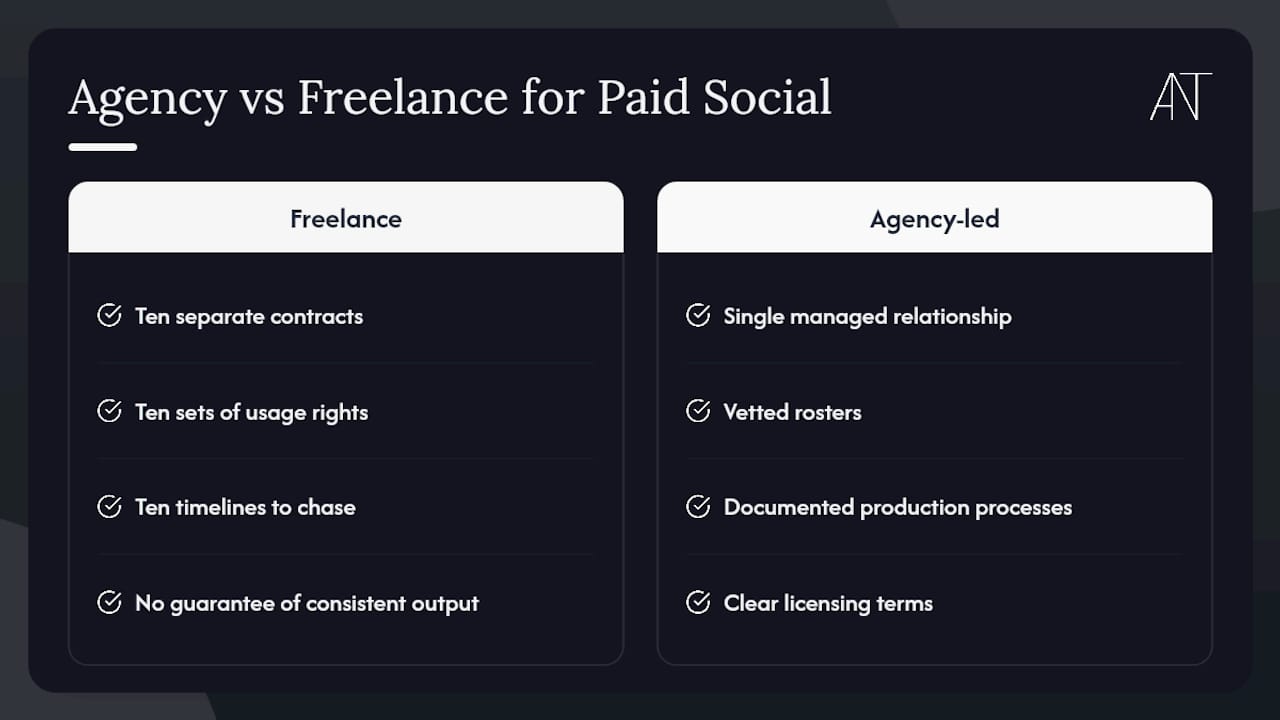
The conventional wisdom says brands should build creator relationships directly — that cutting out the agency saves money and preserves authenticity. The operational reality is more layered. Managing ten freelance creators individually means ten separate contracts, ten sets of usage rights to track, ten timelines to chase, and ten different interpretations of the same brief. At twenty creators per month, that becomes a full-time coordination role with no guarantee of consistent output.
An agency-led approach concentrates that operational complexity into a single managed relationship. Vetted rosters, documented production processes, and clear licensing terms are not administrative luxuries — they are the structural conditions that make paid UGC production repeatable. ANT Management’s talent training program, ANT Camp, adds a further dimension: creators who have been developed within the agency’s own standards arrive on brief with fewer revisions and stronger on-camera instincts. That investment in talent development is what distinguishes a premier agency from a casting directory.
What ANT Management offers brands ready to move forward
ANT Management delivers the full production chain — vetted talent, editorial-grade direction, platform-formatted assets, and usage rights — in a single engagement built for brands that need UGC-style content at a consistent monthly cadence. The agency’s global roster and structured onboarding mean your first campaign can move from brief to final delivery without the coordination overhead of managing creators individually.
To get started, prepare your creative brief, monthly asset volume target, platform mix, and two or three reference ads. Bring those materials to your first conversation with ANT Management and expect a scoping response within a few business days, with first delivery achievable on a standard production timeline.
Sources
- How creator talent agencies are evolving into multi-platform operators - Digiday
- Performance UGC Agency for Meta & TikTok Ads | inBeat Agency
- What Does a Talent Management Agency Actually Do?
- International UGC Agency | UGC Creator Management | PlusROI Media