
Fill Roles in a Week: Copy-Ready Casting Call Template for Creators

A usable casting call must name the project type, role title, shoot dates or location, pay or compensation terms, and exact submission instructions. Every one of those fields has to be stated, not implied. Clarity is what separates a notice that fills a role in a week from one that collects fifty irrelevant tapes and no answer to your actual question.
TL;DR:
- Listing shoot dates as a range and providing precise project details help actors determine availability and reduce irrelevant submissions.
- Character descriptions should focus on function and emotional traits, not physical features, with clear performance requirements and flags for special skills.
- Specify submission materials, process, and deadlines clearly, including self-tape format and testing logistics, to streamline review and communication.
- State pay and usage rights explicitly, including non-monetary benefits for unpaid roles, to establish credibility and attract serious applicants.
- Use specific, informative titles with bolded key details and separate roles to ensure the casting call attracts qualified, relevant talent quickly.
Table of Contents
- What Belongs at the Top of a Casting Call
- Character Breakdowns: How to Write Role Descriptions That Attract the Right Actors
- What to Request in Submissions and How to Run Auditions
- How to Be Transparent About Pay, Usage, and Safety
- Titling and Formatting Your Casting Call
- Copy-Ready Casting Call Template
- What Agencies Look for When They Scan a Casting Notice
- When to Bring In Casting Support
- Sources
What Belongs at the Top of a Casting Call
Before an actor reads a single character description, they need to know what the project is. Skip that, and you get submissions from people who never should have applied, along with silence from the people you actually wanted.
Start with the project title, the type of production (short film, feature, commercial, voiceover, theatrical run), and a one-line synopsis. Follow with your publish date, the shooting timeframe or exact dates, and the city or region where filming happens. Institutional casting guides, including Yale College’s casting resources, consistently structure breakdowns this way because scheduling clarity prevents the back-and-forth that eats up a casting timeline.
Name your creative team and production company, and disclose union affiliation upfront. A strong casting call always states the project description, dates, location, and compensation before it gets into character detail, and that order matters. Each of these elements filters your applicant pool before anyone opens a character breakdown.
- Project title, type, and synopsis
- Shoot dates or timeframe, plus city or region
- Production company and creative team names
- Union status (SAG-AFTRA, Equity, non-union, or not applicable)
Pro Tip: List your shoot dates as a range, not a single day, even for short projects. Actors juggle overlapping bookings, and a fixed single date without flexibility language quietly disqualifies people who would otherwise be perfect.
Character Breakdowns: How to Write Role Descriptions That Attract the Right Actors
A role breakdown works when it describes function and feeling, not physical inventory. Backstage’s guidance is direct on this point: role descriptions should center on character function and emotional beats rather than physical descriptors, and age or ethnicity should stay broad unless the story genuinely requires specificity.
A repeatable structure keeps every breakdown consistent: role name, approximate age range, pronouns, the character’s purpose in the story, and two or three emotional or behavioral cues. Then list performance requirements. Dialects, singing ability, stunt work, or intimacy scenes need to be flagged clearly, with mandatory needs separated from preferred ones.
- Role name, age range, pronouns
- Story function in one sentence
- Emotional or behavioral cues (guarded, impulsive, quietly commanding)
- Performance needs marked mandatory vs. preferred
Weak: “Attractive woman, 25 to 30, blonde, athletic build.” Strong: “MAYA, late 20s. A field medic who hides fear behind dry humor. Needs to convey controlled panic in a single unbroken take. Combat movement experience preferred, not required.”
Pro Tip: Read your breakdown as if you’re the actor deciding whether to apply. If you can’t tell what the character wants or fears in two sentences, the breakdown needs another pass.
What to Request in Submissions and How to Run Auditions
State materials and logistics with no ambiguity. Ask for a headshot, resume, a self-tape or reel link, and agency contact information if the performer is represented.
- Specify self-tape length (usually 60 to 90 seconds), a slate or introduction line, and a clean file-naming format like “LastName_FirstName_RoleName.mp4.”
- Confirm submission platform (email, casting site, or upload link) and whether virtual or in-person auditions follow.
- State when callbacks happen and how you’ll notify people, even the ones you’re not moving forward.
- Headshot and resume (PDF or linked)
- Self-tape or reel link
- Agent or manager contact, if applicable
- Confirmation of receipt within a stated window
A brief automated reply, something like “Thanks for submitting, we’re reviewing through [date] and will follow up with next steps,” keeps your inbox organized and your reputation intact. Applicants remember agencies and creators who communicate on time.
How to Be Transparent About Pay, Usage, and Safety
State the pay type outright: daily rate, flat project fee, or deferred payment, and whether that figure includes agency commission. For commercial work, disclose usage buyouts (broadcast, digital, regional, or worldwide) since usage terms often matter more to working actors than the base rate.
If the project is unpaid, list every non-monetary benefit clearly: copy of the final footage for a reel, meals, travel reimbursement, or on-screen credit. Even zero-budget productions read as more credible when they spell this out instead of leaving compensation vague.
- Pay structure (daily, flat fee, deferred) and whether it’s gross or net of agency fees
- Usage rights and buyout terms for commercial or branded content
- Travel, lodging, and per diem policy if shooting on location
- Safety disclosures: intimacy or stunt coordinators, hazardous scenes, health protocols
Industry checklists from Casting Networks list transparent compensation and disclosure of sensitive content among the top factors separating credible notices from ones experienced talent skip. Any intimate or hazardous performance requirement, and whether a coordinator will be present, needs to be stated plainly. Leaving it out is one of the more common and costly omissions in casting notices.
Titling and Formatting Your Casting Call
Your title is a filter, not a hook. A strong formula reads: role plus project type plus context, like “Casting Lead Actor for Short Brand Film” or “Seeking Background Performers, Non-Union Feature, Atlanta.” Vague titles like “Actors Needed!!” get buried and attract the least qualified applicants.
Bold your dates and pay so they’re scannable, break out each role under its own subheading, and keep requirement lists short enough to read in under a minute. Balancing specificity with openness before you post, deciding which details are fixed and which are flexible, keeps your applicant pool wide without sacrificing the information people actually need.
- Bold dates, location, and pay
- Separate subheading per role
- Plain, accurate industry terms, no genre-speak or slang
- No hidden fees, no bait-and-switch pay language
Pro Tip: Avoid words like “exposure” or “great opportunity” in place of actual pay information. Experienced performers read those as red flags and scroll past.
Copy-Ready Casting Call Template
Here’s a short version sized for a casting board or social post:
“Casting MAYA (late 20s, field medic, dry humor masking fear) for [Project Title], a short shooting in March 2026 in Austin, TX. Paid daily rate. Submit self-tape (about one minute, slate + sides) to casting@[email].com by the submission deadline.”
Below is the modular version for a full breakdown:
- Project: Title, type, one-line synopsis
- Dates/Location: Shoot dates, city, estimated shoot length
- Role: Name, age range, function, emotional cues, performance needs
- Compensation: Pay type, usage terms, or non-monetary details
- Submission: Materials required, self-tape specs, deadline, contact email
For self-tape instructions, paste this: “Submit a 60 to 90 second self-tape, slated with your name and role, filmed horizontally in good lighting, following best practices from our AI-assisted production workflows.” Name your file LastName_FirstName_RoleName.mp4 and upload via the link provided." For a downloadable version with editable fields, ANT Management’s casting brief template covers both formats.
What Agencies Look for When They Scan a Casting Notice
Agencies scan fast. A named contact, upfront pay and usage terms, and clean formatting signal a producer worth responding to first. Sloppy scheduling or vague compensation gets a notice set aside, regardless of how good the project sounds.
Pro Tip: Send your notice to an agency contact directly instead of posting it cold. A direct outreach with complete terms attached gets read before a public listing does.
— ANT
When to Bring In Casting Support
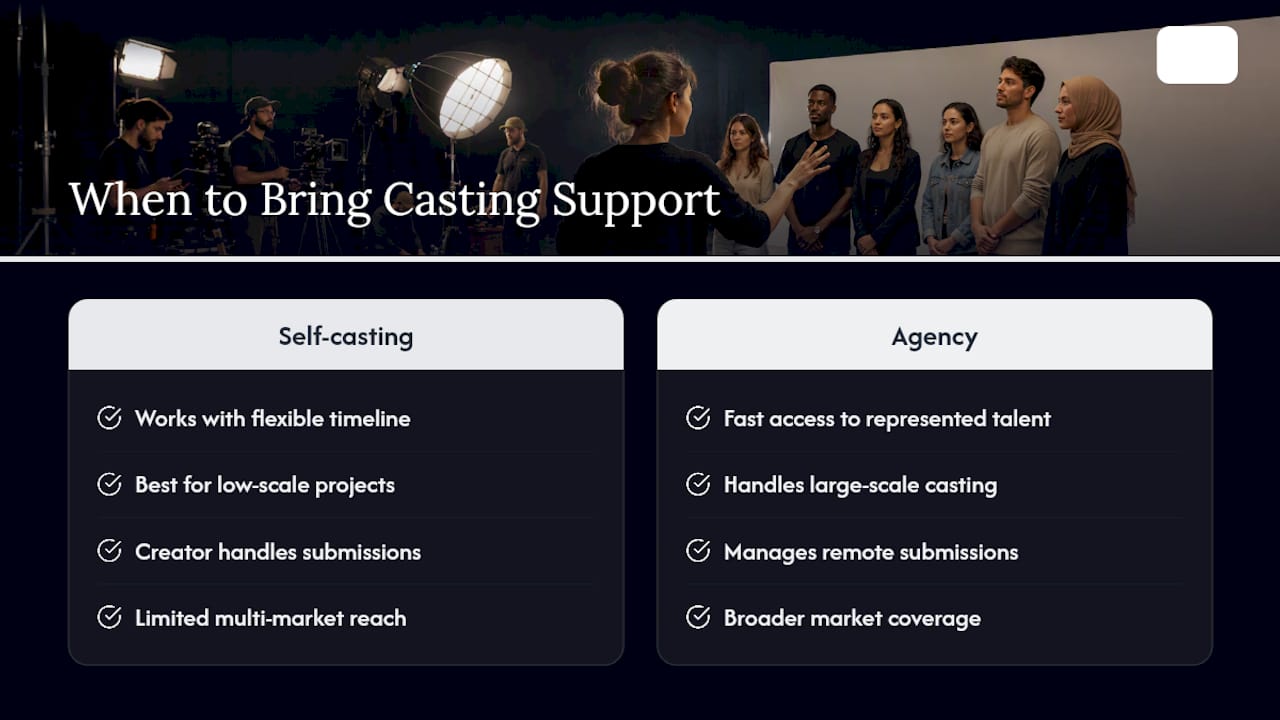
Self-casting works when your notice is airtight and your timeline has room for trial and error. It stops working once you need represented talent fast, need to fill roles across multiple markets, or need someone else handling submission volume so you can focus on the actual shoot. Independent creators regularly cast their own projects successfully, but the calculation changes once budget, scale, or deadline pressure enters the picture.
An agency can work as an extension of your production for exactly that scenario. Beyond sourcing talent, the agency curates across fashion, commercial, and creative categories, and its remote casting playbook covers submission handling for productions running distributed auditions. For projects that need broad representation without sacrificing fit, an agency’s approach to inclusive casting practices can help productions avoid the narrow breakdown language that quietly shrinks a talent pool.
Before reaching out, have your project synopsis, dates, and compensation terms ready. The tighter your materials, the faster an agency can move. If your production is based in the Gulf region, ANT Management’s Dubai agency page is the starting point for a talent consultation, with dedicated support for productions in Qatar, Saudi Arabia, and Kuwait.
Sources
For structural depth, Backstage’s character breakdown guide and FSU’s casting breakdown handbook offer sample forms. For low-budget adaptations, see the indie film casting guide.
- How to Write a Casting Call for an Indie Film
- How to Write a Casting Notice + Character Breakdown
- 5 Best Practices for Creating a Casting Call That Gets Results
- How to Post Casting Calls That Get Replies - Fameidols Talent Network