
Avoid No Shows: 4 Steps Brands Can Use With Online Casting Platforms

An agency-led online casting platform matches brands with curated, vetted models, influencers, and on-set talent, then handles the contracts, backups, and day-of logistics behind that booking. It suits any campaign with real visibility risk: multi-city rollouts, multiple talent slots, or activations where a no-show costs more than the booking fee. Some agencies operate this way, curating global rosters instead of leaving brands to sort submissions alone.
TL;DR:
- Agency-led platforms provide vetted, curated talent pools, reducing the risk of no-shows and last-minute substitutions for multi-city or high-stakes campaigns.
- The process includes four key checkpoints: targeted search, firm confirmation, day-of coordination, and performance logging, to ensure smooth execution and record-keeping.
- Agency staffing costs 30% to 50% more per hour than direct hires but offers benefits like insurance, backup plans, and on-site management that are crucial at scale.
- Effective briefs should focus on campaign goals and KPIs, with verified talents’ performance history, availability, and stamina being critical filters before booking.
- Platform vetting should cover talent verification, backup policies, clear pricing, international booking capabilities, secure data handling, and integration with production tools to avoid hidden risks.
Table of Contents
- How Does an Online Casting Platform Work for Brands?
- Agency-Managed Platforms vs. Direct Booking: What’s the Real Trade-Off?
- How Do You Write a Brief That Gets the Right Talent?
- What Should You Check Before Choosing a Casting Platform?
- Comparing Popular Online Casting Platforms on Features and Pricing
- How Secure Is Talent and Client Data on Casting Platforms?
- Can Casting Platforms Connect With Other Production Tools?
- Where Is Online Casting Technology Headed?
- What Do Successful Casting Bookings Actually Look Like?
- Why Agency-Led Casting Wins for High-Stakes Activations
- Book Curated Talent Through ANT Management
- Sources
- FAQ
How Does an Online Casting Platform Work for Brands?
Booking talent through an agency-led platform runs on a rhythm, not a scramble. The process moves through four checkpoints, each one closing a different kind of risk before it can become a day-of problem.
- Search and shortlist. You submit a brief. Verified profiles, filtered by market, look, language, and availability, come back as a shortlist rather than an open inbox of self-submissions.
- Confirmation. A written agreement locks rate, call time, wardrobe, location, and a point of contact. The strongest production checklists treat 14 days out as the deadline for a final brief and signed confirmation, with backup talent already identified.
- Day-of coordination. Someone on the agency side manages check-in, breaks, and any last-minute substitution, so a delayed flight or a sick call doesn’t become the brand’s emergency.
- Debrief and roster notes. Performance notes get logged after the event, which is what turns a one-off booking into a reusable roster for the next activation.
Each step exists because the alternative, sorting resumes and DMs by hand, tends to surface exactly the gaps this workflow is built to close: unclear rates, no backup plan, and no record of who actually performed well.
Agency-Managed Platforms vs. Direct Booking: What’s the Real Trade-Off?
Agency staffing typically runs 30% to 50% more per hour than booking talent directly. That premium isn’t padding. It buys vetting, insurance coverage, and a no-show buffer that a direct hire simply doesn’t carry.
The math changes with scale and stakes. A single local hire for a low-visibility shoot rarely needs an agency layer. A three-city product launch with fifteen talent slots is a different animal entirely, and hiring guides consistently point brands toward agencies once bookings cross that threshold.
What the premium actually covers:
- Lower no-show rates, backed by a predictable backup pool instead of a scramble for last-minute replacements.
- Reduced recruitment time, since sourcing and reference checks are already done before the shortlist reaches you.
- On-site management, so someone other than your own team is handling check-in, wardrobe issues, and schedule slippage.
- Insurance and contract protection that direct hires almost never carry.
Pro Tip: Run the math on your own hourly overhead before assuming direct hire is cheaper. If a marketing coordinator spends six hours sourcing and vetting one model, the “savings” from skipping an agency often evaporate before the shoot even starts.
Direct booking still makes sense for a single, local, low-stakes engagement, especially when you already have a trusted freelancer on file. Agency staffing earns its markup the moment a no-show would actually hurt the campaign.
How Do You Write a Brief That Gets the Right Talent?
A vague brief produces a vague shortlist. The fix starts with a single sentence: what does this campaign need talent to do, not just look like. “Drive 200 qualified leads at a three-day trade show” filters candidates differently than “look good in photos.”
- Write the one-sentence goal first. Tie it to a KPI, whether that’s lead capture, dwell time, or social reach, so the brief reads like a campaign document, not a mood board.
- Build the concise brief. Cover deliverables, hours, wardrobe, location, and the specific outcome you’re measuring against. Briefing talent on campaign KPIs instead of treating them as static props consistently improves measurable results.
- Filter with intent. Check availability against your actual dates first, then language fit, sample reels, and verified reviews from past bookings. Skip profiles with no verifiable history, regardless of how polished the photos look.
- Confirm stamina fits the shift. Professionalism and endurance matter more than appearance for anything past a two-hour call time. Build structured breaks into the schedule up front rather than discovering fatigue on-site.
- Onboard before the event, not on it. A short pre-event call, a run-through of the schedule, and a shared KPI briefing prevent the most common day-of confusion. Confirm emergency contacts and sign-off approvals at this stage too.
A short reel and a couple of client reviews tell you more than a full page of headshots ever will. If a platform lets you filter shortlists by verified reviews and availability windows, use that filter before anything else. Brands that treat this like a structured casting call process rather than open recruiting consistently report fewer surprises on set.
Pro Tip: Ask for a sample reel shot in conditions similar to yours, outdoor, low light, long shift. A polished studio portfolio doesn’t tell you how someone performs at hour six of a trade show floor.
What Should You Check Before Choosing a Casting Platform?
An RFP or quick decision matrix for any platform or agency should cover five areas, and skipping any one of them tends to surface as a problem after the contract is signed, not before.
- Vetting depth. Ask how candidates get verified, what performance history is tracked, and whether ratings come from real completed gigs.
- Backup policy. A platform without a stated no-show policy is asking you to absorb that risk yourself.
- Pricing clarity. Confirm exactly what the agency fee includes, staffing, insurance, on-site management, versus what gets billed separately.
- International capability. If your campaign spans borders, confirm the platform can actually book talent across markets, not just within one country.
- Project management tools. Calendar sync, secure payment processing, and digital contracts. Online contract and payment tools cut administrative errors sharply compared to email-and-spreadsheet coordination.
Insurance coverage deserves its own line item. A platform that can’t confirm liability coverage for on-site talent is transferring that risk to your event, whether or not anyone mentions it upfront.
Comparing Popular Online Casting Platforms on Features and Pricing
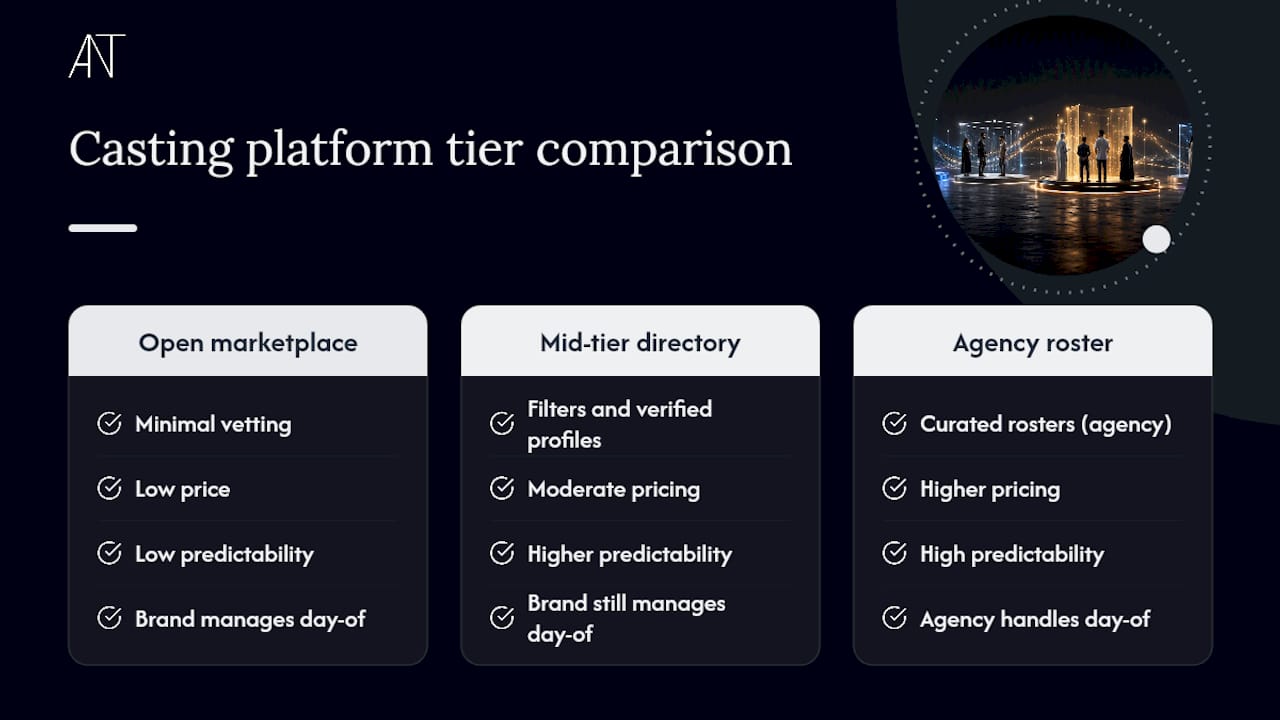
Casting platforms generally split into three tiers, and the differences matter more than the marketing copy suggests. Open marketplaces let talent self-submit with minimal vetting; pricing is low but so is predictability, since anyone can apply regardless of experience. Mid-tier directories add filters, verified profiles, and real-time availability, which speeds sourcing considerably compared to cold outreach, though day-of management still falls on the brand.
Some agencies operate in this tier, curating rosters across fashion, commercial, and influencer talent rather than functioning as an open submission board.
The right tier depends entirely on booking volume and risk tolerance. A single local shoot with a known freelancer doesn’t need agency overhead. A multi-market activation with a dozen talent slots and zero room for a no-show almost always justifies it. Pricing transparency is the one feature worth demanding regardless of tier: know exactly what’s bundled into any quoted rate before comparing numbers across platforms, since one provider’s “flat fee” and another’s “hourly plus travel” rarely mean the same total cost.
How Secure Is Talent and Client Data on Casting Platforms?
Casting platforms handle sensitive material on both sides: talent submit personal contact details, measurements, and portfolio images, while brands share unreleased campaign concepts and contracts before anything goes public.
For talent, the baseline protections worth confirming are limited profile visibility (not every detail should be public), secure storage for identification and payment information, and a clear policy on how long portfolio images stay on file after a booking ends. For brands, the concern runs the other direction: nondisclosure terms for unreleased creative concepts, and confirmation that contracts and payment details route through encrypted channels rather than email attachments.
Agency-led platforms tend to handle this more carefully than open marketplaces simply because the relationship is ongoing rather than transactional. A roster-based agency has a reason to protect both a model’s personal data and a brand’s confidential brief, since both sides are likely to return for future bookings. An open submission board, by contrast, has far less incentive to lock down information once a single gig closes.
Before signing with any platform, confirm who owns submitted images after the campaign ends, whether data gets shared with third parties, and how payment information is processed. These aren’t formalities. A platform that can’t answer them clearly is one where a data mishap becomes your liability, not just theirs.
Can Casting Platforms Connect With Other Production Tools?
Most brands don’t book talent in isolation. A casting decision usually connects to a call sheet, a shared calendar, a payment system, and sometimes a full production management suite already in use for the shoot.
The practical integrations worth checking are calendar sync (so confirmed bookings land directly on a shared production calendar instead of a separate spreadsheet), digital contract tools that route signatures without a print-and-scan detour, and payment platforms that handle deposits and final payouts without manual invoicing. Streamlined contract and payment tools cut down the administrative errors that tend to surface on event day, missed deposits, unsigned riders, wrong call times.
For photo and video-heavy campaigns, some brands also connect casting decisions to asset management tools, so a booked model’s reel or headshots flow directly into the production folder rather than living in a separate inbox. A resource like an event photography portfolio illustrates the kind of visual asset brands often request from talent before locking a booking, sample stills, lighting range, past event work.
None of this needs to be elaborate. The bar is simple: does the platform play well with the tools your production team already uses, or does it force a manual workaround at every step? A platform requiring double entry into three different systems adds exactly the kind of friction agency-led booking is supposed to eliminate.
Where Is Online Casting Technology Headed?
Casting technology is moving in a direction that favors curation over volume. A few shifts are worth tracking if you’re evaluating platforms for the next year of campaigns.
Verified performance history is becoming standard rather than optional. Instead of a static portfolio, platforms increasingly surface a talent’s actual gig history, ratings from real bookings, and reliability metrics tied to specific event types. This mirrors a broader shift toward treating campaign talent as strategic assets tied to measurable outcomes, rather than interchangeable faces.
Real-time availability calendars are replacing the back-and-forth email chain. Brands can now see open dates before reaching out, cutting sourcing time from days to a single afternoon in many cases.
KPI-linked briefing tools are also emerging on more sophisticated platforms, letting brands attach specific goals, lead targets, engagement benchmarks, directly to a booking so talent walk in already aligned with what success looks like. That single shift, briefing talent on outcomes rather than just appearance, is consistently linked to stronger campaign ROI.
None of these trends replace the fundamentals of a solid brief and a clear contract. They just remove friction from the parts of the process that used to eat the most time: sourcing, scheduling, and making sure everyone understands the goal before the shoot starts.
What Do Successful Casting Bookings Actually Look Like?
The clearest pattern across well-run bookings isn’t a flashy technology feature. It’s discipline in the basics: a written brief, a locked confirmation well ahead of the event, and a backup plan nobody hopes to use but everyone has ready.
A multi-city product launch with a dozen talent slots across three markets succeeds or fails on exactly this kind of coordination. When the confirmation, rate, hours, wardrobe, backup names, lands two weeks out rather than two days out, day-of surprises drop sharply. When it doesn’t, the brand ends up managing a crisis instead of running a campaign.

The other consistent thread is the roster effect. Brands that book through the same agency-led platform repeatedly build a shortlist of talent who already know their brand voice, their pacing, and their KPI expectations. That familiarity compounds. A model who’s worked three prior activations for a brand needs far less onboarding than a fresh booking, and tends to perform closer to expectations from the first call time. Debrief notes captured after each event are what make that compounding possible; skip them, and every booking starts from zero again.
Why Agency-Led Casting Wins for High-Stakes Activations
Models booked for a campaign aren’t decorative. They’re the front line of a brand’s message, and treating them as strategic assets tied to KPIs, not visual props, is what separates activations that convert from ones that just photograph well. Certain agencies build this into how talent get briefed and developed, including through structured programs that raise on-set performance before a shoot ever starts. A trained, KPI-briefed model outperforms an untrained one with better bone structure, every time visibility actually matters. Direct hire still has its place for a single low-stakes shoot with a known freelancer. For anything multi-city, multi-model, or genuinely high-visibility, the agency layer isn’t overhead. It’s the risk management the campaign actually needs.
— ANT
Book Curated Talent Through ANT Management
Some agencies give brands curated global rosters instead of an open submission pool, cutting the sourcing and vetting time that direct hiring quietly absorbs.
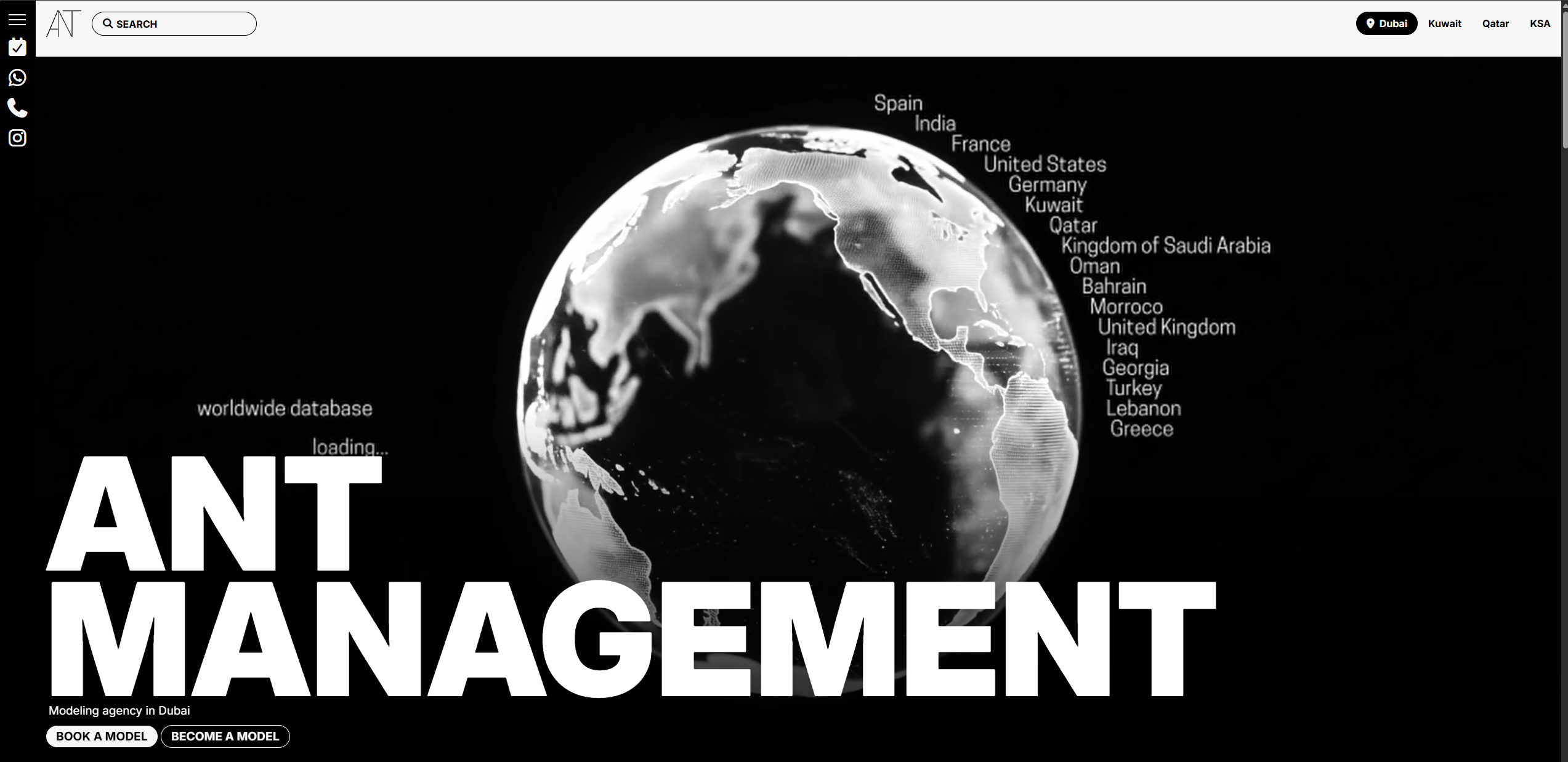
The agency’s scope covers fashion and commercial models, influencers, and on-set creatives, backed by production support that handles contracts, backups, and day-of coordination. Talent development runs through programs like ANT Camp, which means the roster arrives briefed and trained rather than photogenic and untested. Brands running activations across the Gulf region can work directly with regional teams, including dedicated agency contacts in Kuwait, Saudi Arabia, and Qatar. To move forward, request a quote through ANT Management’s main site with your campaign brief, dates, and talent count, and a curated shortlist follows from there.
Sources
- How to hire event staffing | ZipRecruiter
- Booking Models for Your Event: A Production Checklist | BookModels
- How to Hire Promotional Models: Agency vs Freelance (2026 Guide) | Street Teams Co
FAQ
What Is an Agency-Led Online Casting Platform?
It’s a service that matches brands with vetted, curated talent, models, influencers, and on-set creatives, while handling contracts, backups, and day-of logistics rather than leaving sourcing to open self-submission.
How Much More Does Agency Booking Cost Than Direct Hire?
Agency staffing typically runs 30% to 50% more per hour than direct hire, a premium that covers vetting, backup coverage, and reduced no-show risk.
When Should I Book Talent Directly Instead of Through an Agency?
Direct booking works well for a single local hire on a low-stakes shoot, especially with a freelancer you already trust; agencies earn their value once bookings involve multiple talent, multiple cities, or high visibility.
How Far Ahead Should I Confirm a Booking?
Lock the written confirmation, rate, hours, attire, location, and backup talent, roughly 14 days before the event to avoid last-minute scrambling.
Do agencies handle international bookings?
Some agencies coordinate talent across global markets, including support in multiple regions, making them suited to multi-city campaign rollouts.