
Performers: Land International Casting in 4 Channels With ANT

The fastest route into international casting is a compliant self-tape sent to vetted global platforms, casting directors, and agencies with genuine territory reach. Monitor casting aggregators, production open calls, and association member listings such as the International Casting Directors Association (ICDA), then build one polished materials pack you can deploy the moment a brief lands. Representation through an established agency can accelerate the process once your reels and resume are audition ready.
TL;DR:
- Focus on submitting a polished self-tape that clearly follows technical specs, is well-labeled, and highlights regional authenticity with relevant captions or dialect cues.
- Filter casting calls by territory, union status, and pay structure, and use saved searches and direct office contacts to stay organized and targeted.
- Confirm all legal details upfront, including work permits, contract scope, buyout specifics, and payment terms, before accepting international roles.
- Ensure your reel is concise, captioned in the primary language, and demonstrates cultural fit, especially for roles requiring regional nuance or language proficiency.
- Building relationships with reputable agencies and industry networks enhances your chances of landing international roles faster and more reliably.
Table of Contents
- Where to Find International Casting Calls and Platforms
- How to Prepare Professional Submission Materials
- How Does eCasting Work and Who Reviews Your Tape?
- Application Logistics: Pay, Buyouts, Travel, and Visas
- Understanding Cultural Differences in International Casting
- Navigating Legal Requirements and Contracts by Country
- Building International Industry Connections
- Managing Language Barriers in Casting
- ANT Management’s Perspective on Professional Representation
- Book Faster With ANT Management’s International Network
- Sources
- FAQ
Where to Find International Casting Calls and Platforms
International casting doesn’t live in one place. It moves across four distinct channels, each with its own rhythm, and treating them as interchangeable is where most performers lose momentum.
Commercial casting aggregators post the highest volume. ProjectCasting listings, for instance, regularly feature worldwide commercial casting calls for unique creators and specialists, open to applicants regardless of home market. Production and casting offices run their own open calls separately, often for feature work or co-productions that need very specific regional representation. Festival and co-production notices form a third lane, usually shorter windows tied to funding cycles in a particular country. Association member listings round out the picture, offering vetted casting director bios rather than raw job posts.
Search discipline matters more than search volume. Filter every listing by territory, day rate or buyout structure, and union status before you submit, because a role built for a UUK-only union performer wastes your tape if you’re not eligible.
- Set saved searches and alerts on major aggregators rather than browsing cold each week.
- Follow individual casting offices directly. Sien Josephine Teijssen’s casting office, for example, regularly handles European co-productions that value cross-territory viability.
- Join or monitor ICDA’s public listings for legitimacy screening built into the membership requirement itself.
- Watch for global campaigns naming priority markets outright; a tech talent casting call spanning the US, UK, Germany, Japan, and India is a useful example of how explicit that targeting has become.
- Don’t ignore open calls for new talent. ProjectCasting’s worldwide open casting call for emerging performers shows there’s real entry room even without prior credits.
How to Prepare Professional Submission Materials
A weak self-tape kills more international opportunities than a weak resume ever will. Digital casting has made the tape the primary audition, and casting directors now decide from footage alone far more often than they meet a performer in person first.
Frame yourself from mid-chest up against a plain background, with soft, even light on your face and no shadow cutting across your eyes. Record sound with an external microphone whenever possible; a phone’s built-in mic picks up room echo that reads as amateur the second a casting associate hits play. State your slate (name, height, location, and representation if any) at the start, export as MP4, and name the file with your last name and the role, exactly as the casting notice requests.
- Keep your reel under two minutes and lead with your strongest, most recent clip in the first ten seconds.
- Caption or subtitle any dialogue delivered in a language other than the production’s primary language.
- Include two current headshots, one commercial and one character, shot within the last twelve months.
- Attach a resume listing credits, training, special skills, union status, and passport or work eligibility notes.
- List an agent or direct contact number and confirm it’s monitored.
Localizing your reel with captions and role-relevant clips isn’t cosmetic. Global briefs increasingly name priority markets explicitly and expect performers to demonstrate regional fit at a glance, so a caption that flags “fluent Spanish, dialect neutral” can be the difference between a callback and a pass.
Pro Tip: Rename every file before you submit. “IMG_4821.mov” tells a casting associate nothing; “Martinez_LEADROLE_selftape.mp4” tells them everything in two seconds, and that speed is often what gets a tape actually opened.
The most common ways submissions get ignored: unlabeled files, audio recorded in a room with hard echo, aspect ratios that don’t match the platform’s spec, and reels so overproduced with music and transitions that the actual performance gets buried.
How Does eCasting Work and Who Reviews Your Tape?
Modern international casting runs almost entirely through eCasting, encrypted platforms where casting offices receive, timestamp, and sort submissions by role and territory. Casting director Nancy Bishop, CSA, notes that successful international casting depends on assembling talent who are creatively precise and strategically viable across multiple territories at once, which is exactly what a well-tagged, well-labeled tape helps a busy casting office assess quickly. Files that follow naming and metadata conventions move through review faster than files that don’t, according to guidance from DBPS Casting, which tracks eCasting workflows closely.
That shift means a strong tape can outperform having a local agent, since decisions increasingly happen remotely. It doesn’t mean every opportunity is legitimate, though.
- Confirm the casting director or office appears on an ICDA or CSA membership list before submitting anything.
- Ask for direct production contact details, not just a generic inbox.
- Request written payment terms upfront, including rate, schedule, and buyout scope
- Ask to see a sample contract before you commit to travel or exclusivity.
- Treat any request for an upfront fee, vague production details, or “pay to audition” language as a hard red flag.
Application Logistics: Pay, Buyouts, Travel, and Visas
Day rates and buyouts are not the same payment, and confusing them costs performers money. A day rate covers your time on set; a buyout covers the right to use your image or performance afterward, and buyout size varies sharply by platform: a social media placement, a national TV spot, and a global out-of-home campaign each carry different value because they reach different audiences for different durations.
Some listings do publish real numbers. Backstage’s roundup of global casting calls has cited day rates as high as AU$5,500 or $400 to $848.80 per day for select commercial bookings, though treat figures like these as examples of what’s possible, not a guaranteed norm across every market.
- Confirm who covers travel, lodging, and per diems before you accept, since norms shift by country and production budget.
- Ask about cancellation terms in writing, especially if you’re expected to hold dates exclusively.
- Get explicit territory, duration, and media-platform language in any buyout clause rather than accepting a vague “worldwide, all media” line.
- Clarify exclusivity: does accepting this role block you from competing brands during a specific window?
- Request a written offer, confirm the payment schedule, insist on a signed contract, and keep copies of every communication.
Understanding Cultural Differences in International Casting
Casting directors increasingly weigh cultural authenticity as a deciding factor, not a nice bonus. Bishop’s own approach treats a cast as strategically viable only when performers can carry regional nuance convincingly, and that standard shows up constantly on co-productions where a role written for one market gets cast, shot, and distributed across several.
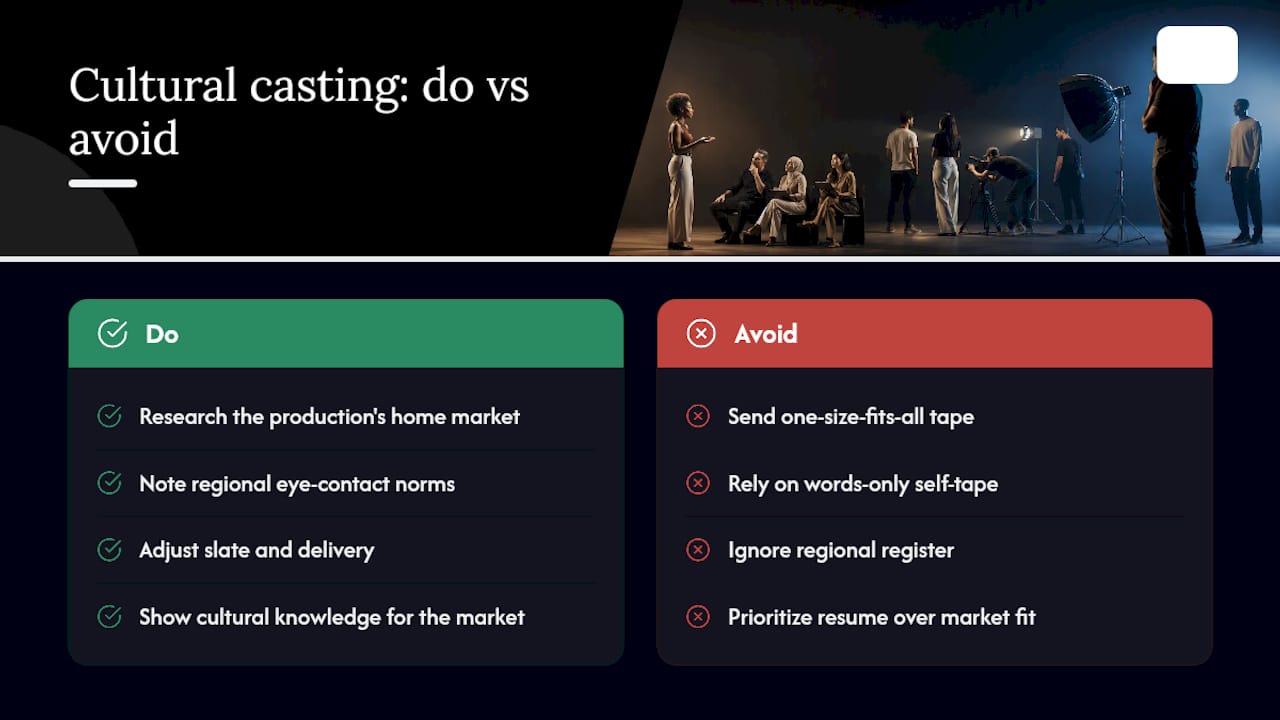
What reads as confident in one market can read as aggressive in another; what reads as warm in one culture can read as overly familiar somewhere else. A self-tape that nails the words but misses the register a director wants for that specific audience rarely advances, even when the performance is technically strong.
Casting professional Sien Josephine Teijssen, who works regularly on European co-productions, emphasizes cultural authenticity and cross-territory viability when building a cast, meaning a performer’s ability to represent a specific market convincingly often outweighs raw resume length. If a brief calls for someone who reads as authentically Northern European, or specifically Latin American, or unmistakably Southeast Asian, that specificity is the brief, not a suggestion.
Do your homework before you tape. Research the production’s home market, note any regional expectations around eye contact, physical space, humor, or formality, and adjust your slate and delivery accordingly. A performer who shows they understand the cultural target signals professionalism a generic, one-size-fits-all tape never will.
Navigating Legal Requirements and Contracts by Country
Every country handles performer contracts differently, and assuming your home market’s norms apply abroad is a common, avoidable mistake. Work permits, union recognition, minor performer rules, and tax withholding all vary by jurisdiction, sometimes drastically between neighboring countries.
Before accepting any international role, confirm whether you need a specific work visa or permit for the shoot location, since tourist status typically doesn’t cover paid work. Ask whether the production is signatory to a recognized performer union in that country, because that status affects minimum pay, break requirements, and dispute resolution options if something goes wrong on set.
Buyout and rights language deserves particular scrutiny. Industry guidance on rights and buyouts stresses asking for explicit territory, duration, and platform clauses in writing rather than accepting broad, undefined usage terms, since a contract that says “all media, all territories, in perpetuity” can quietly sign away far more than a single campaign’s worth of use.
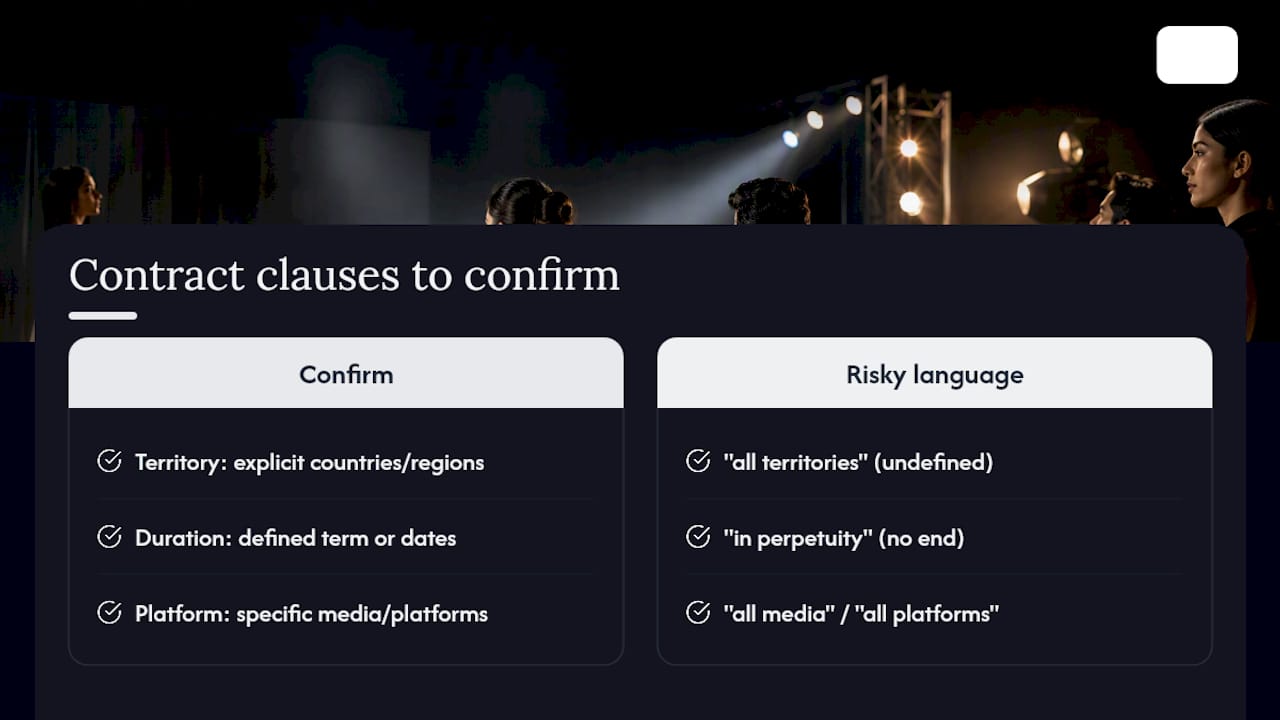
When a contract includes unfamiliar legal terms specific to that country, don’t guess at the meaning. Ask the production for plain-language clarification, or route the document through representation or an entertainment attorney familiar with that jurisdiction before you sign. A short delay for legal review costs far less than an unfavorable clause discovered after the fact.
Building International Industry Connections
Relationships travel further than any single audition. Casting directors, coordinators, and fellow performers who’ve worked internationally are often the fastest source of legitimate, unlisted opportunities, well before a role ever reaches a public casting aggregator.
Start by engaging directly with casting offices rather than only submitting blind. Following a specific office’s public listings, commenting thoughtfully when appropriate, and submitting cleanly formatted materials consistently builds familiarity over time, and familiarity is what gets your next tape opened faster.
Industry associations function as networking infrastructure as much as vetting bodies. ICDA membership connects you, even indirectly, to a network of casting professionals who share credibility standards across borders. Attending industry events, workshops, or training programs designed around international work puts you in rooms with people who make casting decisions, not just people applying alongside you.
Representation adds a structural layer to this networking. An agency with real reach across markets already holds relationships with casting offices in multiple territories, which means your materials reach decision makers your solo outreach might never find. That’s less about any single introduction and more about consistent presence: an agency keeps your name and reel in front of the right people between bookings, not just during an active search.
Managing Language Barriers in Casting
Language mismatches derail more submissions than performers realize, often before a casting director even watches the full tape. A brief written in one language, submitted through a platform interface in another, reviewed by a team split across two more, creates real friction if you don’t account for it upfront.
Read casting notices carefully for language requirements, and don’t assume conversational fluency counts if the role specifies “native” or “dialect neutral.” If a role requires a language you don’t speak fluently, say so honestly in your submission rather than risk a tape that falls apart the moment dialogue starts.
Caption your reel in the production’s primary language when your dialogue is in a different one, and note your actual language proficiencies plainly on your resume rather than rounding up. When corresponding with an international casting office, keep emails short, direct, and free of idiom that might not translate cleanly. Where real ambiguity exists, a quick clarifying question beats a guess that leads to a wasted tape or a missed technical spec.
ANT Management’s Perspective on Professional Representation
Agencies earn their place in this process by tightening what performers submit, not by replacing the self-tape. Materials polishing, direction tailored to a specific brief, and localization guidance turn a decent tape into a competitive one. Representation matters most on complex bookings: multi-territory buyouts, layered logistics, or productions that need coordination an individual performer can’t manage alone.
— ANT
Book Faster With ANT Management’s International Network
Some agencies provide performers a shortcut past the guesswork of solo international submissions through curated agency networks that have relationships with casting offices and brands running cross-border campaigns.
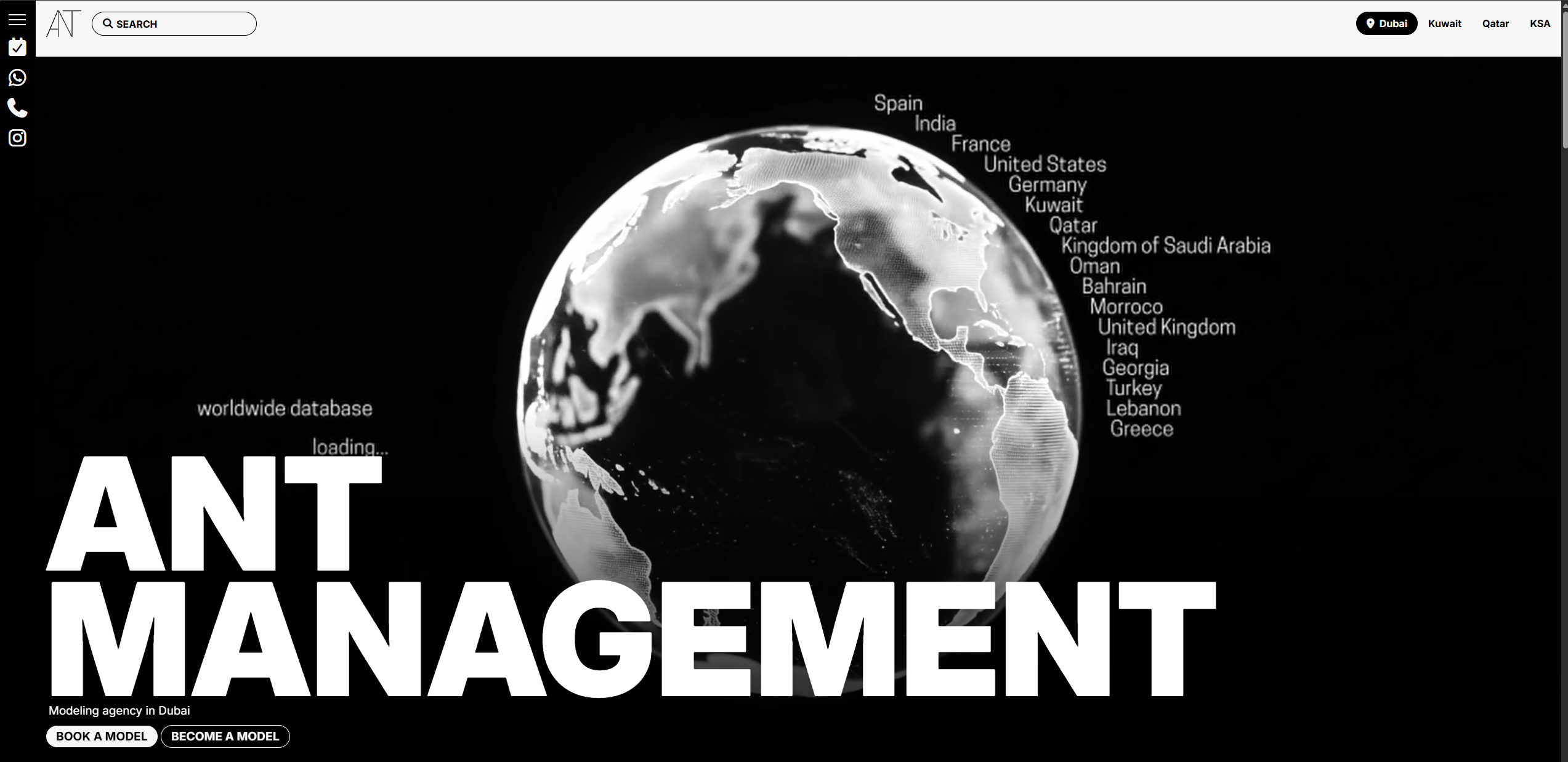
Through talent booking, influencer marketing, and sports talent booking, ANT Management coordinates the details that trip up independent submissions: buyout terms, travel logistics, and materials that meet each production’s actual spec. The agency also offers portfolio development and ANT Camp, a training program built to get performers audition ready before they ever tape a self-tape for a live brief. First contact typically starts with a materials review: send your current reel, headshots, and resume, and the team evaluates fit against active and upcoming briefs before outlining next steps. If you’re a performer or creative ready for coordinated international representation, visit ANT Management’s booking page to submit your materials and start the conversation.
Sources
FAQ
Is an International Casting Agency Real or Fake?
Most legitimate casting agencies never charge performers an upfront fee to apply or audition, so that’s the fastest test. Verify legitimacy through association membership like ICDA, direct production contact details, and clear written payment terms before sending materials or money anywhere.
How Do I Get Cast by Netflix?
Netflix productions typically cast through established casting directors and offices rather than accepting unsolicited public submissions, so the realistic path is building a strong reel, securing representation, and getting your materials in front of casting directors who work regularly on streaming productions. Monitoring casting aggregators and association listings for specific project notices is the practical starting point.
Which Casting Websites Are Legit?
Casting sites tied to recognized industry associations or with verifiable production contacts, clear payment terms, and no upfront fees are generally trustworthy. ProjectCasting listings, for example, regularly post worldwide commercial and open calls with named productions, which is a reasonable legitimacy signal compared to vague, anonymous postings.
What Are the Big Five Talent Agencies?
Definitions of the “big five” vary depending on the source and shift over time as agencies merge or expand, so there’s no single fixed list worth stating as fact. Performers are better served researching a specific agency’s current roster, territory reach, and verified bookings than chasing a ranked list.
Does ANT Management Help With International Casting?
Yes. ANT Management represents talent across fashion, commercial, and creative categories and coordinates international talent booking including logistics, materials review, and multi-territory campaign support. Current service details and booking terms are available directly on the agency’s site.