
Stop Collapsing Budgets: Treat UGC Creators and Influencers Separately

UGC creators sell brands assets they own outright, built for conversion; influencers sell access to an audience, built for reach. Prioritize UGC when the goal is ad performance and product-page proof, and influencers when the goal is awareness or credibility with a niche audience. Most mature paid social programs need both, running on separate budget lines with separate KPIs.
TL;DR:
- UGC content is typically a low-cost asset-focused production that can be reused across ads and product pages, while influencer content primarily builds awareness and credibility with a niche audience.
- UGC contracts transfer full usage rights and are best suited for conversion-focused campaigns, whereas influencer contracts usually grant limited licenses with higher costs for extended rights, making them more relationship and reach driven.
- UGC scales efficiently through operational expansion, while influencer programs depend on relationship management and typically grow with increased headcount rather than budget alone.
- For attribution, UGC performance is measured via click-through rates and return on ad spend, while influencer effectiveness relies on reach, impressions, and brand lift metrics.
- A combined approach involves using influencer campaigns for buzz and trust-building before deploying UGC to convert that awareness into measurable sales.
Table of Contents
- UGC creators vs influencers: how each role actually works
- What are the real differences between UGC creators and influencers?
- Should you choose UGC or influencers for your campaign?
- How much should you budget for UGC and influencer content?
- How do you brief and produce UGC content that actually converts?
- What does an agency actually add to UGC and influencer sourcing?
- Sources
UGC creators vs influencers: how each role actually works
The two terms get used interchangeably in briefs and pitch decks, and that sloppiness costs money. A UGC creator is hired to produce a deliverable: a piece of vertical video, a testimonial-style clip, a product demo, filmed to look native even though a brand commissioned and now owns it. Follower count is mostly irrelevant here. What you’re paying for is the finished file and the rights to run it as an ad. A UGC creator’s real product is the video itself, priced in the low hundreds of dollars and reused across ads, product pages, and email for months.
An influencer, by contrast, sells distribution. The content typically lives on the creator’s own channel, to their own following, and the value is the audience it reaches, not just the footage. Licensing that content for your own ads is usually a separate negotiation, often at a premium over the original sponsorship fee.
Two complicating factors show up constantly in practice:
- Hybrids exist everywhere. Plenty of influencers with modest but engaged followings will happily sell you a video as a pure UGC deliverable, no posting required, at UGC-adjacent rates. Meanwhile, some “creators” listed on UGC marketplaces have real audiences and will negotiate for a post too. Ask directly what you’re buying: the asset, the post, or both.
- Platform norms shape which format wins. TikTok’s algorithm rewards native-feeling clips regardless of who made them, which is why brands lean on UGC creators there. YouTube’s discovery model still favors established channels and long-form trust, which keeps influencer partnerships more valuable on that platform specifically.
The standard industry term for this whole category, when you’re briefing agencies or filling out a media plan, is “creator marketing.” UGC creators and influencers are both subsets of it, distinguished mainly by whether you’re buying an asset or buying reach.
What are the real differences between UGC creators and influencers?
Once you strip away the marketing language, the two tactics diverge on six dimensions that actually change how you plan, budget, and staff a campaign.
Distribution. UGC content posts wherever you decide to put it: paid social, your website, email flows, retail media. Influencer content posts on the creator’s own channel first, and any distribution beyond that is bonus or negotiated separately.
Ownership and usage rights. UGC contracts typically transfer full usage rights by default, since the entire point of the deal is that you own the file. Influencer contracts default to the opposite: the creator owns the content and grants you a limited license, often 30 to 90 days, unless you pay more for extended or perpetual usage. This is the single most common line item marketers forget to negotiate upfront and then pay for twice.
Cost. UGC videos commonly run in the low hundreds of dollars per asset, with price driven by revision count, hook variations requested, and whether the creator has niche expertise (skincare, fitness, tech unboxing). Influencer rates vary widely, from modest amounts for nano creators to very high fees for top-tier talent, with price driven almost entirely by follower count and engagement rate rather than production complexity.
Funnel role. UGC belongs at the bottom and middle of the funnel. It’s built to convert, tested in ad accounts against a specific product claim or offer. Influencer content belongs at the top: it builds awareness, seeds a launch, or lends third-party credibility to a category a brand hasn’t earned trust in yet. A skincare brand runs an influencer’s grid post to introduce a new serum to her audience, then runs a UGC creator’s demo of the same serum as a conversion ad targeting cold traffic that never saw the influencer post.
Scalability. UGC scales like a production line. More budget buys more creators, more videos, more hook variations, and the bottleneck is creative operations, not relationships. Influencer programs scale like a sales team: growth requires more outreach, more negotiation, more relationship management, and headcount tends to grow alongside campaign volume rather than staying flat.
Measurement. UGC gets measured the way any paid ad creative gets measured: click-through rate, cost per click, and ultimately return on ad spend inside the ad platform itself. Influencer content gets measured on reach, impressions, brand lift, and sentiment, metrics that rarely tie cleanly to a single sale and require a different measurement framework entirely.
Here’s the comparison in one view:
| Dimension | UGC creators | Influencers |
|---|---|---|
| Distribution | Brand’s own channels (paid social, site, email) | Creator’s own channel first |
| Ownership | Full usage rights, typically by default | Limited license unless extended rights are purchased |
| Primary goal | Conversion, direct response | Awareness, credibility, reach |
| Typical cost | Moderate per-asset costs | From lower amounts for nano creators up to much higher fees for macro/celebrity influencers |
| Scalability | Operational, scales with production budget | Relationship driven, scales with headcount |
| Measurement | CTR, CPC, ROAS in the ad account | Reach, impressions, brand lift |
Should you choose UGC or influencers for your campaign?
Neither tactic is universally better. The right choice depends on what you’re actually trying to move: a sale this week, or a perception over the next quarter.
UGC creators are the stronger bet when:
- You need ad creative that performs, not content that looks polished. UGC ads regularly outperform branded studio content on click-through rate because they read as a real person’s opinion rather than an ad.
- You want to test messaging fast. A dozen UGC hooks can be in an ad account within a week, letting a performance team find the winning angle before committing real media budget.
- You need reusable assets. One well-shot UGC video can run for months across Meta, TikTok, and product pages without paying twice.
The tradeoff: UGC generates zero organic reach on its own. Nobody sees it unless you put media dollars behind it, and someone on your team has to manage the creative pipeline, briefs, revisions, and testing cadence.
Influencers are the stronger bet when:
- You’re launching into a category where the brand has no existing trust, and a respected voice in that niche can vouch for you faster than any ad can.
- You need a visible cultural moment: a launch event, a PR push, a product seeding campaign that generates screenshots and press pickup.
- You’re targeting a tightly defined community where one credible insider outperforms twenty generic ad impressions.
The tradeoff: cost per deal climbs fast once you move past nano tier, usage rights get complicated if you want to repurpose the content as an ad, and attributing a specific sale to a specific post is genuinely difficult without promo codes or dedicated landing pages.
Pro Tip: Run a small influencer seeding wave two weeks before a product launch, then feed the best-performing organic hooks from that wave into your UGC briefs. You’ll waste less money guessing at what resonates.
For an always-on paid social program, default to UGC as your primary spend and use influencers opportunistically for launches or credibility gaps. For a true product launch with a fixed date, flip the order: influencers first for buzz, UGC second to convert the traffic that buzz generates.
How much should you budget for UGC and influencer content?
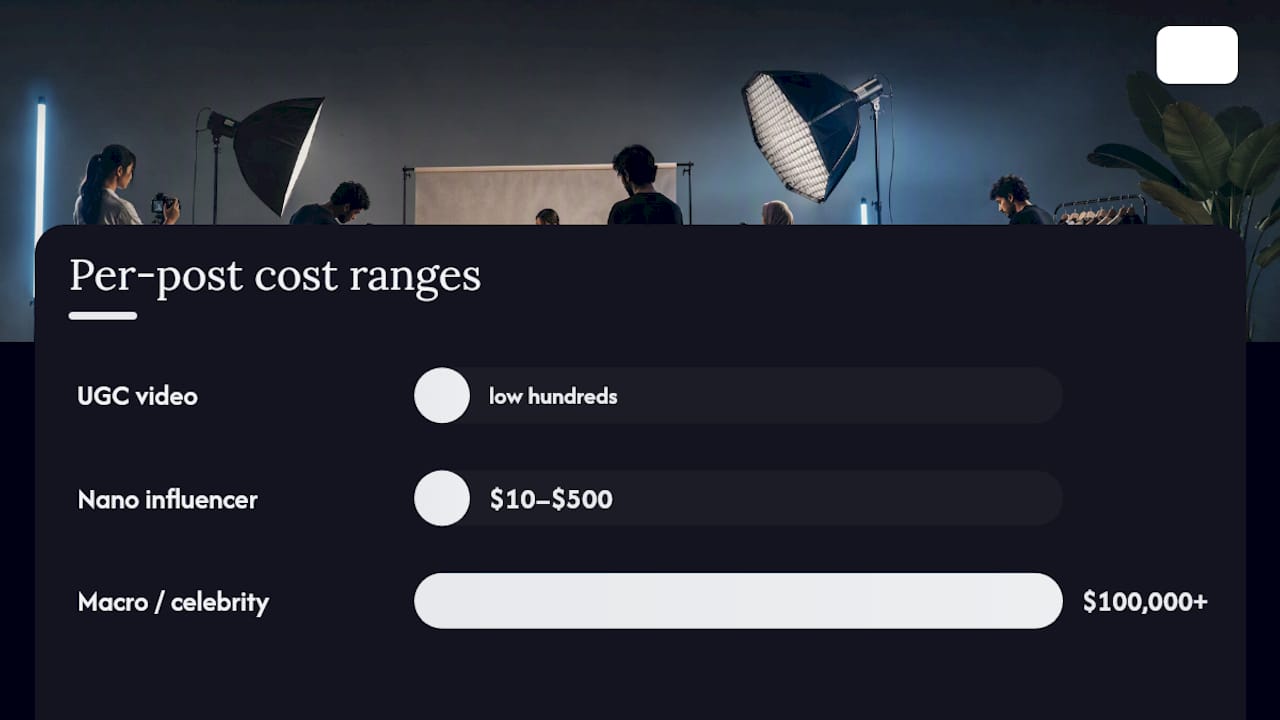
Price ranges vary enough by platform and niche that a single number is useless, but the bands are consistent across most reports. UGC videos tend to land in the low hundreds of dollars per finished asset, with cost driven by how many hook variations and revisions you request rather than production value. Influencer rates run far wider: nano creators may charge as little as $10 to $500 per post, while macro and celebrity talent can command $100,000 or more, scaling almost entirely with follower count and engagement rate.
The budgeting mistake that shows up most often is treating both tactics as one line item measured against one KPI. Experts consistently recommend the opposite: treat UGC as a creative buy and influencer marketing as a media buy. You’re paying for a perpetual asset in one case and paying for temporary distribution in the other, and collapsing them into a single budget line makes it impossible to tell which dollar did what.
Attribution follows the same split:
- For UGC, track performance the way you’d track any ad creative: CTR, CPC, and ROAS inside the ad platform, ideally with structured A/B tests isolating hook and format.
- For influencers, lean on brand lift studies, unique promo codes, and dedicated UTMs, since a single social post rarely drives a clean last-click conversion.
Nano-tier influencers on TikTok have been reported to reach high engagement rates, well above what larger accounts typically achieve, which is one reason smart brand-lift budgets skew toward smaller creators rather than chasing follower count.
As a rule of thumb: if you can trace a sale to the content, optimize for ROAS and lean UGC. If you’re building a perception that pays off over months, optimize for reach and frequency and lean influencer, accepting that the return will show up indirectly.
How do you brief and produce UGC content that actually converts?
Treat every UGC shoot as a mini testing lab rather than a one-off deliverable. The brands getting the best return from creator marketing follow a repeatable process instead of reinventing the brief each time.
- Write a brief that specifies the deliverable, not just the vibe. Include the exact claim or offer, format specs (vertical, under 30 seconds, captions on), and usage rights terms in plain language before the shoot happens, not after.
- Ask for multiple opening hooks per shoot. Requesting three to five different first lines from the same creator, in the same session, gives a performance team enough raw material to A/B test without paying for a second shoot.
- Run the variations as a structured test. Cut each hook into its own ad, run them against the same audience with the same budget, and let the data pick the winner within days rather than guessing.
- Iterate on the winner, not the whole batch. Once one hook outperforms, brief follow-up variations on that specific angle rather than starting from scratch.
For influencer content, the equivalent operational question is whether to repurpose the original post as an ad or re-shoot it as UGC. If the organic post already performed well and the creator will grant extended usage rights, negotiating that license is usually cheaper than a fresh shoot. If the influencer’s rate for extended rights is steep, a UGC creator can often replicate the same concept for less, filmed specifically for ad use from the start.
Whitelisting, running paid ads directly from the influencer’s own account handle, sits between these two options. It preserves the creator’s social proof and comment history while giving your media team full targeting control, though it requires platform-level partnership setup and typically costs more than a standard usage license.
Pro Tip: Avoid over-polishing UGC footage in post-production. The native, slightly imperfect feel is what makes it outperform branded content in the first place, and heavy editing can quietly kill the exact quality you paid for.
A clear creator brief template removes most of the back-and-forth that eats into shoot budgets, and a solid UGC sourcing process matters as much as the brief itself, since a vetted creator needs far fewer revision rounds to hit the mark.
What does an agency actually add to UGC and influencer sourcing?
Most of the friction marketers hit with creator marketing isn’t strategic. It’s operational: chasing usage rights after a post has already gone live, discovering a creator’s engagement was inflated, or losing weeks to a single unreliable freelancer during a launch window.
ANT Management scopes usage rights and production quality before a single frame gets shot, not after, which is the difference between owning an asset outright and negotiating for it under time pressure. Agency-managed talent also solves a logistics problem freelance marketplaces can’t: reliability at scale, backup talent when someone drops out, and a consistent creative standard across dozens of assets rather than one good video and nine mediocre ones.
Training raises that consistency further. Programs like ANT Camp teach talent to deliver multiple hooks in a single session and to shoot with usage rights and platform specs already in mind, which cuts revision cycles considerably compared to briefing an untrained creator cold.
Before signing with any agency partner, brands should ask: Does the contract specify usage rights explicitly? Is there a vetting process behind the talent roster, or just a searchable directory? Can the agency guarantee backup talent for time-sensitive shoots? Those three questions separate a real production partner from a booking platform with a nicer interface.
— ANT
Sources
For deeper data on engagement benchmarks and trust in creator content, see Statista’s influence marketing coverage and the Harvard Business Review’s analysis of trustworthy influencer marketing. For a broader look at pricing and sales impact, review Sepia’s breakdown of UGC versus influencer performance.
Brands ready to move from strategy to execution can explore talent options through ANT Management’s Dubai agency page, or reach country-specific teams via the Qatar and Saudi Arabia talent pages for regional production support.
- UGC vs Influencer Marketing: Key Differences in 2026 | Promote Blog
- Statista topic: influence marketing